Industrial SMEs and subcontractors
Bar turning, precision engineering, plastics, electronics: your industrial website presents capabilities, certifications and sectors served to buyers who compare several suppliers before asking for a quote.
Building a B2B website starts with one simple question: what does a professional buyer need to understand before asking you for a meeting? We then build the site structure, pages and design of a corporate website that answers it, in 3–6 weeks depending on how many pages need writing.
In B2B, no one decides alone. An engineer spots your solution, a buyer compares suppliers, management signs off the budget. Each arrives on your site with a different question, and many corporate sites answer none of them: an unreadable catalogue, internal jargon and a generic form as the only way in.
An effective B2B website organises information by profile and by need: industries served, problems solved, technical proof, references. It is built for industrial SMEs, service companies, manufacturers selling through distributors and software vendors who need a marketing site separate from their product.
The most common mistake is to copy the org chart into the menu. Visitors are looking for an application, a constraint, a case close to their own. Other traps: product sheets as PDFs that Google reads poorly, half-translated language versions, and forms that never say what happens after you hit send.
Companies that sell to other companies, with long decision cycles and several people to convince.
Bar turning, precision engineering, plastics, electronics: your industrial website presents capabilities, certifications and sectors served to buyers who compare several suppliers before asking for a quote.
Engineering offices, consultancies, logistics providers, fiduciaries: trust comes from method, references and people. Your corporate site shows how you work, not just what you sell.
The marketing site explains the product’s value, reassures on security and integrations, and captures demo requests. We know the subject from the inside: we design B2B SaaS products too.
The site serves resellers, specifiers and end users at once: product ranges, technical documentation, points of sale, downloads and contacts by region.
Building blocks designed for a long sales cycle, where the site supports every stage of the buyer’s thinking.
Menus and pages organised by industry, application or customer problem, so every visitor quickly finds the part of your offer that concerns them.
Case studies, technical sheets in HTML, references and certifications: what a buyer must be able to show internally to argue for choosing you.
French, English or German, with dedicated URLs and hreflang tags, to target your markets in France, Switzerland and beyond.
Forms tailored to each intent (quote, sample, demo), connected to your CRM, with conversion tracking in your analytics.
Roles, workshops, teams and live vacancies: your corporate website also builds your employer brand, in regions where hiring is hard.
A complete, documented company website that your teams can keep alive after we hand over.
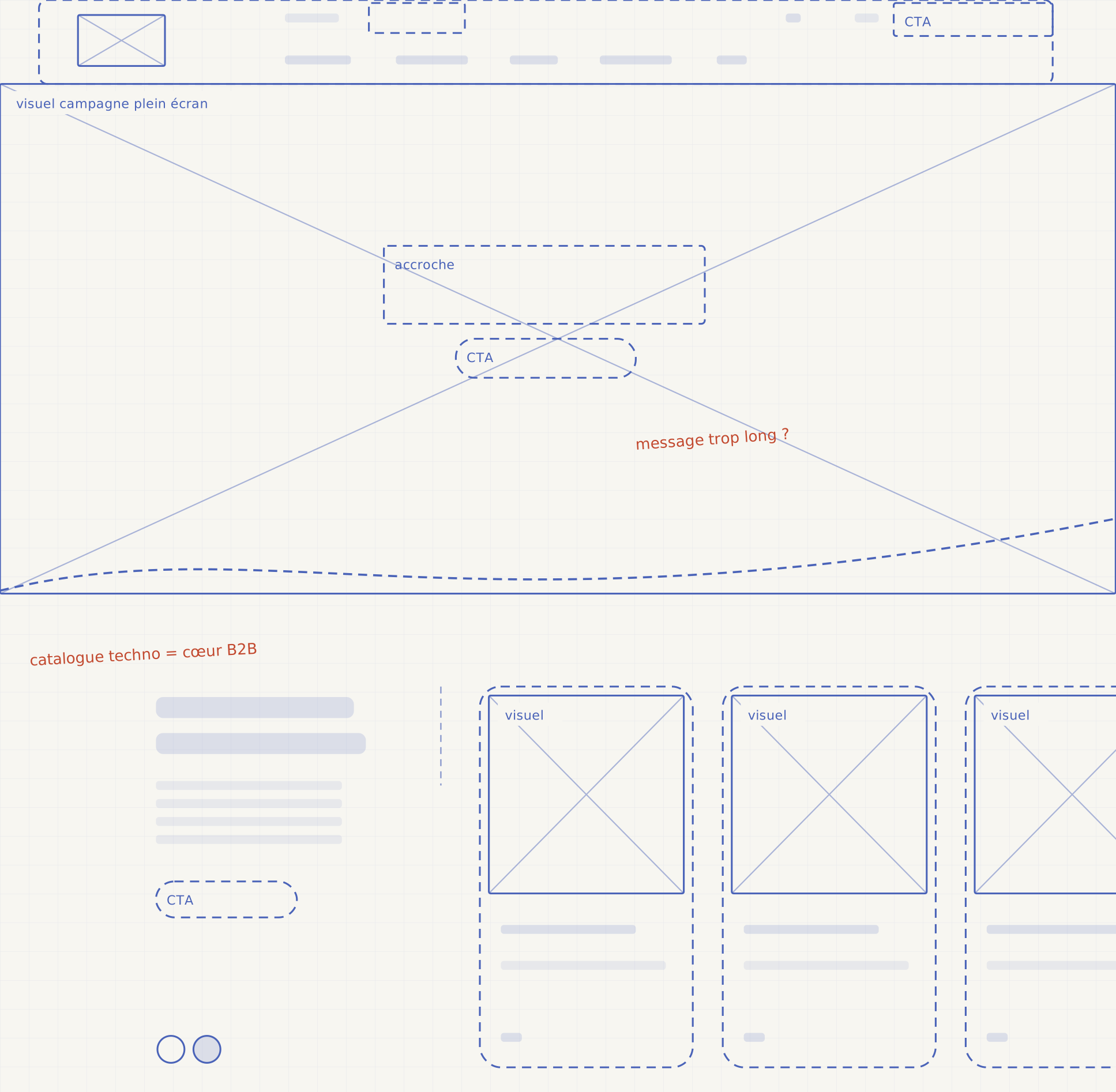
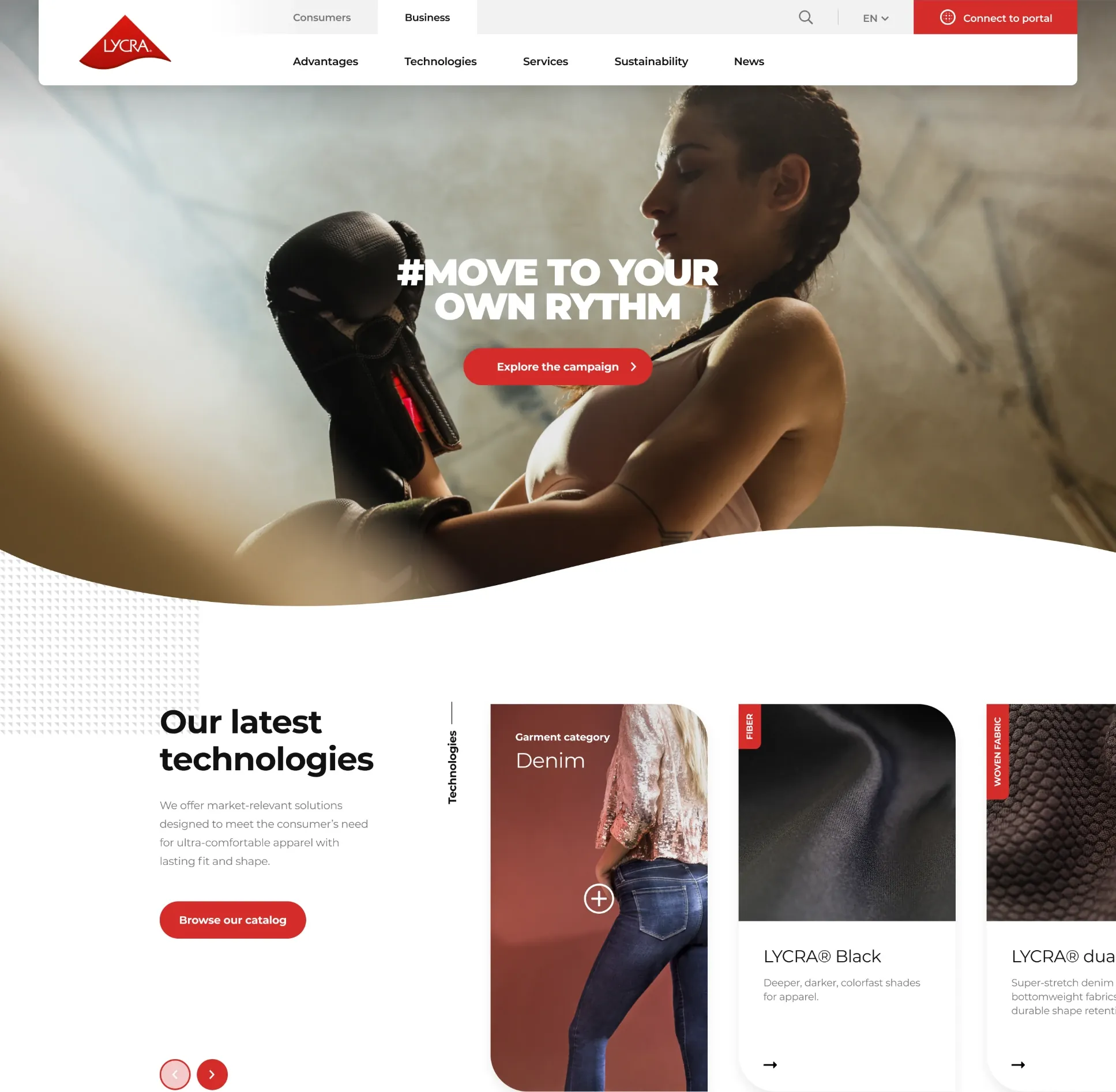
For The LYCRA Company, the wireframe of the B2B site first set the order of things: who each block speaks to, which proof comes next, where the call to action sits. Move the bar to compare that raw structure with the delivered home page.
Three to six weeks, depending on the volume of content and the number of languages.
With your sales and technical teams, we list buyer profiles, their objections and the proof you already have.
Each type of visitor’s path is mapped page by page. We decide what goes on the site and what stays in the sales brochure.
Key pages written or rewritten, design aligned with your brand, reusable components so products or industries can be added later.
Next.js site, language versions, forms connected to the CRM, structured data: everything is checked before the domain is switched over.
The points we raise in the very first workshop with a sales, marketing or executive team.
A B2B purchase often involves an engineer, a buyer, a quality manager and senior management. Each looks for different proof: tolerances and standards, lead times and terms, certifications, return on investment. A good corporate website gives each profile its own way in, with suitable vocabulary, rather than one message that speaks to nobody. Industry and application pages are often the ones that bring in the best-qualified enquiries.
B2B lead generation is not about the number of “Contact” buttons. It is about offering the next step at the right moment: a sample request after a product page, a demo after a features page, a call with an engineer after a case study. Each form asks only for what is needed, says what happens next and feeds your CRM with the page it came from. Your sales team gets fewer browsers and more projects.
Many manufacturers publish catalogues and technical sheets only as PDFs. Google indexes them poorly, they display badly on mobile and AI answer engines rarely cite them. Better to have one HTML page per product or range, with the key specifications as text, and the PDF as a download. That is also how you show up for the very precise queries engineers type: material, process, standard, dimension.
Targeting German-speaking Switzerland, Germany or export markets takes more than a machine-translation button. Each language needs its own URLs, hreflang tags and keywords, because a German buyer does not search with a French buyer’s terms. We plan the multilingual structure from the start and work with your translators so the technical terminology stays accurate in every version.
In tight labour markets such as Haute-Savoie or the Lake Geneva region, candidates look at your website before they apply. Role pages, real photos of workshops and offices, staff voices and current vacancies make up your employer brand. We build them into the site structure so recruitment gets the same care as sales, and your job ads read well on mobile.
For a B2B website, the difference comes down to how well your offer is understood, and who actually does the work.
| Criterion | Brutux Studio | Generalist web agency | Freelancer / platform |
|---|---|---|---|
| Point of contact | The studio’s founder, from scoping to launch | Project manager, team varying by phase | One person, often a design or development specialist |
| Understanding your offer | Workshops with your sales and technical teams | Marketing brief, often standardised | Content supplied ready to drop in |
| Structure | Wireframes by buyer profile before design | Visual mock-ups from the outset | Adapted theme or template |
| Content | Key pages written or rewritten as part of the process | Often optional or outsourced | Usually down to you |
| Multilingual and technical SEO | Hreflang, structured data and performance planned from day one | Depends on the agency and CMS | Depends on the person’s skills |
| Timeline | 3–6 weeks | Depends on the agency’s schedule | Depends on availability |
| Future changes | Reusable components, code you own | Depends on the chosen CMS | Depends on theme and plugins |
B2B website design: answers to the questions we are asked.
Between 3 and 6 weeks. The timeline depends mostly on content: number of product ranges or industries, case studies to write, languages to produce. Technology rarely slows a project down; internal sign-off on the copy does, far more often.
A showcase site presents a local business in a few pages. A B2B website organises a broader offer for several buyer profiles: industries, applications, technical proof, language versions, CRM integration. It needs more content, hence 3–6 weeks rather than 10–15 days.
Yes. Every enquiry goes directly into your CRM, or into the marketing automation tool you use, along with the page it came from and the type of need. Your sales team knows who is writing, about what, and can reply without delay.
No. The site must give enough detail for an engineer to take you seriously without drowning the buyer. We publish what moves the decision forward and keep the rest for the sales conversation or downloadable documentation.
Yes, with one URL per language, tags that tell Google which version to show, and copy that is adapted rather than translated word for word. We work with your translators or your teams abroad on the review.
Usually, yes: the marketing site explains, reassures and captures demo requests, while the application serves customers who are already convinced. The two share an identity, but they have neither the same update rhythm nor the same visibility goals.
A customer area, a configurator or an ordering portal is closer to a web application than a website. We design them as part of our custom business software projects, with the same method: wireframes, testing, then development. The marketing site and the portal can share the same visual identity.
Each enquiry is tracked from its landing page into your CRM. You can see which pages and which Google queries bring in contacts, and which of those become opportunities. That is more useful than a raw visit count when deciding which pages to write next.
Yes. We build on your visual identity, brand guidelines and existing content, and coordinate with the people running your campaigns, trade shows or social media. Our role: the site’s structure, design, development and organic SEO.
Nobody controls what AI answer engines cite. You can, however, improve your chances with pages that answer a question clearly, technical sheets as text, structured data and consistent information wherever your company is mentioned. It is the same discipline as good organic SEO.
30 minutes to talk about your project, in Thonon or by video call. I’ll tell you honestly what will make the difference.
Book 30 minutes ↗