Founder with deep domain expertise
You know a problem from the inside, in property, industry or services, but not yet how to turn it into software. We structure the idea, check the demand and build the first version with you.
Building a B2B SaaS starts with a very concrete question: what problem are your future customers already trying to solve? We start there to scope, design and develop a useful first version, then grow it with your users, cycle after cycle.
Many SaaS projects stall before they ever go live: scope creep, development started on assumptions nobody checked, screens designed for the demo rather than for daily use. The story is a familiar one: months of work, a product weighed down with features, and early customers who drop off after the trial.
We work with founders who bring domain expertise and a feel for their market, SMEs that want to sell a tool originally built for their own use, and software vendors launching a new standalone module. What they share: a real professional problem to solve, and the wish to validate it before committing the whole budget.
A good first version does few things, but does them very well: a smooth core journey, solid account and permission management, clean data. The usual trap is copying an established competitor’s feature list; it pays far more to target the action your customers repeat every day and make it obvious.
Our B2B SaaS development work serves four kinds of client, each with a different starting point.
You know a problem from the inside, in property, industry or services, but not yet how to turn it into software. We structure the idea, check the demand and build the first version with you.
A tool built for your own teams interests your partners or peers. It has to become multi-tenant, configurable and usable without training: that is a product project, not simply putting it online.
You already have customers and a tech team, but a standalone product needs its own discovery and its own design. We run that workstream alongside your roadmap.
Your no-code MVP proved there is a market and has hit its limits: permissions, performance, integrations. We take what you learned and build a coded version that is robust and ready to grow.
Four workstreams run by the same team, so nothing gets lost between design and code.
Interviews with prospective customers, a review of existing alternatives and a decision on the smallest scope that proves the value, before any development begins.
The screens of the core journey assembled into a prototype, shown to target users and revised for as long as they hesitate or click the wrong button.
Accounts, organisations, roles and permissions, subscriptions, separate environments: the foundations of a SaaS laid properly from the very first version.
Deployment, usage analytics and feedback from early customers feed into the next cycle, so the roadmap is built on observed facts.
Every cycle produces concrete deliverables that remain yours, even if you change provider one day.
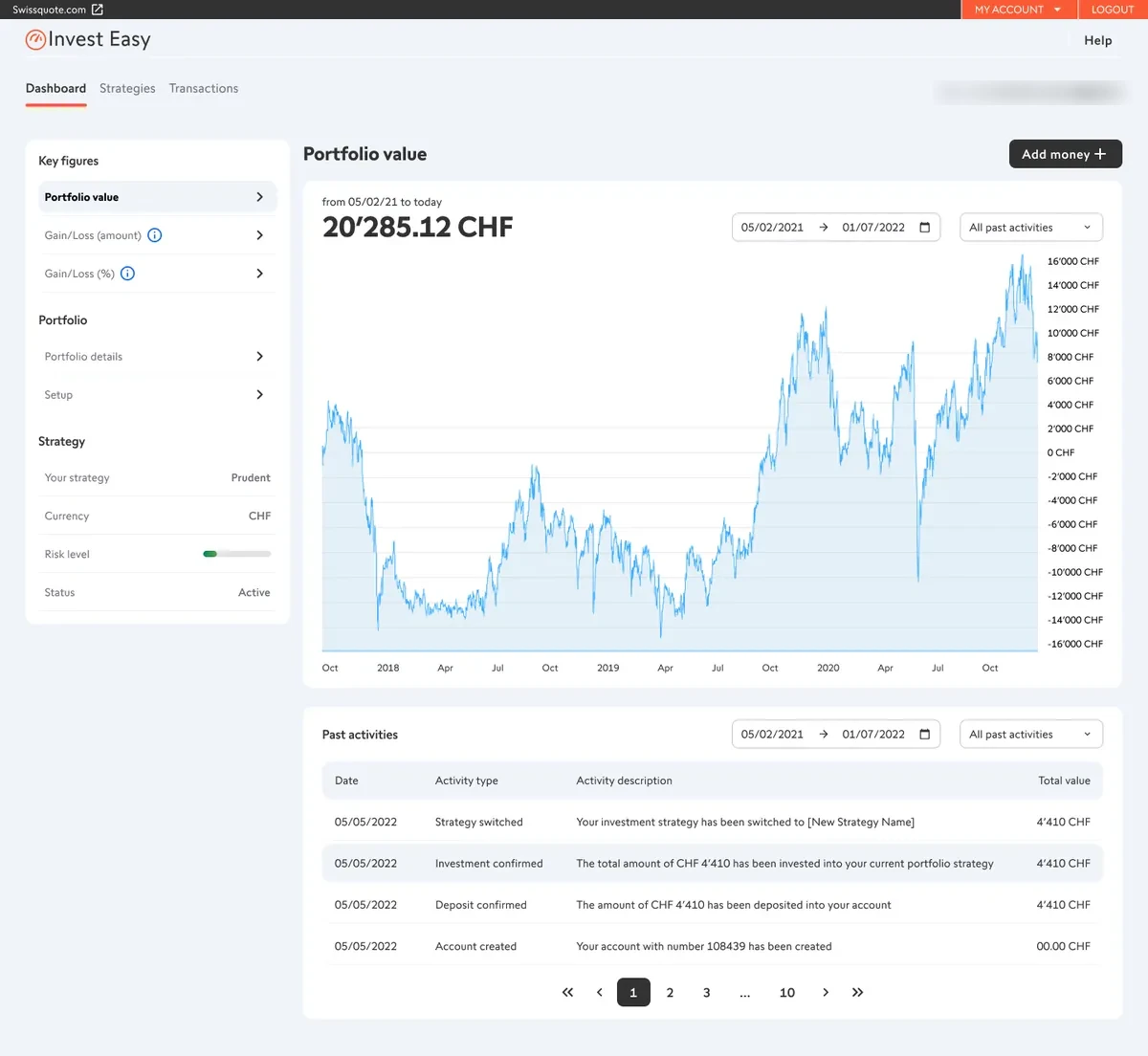
Building a SaaS product means starting from a blank page without losing sight of real use. Victor Michel, the studio’s founder, did exactly that for Swissquote, Switzerland’s leading online bank, designing the Invest Easy robo-advisor from scratch: interviews, co-design workshops, user testing, BDD specifications and the final interface. The same approach shapes every first release we launch.
Each cycle lasts 6 weeks and always ends with something you can show.
Together we define the target, the problem and the assumptions to check, then choose which ones deserve testing first.
Wireframes and prototype are put in front of a handful of target users; whatever does not survive those sessions is reworked or dropped.
Design system, interface and development move forward together, with a demo at the end of each cycle and the product deployed to a staging environment.
Launch to an initial group, usage instrumentation, quick fixes, then prioritisation of the next cycle based on what we observe.
Five points we share with every founder at the start of a B2B SaaS development project.
A minimum viable product must solve one specific problem, completely, for one specific type of user. The aim is not to ship every feature in a rushed version, but a single task end to end, at a quality that makes people come back. A successful MVP shows itself through repeat use, not screen count. That is also what makes it sellable: a B2B buyer pays for an outcome, rarely for a roadmap promise.
Accounts, organisations, roles, permissions and data isolation between customers: this multi-tenant foundation is invisible in a demo, but very costly to add later. We put it in place from the first version, however modest, with separate development, staging and production environments. Your SaaS can then take on a second customer, then a tenth, without a rewrite, and your first clients find the guarantees their IT team asks for.
No-code tools are useful for validating an idea quickly, with a prototype or a manually delivered service behind a simple interface. They show their limits once the SaaS has to handle fine-grained permissions, data volumes, integrations or the security requirements B2B customers impose. We build in code, with AI helping us move faster, and we tell you honestly when a no-code test is enough before committing to development.
More and more B2B buyers try software before they speak to a salesperson: that is the logic of product-led growth. The first fifteen minutes often decide what happens next. We design sign-up, initial set-up, sample data and empty states as screens in their own right, tested with users, so that a new customer reaches a first result without calling anyone.
In 2026, many new SaaS products are designed so that AI takes on part of the work: pre-filling, sorting, summarising, suggesting an action. The question is not whether to add a chatbot, but which tasks users delegate, how they check the result and how they correct it. We design these interactions with the same care as the rest of the product, keeping a human in the loop for decisions that matter.
Three ways to get a B2B SaaS built. None is wrong in itself; they simply answer different needs.
| Criterion | Brutux Studio (product studio) | Web agency | Dev shop or freelancer |
|---|---|---|---|
| Starting point | Your future customers’ problem, checked in interviews | A brief or a visual mock-up | Specifications to build |
| User research | Discovery and prototype testing built into the project | Rarely planned, or limited to the website | Out of scope, to be supplied by the client |
| Design | Journeys, design system and complete interface | Polished interface, often marketing-led | Variable, often kept to a minimum |
| Development | Through to production, AI-augmented, multi-tenant foundation | Mostly websites and CMS | Core strength, from detailed specs |
| Pace | 6-week cycles, a demo at the end of each one | Project delivered in one go | Time and materials or fixed price |
| After launch | Usage tracking and prioritisation of the next cycle | Website maintenance | Changes on request |
B2B SaaS development: answers to the questions we are asked.
Depending on scope, allow 2 to 6 months, delivered in 6-week cycles. The first cycle is often used to scope and prototype; a version early customers can use comes next, without waiting for everything to be finished.
Not necessarily, but you do need to be able to meet some. We build discovery around interviews with professionals in your target market: without them, you end up designing for yourself. A few conversations are often enough to choose between two directions.
We can handle all of it, using AI to code faster, or work alongside a CTO or developers you have already hired. Either way, the code, the design system and the documentation belong to you and are handed over.
Yes, when it serves the core journey: pre-filling forms, summarising, searching documents. We do avoid making it the headline of an MVP if your customers’ problem can be solved more simply.
The market includes product design studios that do not build, development agencies that do no user research, and a few studios that do both. Brutux Studio, based in Thonon-les-Bains, is one of the latter: discovery, design system and development by the same team, for clients in France and Switzerland.
Yes. We do not stop at mock-ups: we develop the product, lay the multi-tenant technical foundation and deploy it to production. Development is AI-augmented, which speeds up the work without skipping code reviews or tests.
Not necessarily for the first version: we make and document the MVP’s technical choices. We do not offer a fractional CTO as such; however, a future CTO or in-house team can take over the product without starting from scratch, since the code belongs to you.
No. A startup studio co-founds companies. Brutux Studio works as a service provider: you stay in charge of your company, your product and your code. We help you build, without taking your place.
Victor Michel, the studio’s founder, designed Swissquote’s Invest Easy robo-advisor from scratch and reworked MSC’s B2B self-service dashboard. Within the studio, he led the product design, design system and demo prototype of EPItrack, a SaaS for managing personal protective equipment, as well as the product strategy, UX and development of ProFlow, the main working tool of a property valuation expert. The case studies are detailed in the References section.
Ask to see live products rather than mock-ups, how the agency meets your users, who designs and who codes, how often you get demos and who owns the code at the end. An agency that asks nothing about your customers will be building blind.
30 minutes to talk about your project, in Thonon or by video call. I’ll tell you honestly what will make the difference.
Book 30 minutes ↗