Local trades and shops
Most of the game is played on the Google map and in “trade + town” searches. A well-kept Google profile, regular reviews, pages by area: local SEO is the first lever, well before any blog.
Search engine optimisation covers all the work that lets your site appear when a potential customer searches for what you offer, on Google as well as in AI answer engines. We fix the technical foundations, write the pages that are missing and strengthen your local SEO, with results tracked in Search Console.
Many companies have a decent website that Google almost never shows. The causes are often simple: pages not indexed, identical titles everywhere, no text that really describes the services, an incomplete Google profile. Organic SEO starts with these fixes, long before anyone talks about competitive keywords or blog posts.
For a tradesperson or a practice, most of the game is local: appearing on the map and in “trade + town” searches. For a B2B SME, it is more about being visible for technical queries with low search volume but very high intent. The two call for different strategies, and we begin by working out which one applies to you.
Be wary of promises of the top spot within days, links bought in bulk and duplicate pages for every keyword variant: these practices end up penalising a site. Lasting SEO rests on a fast site, content that answers real questions and a reputation built on genuine reviews.
Organic SEO is not done the same way for a tradesperson, an industrial SME or a company targeting Switzerland.
Most of the game is played on the Google map and in “trade + town” searches. A well-kept Google profile, regular reviews, pages by area: local SEO is the first lever, well before any blog.
Few searches, but highly qualified ones: processes, materials, standards, applications. The work focuses on technical pages, internal linking and language versions.
A search made from Geneva or Lausanne does not return the same results as one from Annecy. Pages by country or canton, clear terms, consistent profiles: each market needs its own work.
After a botched redesign, a Google update or a new competitor, visits drop. We look for the cause in Search Console before proposing anything at all.
Every action is explained, prioritised by its expected impact, and verifiable by you in Google’s own tools.
Indexing, speed, title tags, structured data, internal linking and crawl errors: a readable diagnosis, with fixes ranked by priority.
A complete Google Business Profile, the right categories, pages for each area served and identical contact details in the directories that matter for your trade.
Service pages and articles built around your customers’ real questions, written to be read before they are indexed.
Clear answers at the top of the page, explicit questions, structured data and consistent information, to be cited by AI Overviews, ChatGPT or Perplexity.
A dashboard of the queries, clicks and enquiries generated by Google, reviewed regularly to adjust the next actions.
Clear documents, fixes actually made, and indicators you can check for yourself.
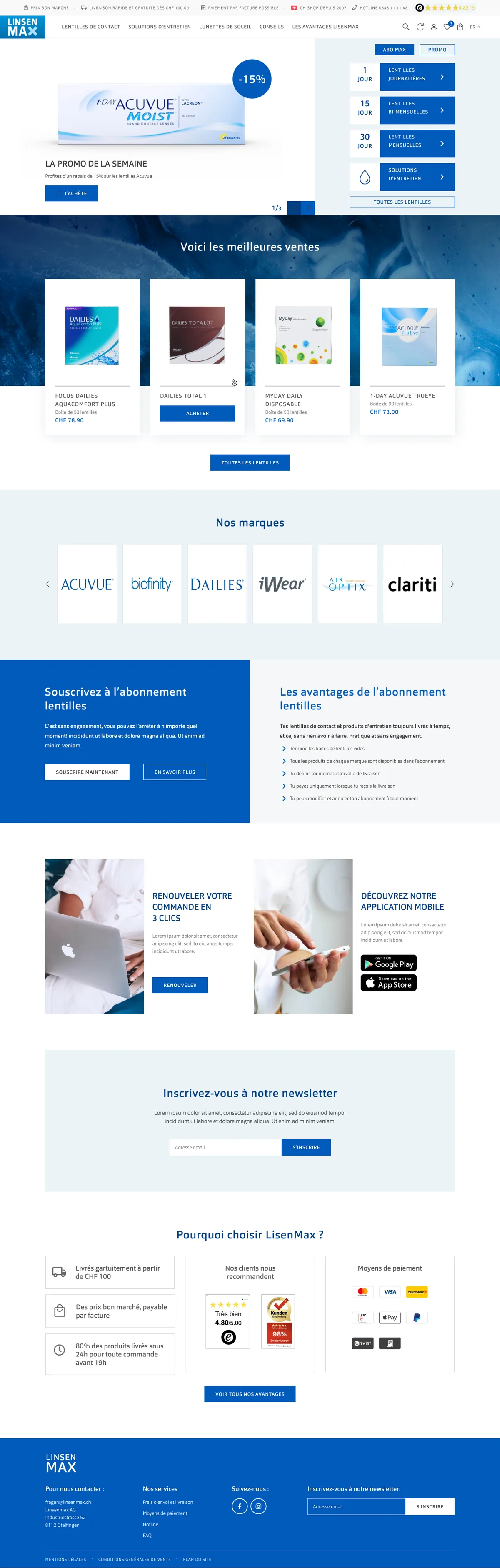
Search brings visitors; they still have to buy or get in touch once they land. For LinsenMax, an online optician, Victor Michel, the studio’s founder, reworked the buying journey through to the checkout funnel, with particular attention to mobile, where much of the browsing happens. A useful reminder: traffic won on Google pays off on clear pages.
SEO is a long game: we start with whatever is blocking you, then we build.
Site crawl, Search Console analysis, research into the queries in your market and a study of the competitors who rank in your place.
Indexing, performance, markup and structure are brought up to standard. This is often the step that produces the first visible effects.
Writing the missing pages, enriching existing ones, optimising the Google profile and setting up a process for collecting customer reviews.
A regular review of rankings, clicks and enquiries obtained; the next actions are decided on that data.
Search is changing fast. Here is what really matters for an SME or a freelancer, without jargon or promises.
A serious SEO agency or consultant starts with an audit, not a keyword package. Ask what will be analysed, which tools measure progress, what schedule of actions is planned and who will actually do the work. Be wary of guaranteed top spots, reports full of rankings unrelated to your sales and contracts that cut you off from your own data. With us, every action stays verifiable by you in Google’s own tools.
Local SEO rests on three pillars: a complete, active Google Business Profile (accurate categories, up-to-date hours including bank holidays, recent photos), regular reviews that you reply to, and pages on your site describing each service and each area. Your contact details must be identical everywhere: site, profile, directories, social networks. One mismatched phone number or address is enough to blur the signal.
Google’s AI Overviews, ChatGPT, Perplexity and Gemini answer questions directly, citing a handful of sources. GEO, or generative engine optimisation, is about becoming one of those sources. The principles are those of good SEO: a clear answer at the top of the page, explicit questions as headings, structured data, consistent information about your company and mentions on other reputable sites. We apply these rules to every page we write; our AI visibility (GEO) service goes further, with an audit of what assistants answer and monthly monitoring, with no guaranteed citation.
Producing dozens of articles with AI does not move a site forward. Google looks for useful pages written by someone who knows the subject, with examples and proof. AI helps to structure, proofread and find the questions your customers ask; the substance must come from your experience. Five precise service pages beat a blog of fifty interchangeable articles.
Links from other sites to yours still count, but buying links in bulk invites a penalty. Useful links come from your own ecosystem: suppliers, partners, trade bodies, local press, recognised directories for your trade. We identify the ones that are genuinely within reach, with no artificial link building and no networks of sites created for the purpose.
An average ranking says little. The right indicators are clicks from Google on your trade queries, the enquiries that follow and the pages that generate them. Search Console, privacy-friendly analytics and form tracking are enough for most SMEs. We review these figures with you at regular intervals to decide what to do next.
The right choice depends on your market, but also on how much you want to understand about your own visibility.
| Criterion | Brutux Studio | Subscription SEO agency | Automated tool or platform |
|---|---|---|---|
| Starting point | Technical audit and research into your queries | Keyword package | Automatic site scan |
| Technical fixes | Made in the code where the site allows | Recommended, for your web provider to apply | Listed, for you to apply |
| Content | Written from interviews about your trade | Often produced in volume | Generated, or yours to write |
| Local SEO and Google profile | Part of the approach | Depends on the package | Partial |
| AI answer engines | Pages structured to be cited | Depends on the agency | Rarely considered |
| Transparency | Actions verifiable in Search Console | Ranking reports | Automatic dashboard |
SEO services: answers to the questions we are asked.
Technical fixes can show fairly quickly, once Google has recrawled the pages. Ranking for contested queries takes several months and depends on your content, your reviews and the competition in your area.
No, and nobody honestly can: Google does not sell its organic rankings. What we can do is remove technical obstacles, produce relevant content and measure every step forward. Be wary of any offer that promises a specific ranking.
Not necessarily. Many sites improve with targeted fixes and new content. A redesign becomes relevant when the technology prevents those fixes, or when the current structure does not let you create the pages you need.
It is the work that makes you appear in location-based searches, such as “roofer Chablais” or “osteopath Annemasse”, and on the Google map. It relies on your profile, pages for each area, customer reviews and consistent contact details everywhere.
Google Ads buys immediate visibility that stops when the budget does. SEO builds lasting visibility that takes longer to arrive. For a local business, a well-kept Google profile and good service pages are often enough. We do not run advertising campaigns, but we build pages that serve both.
No tool can force a citation. AI answer engines draw on pages that rank well, read clearly and match what the rest of the web says about you. Answering your customers’ questions precisely, structuring your pages, completing your Google profile and earning mentions on reputable sites: that is the basis of GEO, just as it is of SEO.
An SEO audit looks at why Google does not show your pages: indexing, technical issues, content, competition. A UX audit looks at why visitors who arrive do not take action: journeys, clarity, forms. The two complement each other; our UX audit takes 2–3 weeks.
Yes. We audit and improve WordPress, Wix, Webflow and Shopify sites. Which fixes are possible depends on what the platform allows: when it blocks essential settings, we tell you plainly and present the alternative.
No. They are useful when your customers have questions before buying and you can answer them better than others. For many local businesses, solid service pages and a well-kept Google profile matter more.
Most of the work happens at the start: technical fixes, missing pages, the Google profile, the first reviews. After that, competitors publish, Google evolves and your offers change: a regular review lets you decide the next actions from the figures, rather than producing content out of habit.
30 minutes to talk about your project, in Thonon or by video call. I’ll tell you honestly what will make the difference.
Book 30 minutes ↗