SMEs with an ageing site
A site built years ago, slow on mobile, that nobody in-house really knows how to edit. The offer has changed, so has the team, yet the site still describes the company you used to be.
A successful website redesign keeps what Google and your customers already value, and fixes everything else: slowness, fuzzy messages, painful editing. We start from a precise inventory of the existing site, rebuild it in code, then watch the migration closely so you keep your search rankings.
The warning signs are usually the same: pages that take several seconds to load on mobile, a theme nobody dares update any more, plugins piled on plugins, an offer that has moved on while the site still tells the old story. Sometimes it is simply that the phone no longer rings thanks to the site.
A website redesign is as relevant to the SME whose site is ten years old as to the young company that started on Wix and now feels cramped. In both cases the challenge is identical: modernise without wiping out the history built up with Google, or the links other sites point at you.
The classic trap: changing every page URL without redirects, deleting content that used to attract traffic, or launching the new version on a Friday evening without checking indexing. A good redesign is prepared with Search Console data, settles the list of pages to keep and plans close monitoring once the new site is live.
Websites that have had their day, whatever tool they were originally built with.
A site built years ago, slow on mobile, that nobody in-house really knows how to edit. The offer has changed, so has the team, yet the site still describes the company you used to be.
A bought theme, a page builder, dozens of plugins: every update is a worry, security is a concern, pages keep slowing down. The redesign replaces that pile-up with clean, lean code.
The builder got you started fast, but the limits are showing: SEO that is hard to push, awkward multilingual support, a rigid design. We migrate your content and rankings to a bespoke site.
A new market, a merger, a new product line, a move from consumers to professionals: the site has to tell a different story. The redesign then starts from the message and the structure, before the visuals.
Every redesign starts from what exists: we throw nothing away before knowing what it brings you.
We extract every URL, the pages that receive visits and the inbound links, to decide page by page: keep, merge or remove.
Every useful old URL points to its new version through a 301 redirect, tested before and after the switchover.
Copy, images, articles and product pages brought over from WordPress, Wix, Webflow or Shopify, cleaned up and reorganised in the new structure.
404 errors, pages dropped from the index, traffic dips: we watch Search Console for several weeks and fix issues without delay.
A clearer message, a rethought contact journey, a refreshed design built from wireframes: the visual redesign comes after the substance, not before it.
Every stage leaves a written record you can read, share and reuse.
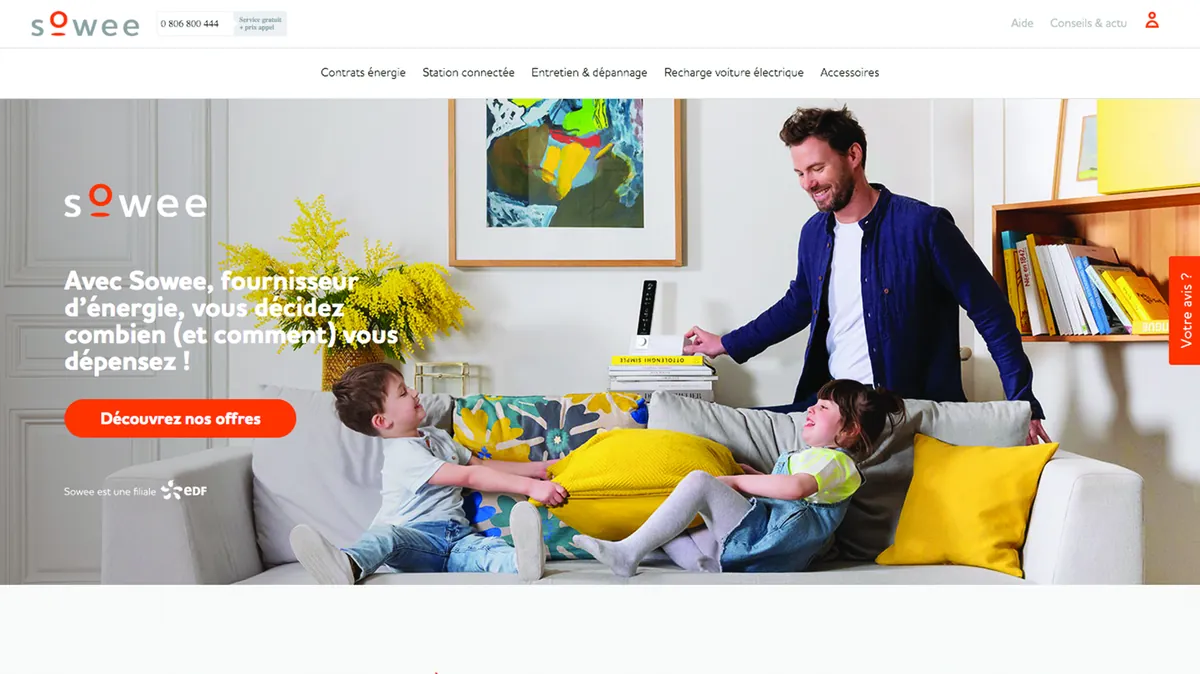
A redesign should not just freshen up a site: it should remove what makes visitors leave. On the e-commerce site of Sowee, an EDF subsidiary, marketing wanted more advertising; Victor Michel, the studio’s founder, argued for less friction. Benefits before features, reassurance, a savings calculator, each choice checked through A/B tests. The same logic guides our website redesigns.
The schedule depends on the size of the site; the order of the steps never changes.
A full crawl of the current site plus a review of Search Console and analytics: we identify the pages that earn their keep and those holding you back.
Revised site structure, wireframes of the key pages and a mapping between old and new URLs, approved with you before design starts.
Refreshed design, Next.js development, content migration and a staging version where you test the future site in real conditions.
Go-live, redirects activated, sitemap submitted, then regular checks on indexing and errors until everything is stable.
What redesigns have taught us: most traffic losses come from oversights, not from the technology.
A redesign is justified when the site holds the business back: slow pages on mobile, no way to add the pages you need, technology nobody maintains any more, a message that no longer matches the offer. Following a visual trend is not a reason. Before rebuilding everything, an audit often shows whether targeted fixes would do. For a site that converts poorly, our UX audit, run over 2–3 weeks, can be the right starting point.
Many website redesign briefs list visual wishes and features but forget the current state of play. Yet that is what prevents nasty surprises: pages that bring traffic, links from other sites, forms that generate enquiries, content to merge. We write this section with you from Search Console, analytics and a full crawl of the site, and only then define the new structure.
Redirecting every old page to the home page is still the most common mistake: Google treats those redirects as lost pages. Each useful old URL must point to the closest new page by topic, with a permanent 301 redirect and no chains of successive redirects. Worthless URLs can return a clean error instead. We test this mapping before the switchover, then again in production.
Core Web Vitals measure how fast, stable and responsive your pages are for real visitors. A site weighed down by a theme and plugins often struggles on all three, especially on mobile. Rebuilding in code lets you start from a light base: optimised images, fewer third-party scripts, fonts loaded properly. Google benefits, and above all, so do your visitors.
A redesign is the best time to fix weak contrast, unlabelled buttons and forms that cannot be completed with a keyboard. Since the European Accessibility Act came into application in June 2025, certain online services, e-commerce in particular, are required to do so. Even without a legal duty, an accessible site is easier for everyone to use. We build these rules in from the wireframes; your adviser confirms your exact obligations.
Not all redesigns are equal: the difference shows mostly in the months after launch.
| Criterion | Brutux Studio | Traditional web agency | New theme on the old CMS |
|---|---|---|---|
| Starting point | SEO inventory and audit of the current site | Visual and functional brief | Choosing a new theme |
| Message and structure | Reworked in wireframes before design | Often carried over as is | Unchanged |
| Technology | Site coded in Next.js, no plugin pile-up | Depends on the agency, often a themed CMS | Same CMS, same plugins |
| SEO | URL mapping and 301 redirects tested | Varies with the team | URLs kept, speed rarely improved |
| After launch | Search Console monitoring for several weeks | Often limited to the warranty period | Down to you |
| Point of contact | The founder, from diagnosis to switchover | Project manager and team | You, or an occasional contractor |
Website redesign: answers to the questions we are asked.
It can, if URLs change without redirects or if pages that drew traffic disappear. With a full inventory, 301 redirects and indexing monitoring, the risk is under control. A slight wobble is still possible while Google recrawls the site.
It depends on the size of the site and how much content needs bringing over. Redesigning a showcase site follows a pace close to building a new one; a multilingual company website takes longer. We set a precise schedule after the inventory, and the switchover date is chosen so the following days can be monitored.
In most cases, yes: the domain carries its age and the links it has earned. Changing it is possible, but it calls for a heavier migration and a change-of-address declaration in Search Console. We advise you based on your situation.
Technically yes, but it is rarely the best choice. A site that brings no enquiries usually suffers from a fuzzy message far more than from dated visuals. We look at both, and you decide on the scope.
If the technology holds up and only a few pages cause problems, a partial redesign is enough: new key pages, a reworked contact journey, rewritten copy. If the site is slow, fragile or impossible to evolve, a full redesign often costs less in the long run than successive patches. We tell you which one fits after the audit.
If the site is slow, breaks with every update or is hard to evolve, rebuilding it in code removes those dependencies. If the tool suits you and the problem lies in the content instead, we will tell you so honestly.
Yes, for content and SEO: we retrieve copy, images and URLs, rebuild the site and redirect every old address. For a Shopify store, we first check whether you really need to leave the platform: if online sales remain your core business, a dedicated e-commerce platform is often the right tool, and a UX audit of the checkout journey will help more than a migration.
We keep everything that has value: pages that receive visits, well-ranked articles, content cited by other sites. Dated copy is rewritten, duplicate pages are merged, pointless content is removed cleanly. Nothing is deleted without a joint decision, page by page.
That is often its real purpose. A clearer message at the top of the page, better-placed proof, a shorter form and a visible call button on mobile change how visitors take action. We sketch these journeys as wireframes before the design, so they can be judged on substance.
In an emergency, secure it first: back up, update or disable vulnerable plugins, change the passwords. One-off troubleshooting is not our main line of work. A rebuild in code, on the other hand, permanently removes the dependence on the plugins behind those breaches; let’s talk once the site is stable.
30 minutes to talk about your project, in Thonon or by video call. I’ll tell you honestly what will make the difference.
Book 30 minutes ↗