Fast-growing scale-up
Teams multiply, modules too, and the interface loses its consistency. You need a design system and an overall vision without slowing delivery.
For Paris software vendors, a SaaS agency should strengthen a product team that is already in place, not replace it. We work on audits, redesigns, design systems and AI built into the product, mostly remotely, coming to Paris for the decisive workshops.
Paris and the wider Île-de-France region are home to a large number of business software vendors, from young start-ups to scale-ups and long-established players. In most categories, buyers choose between several comparable solutions; the user experience, how quickly people get up to speed and perceived quality all weigh on the decision.
These vendors often have a product manager, developers and sometimes a designer, but an overloaded roadmap. Foundational topics (interface consistency, design debt, onboarding, the arrival of generative AI) come after customer requests. Senior outside support makes it possible to tackle them without slowing releases.
For a SaaS in Paris, the difference rarely comes from one more feature. It comes from how fast a new user gets a result, how consistent the modules feel, and how quickly the team can ship thanks to a shared design system. That is where we focus our work.
The Paris software vendors who call on our SaaS agency, and what they come looking for.
Teams multiply, modules too, and the interface loses its consistency. You need a design system and an overall vision without slowing delivery.
Recognised software, loyal customers, but an interface that has aged against new entrants. The redesign has to modernise without unsettling anyone.
The product has found its first customers; now activation needs improving and scale needs preparing before hiring the whole team.
Product managers and developers are moving, but user experience issues stay on hold for lack of an experienced profile.
Engagements that fit into your organisation and your release rhythm.
Analysis of activation journeys and drop-offs, interviews with recent customers, and mocked-up recommendations to shorten time to value.
Component inventory, unification of modules designed by successive teams, documentation shared between design and development.
Identifying the tasks where AI genuinely saves your customers effort, designing the interaction and developing the first features.
A senior designer joining your rituals (planning, reviews, demos) to tackle the foundational work your team keeps putting off.
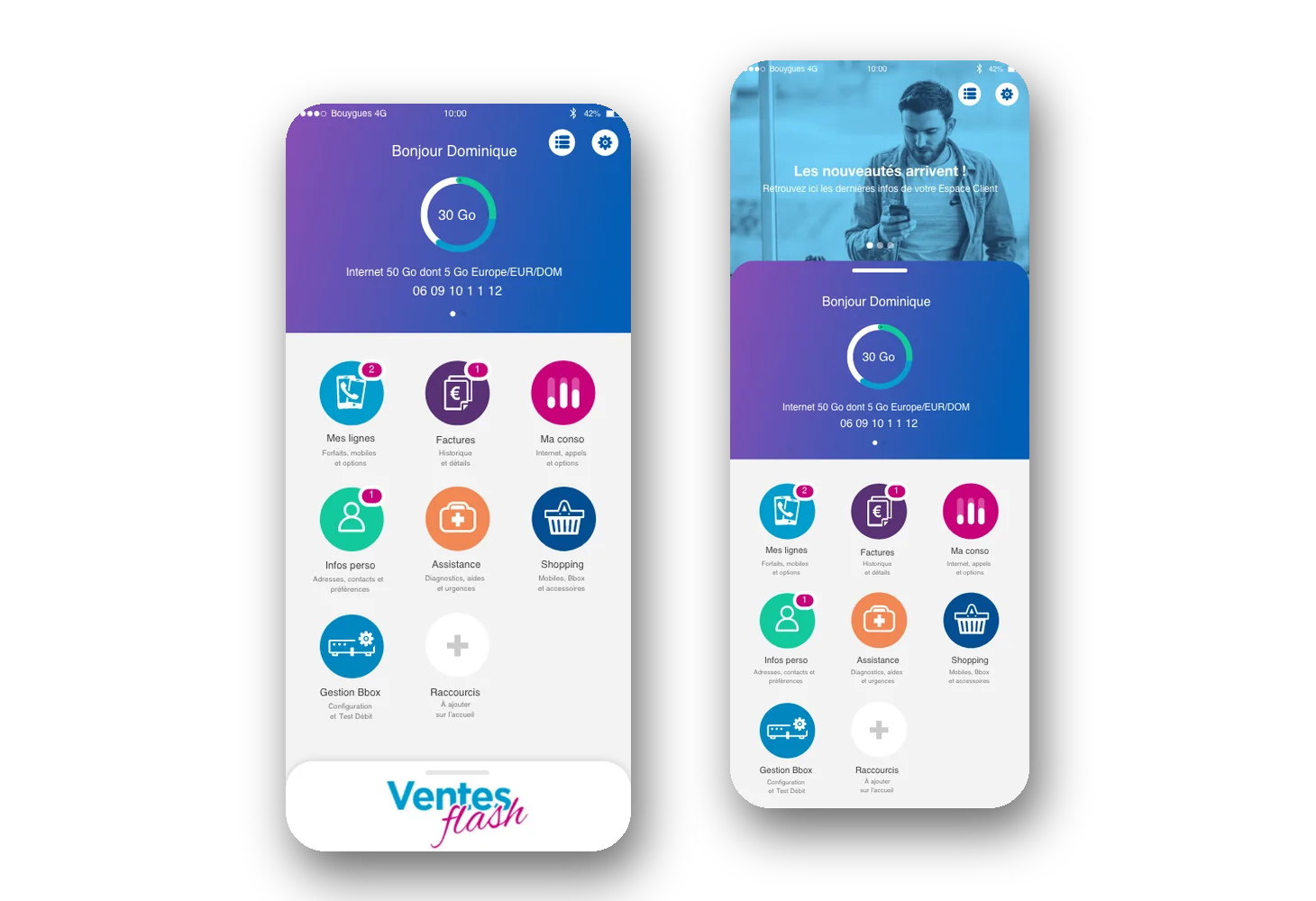
In Paris, a studio has to slot into a team that is already running. That is what Victor Michel, the studio’s founder, did on the Bouygues Telecom app, with its fifteen million customers: coordinating product, development and marketing, running weekly design reviews, setting documentation standards still in use after he left, and mentoring junior designers. A setting close to that of Paris software vendors.
Four issues that keep coming up with SaaS companies in the Paris region.
In a market where every category has several serious competitors, attracting trials is expensive; losing them on the first screen costs even more. Product-led growth relies on a short activation journey: a new user must reach a first useful result without help. We analyse that journey step by step, using usage data and interviews with recent customers.
Hiring a senior product designer takes time, and the need is sometimes one-off: a design system to set up, a redesign to scope, an AI feature to design. Outside support tackles the issue now and leaves behind components, rules and documented decisions. It can also help define the role, then onboard the person you hire.
In 2026, many vendors are adding copilots or agents that carry out tasks for the user. The difficulty is rarely technical: it is about trust. What does the agent do, with which data, how does the user approve, how do they undo? We design these interactions with clear states, previews before action and a history users can consult.
A design system that lives only in the design tool degrades within months. One implemented in code, documented and used by every team becomes an accelerator: new pages assembled faster, simpler reviews, consistency across modules. We design the system, then implement it with your developers, component by component.
Three ways to handle the product work your team has been putting off for months.
| Criterion | Brutux Studio (product studio support) | In-house hire | Freelance designer |
|---|---|---|---|
| Start | After a call and a detailed proposal | After a recruitment process | Quick, depending on availability |
| Scope | Audit, design system, design and development | Broad, over the long term | Often limited to interface design |
| Development | Components implemented in code | Depends on the profile hired | Rarely included |
| Duration | 2 to 3 week audit or 6-week cycles | Open-ended | Depends on the assignment |
| What remains | Components, documentation and decisions handed over | Skills built into the team | Design files |
With Paris teams, most of the work happens over video and in your design and project-tracking tools; we travel to Paris for the kick-off, priority-setting sessions and major presentations.
SaaS agency Paris: answers to the questions we are asked.
Because you work directly with a senior contact, with no sales layers or rotating juniors. Our remote setup is well established, and we come on site for the moments that benefit from being shared in person.
That is the ideal setup: we fit into your rituals, your tools and your roadmap, and leave behind components, documentation and decisions your team can pick up.
By starting from your customers’ repetitive or lengthy tasks, not from the technology. We test interaction mock-ups before developing, and plan how users can control, correct or ignore a suggestion.
Yes, especially when several teams have built different modules. It makes the interface consistent for your customers and speeds up your developers’ work. We build it gradually, starting from the components actually in use.
Brutux Studio audits, builds and redesigns B2B SaaS: a 2 to 3 week product audit, discovery, design system, complete interface and development through to production, in 6-week cycles. The studio also advises software vendors on integrating AI, using its CRAFT method.
Yes. We do not just deliver a library of mock-ups: components are built in your codebase, by us or with your developers, documented and integrated into existing screens, module by module.
Victor Michel, the studio’s founder, has worked for companies such as Air France, Bouygues Telecom, Metroscope, EDF and TotalEnergies. In particular, he led the redesign of the Bouygues Telecom mobile customer area and designed the interface of Metroscope’s predictive-maintenance AI for EDF. Both projects are detailed in the References section.
Yes, it is often where an audit starts: we follow a new user’s journey, spot where people drop off and propose designed fixes, from sign-up to the first useful result.
No, we do not place staff. We work on defined assignments with a set scope and deliverables, and a senior product designer who joins your rituals for the duration of the project.
30 minutes to talk about your project, in Thonon or by video call. I’ll tell you honestly what will make the difference.
Book 30 minutes ↗