Industrial software vendor
Maintenance, quality, safety, traceability: your SaaS is used on the factory floor, and customers judge the interface on how fast it is at the workstation.
Brutux Studio acts as a SaaS agency for Lyon software vendors and manufacturers building software used on the shop floor, on building sites or in the lab. We design interfaces that stand up to field conditions, then develop them with you.
Lyon and its metropolitan area are among France’s leading economic hubs, where industry, chemicals, healthcare and digital coexist. Many Lyon software vendors sell to industrial companies, and many manufacturers develop their own digital tools for maintenance, quality or logistics.
These products have users very different from head-office staff: operators, technicians, HSE managers or team leaders, sometimes wearing gloves, often on a tablet, rarely available for training. Industrial SaaS must show the right information at the right moment, with few actions and no ambiguity.
In Lyon, two situations come up often for a SaaS project: turning a proven internal tool into a product that can be sold to other sites or customers, and redesigning installed software whose screens have aged. Each time, field observation comes before design, and integrations with the ERP or CMMS are tackled early.
The businesses in the Lyon metropolitan area that our SaaS agency supports.
Maintenance, quality, safety, traceability: your SaaS is used on the factory floor, and customers judge the interface on how fast it is at the workstation.
An application built internally works on one site; now it needs rolling out to the others, or even offering to partners.
Software where accurate data entry, traceability and readable results matter as much as speed.
Call-outs, worksites, regulatory inspections: mobile teams who need a reliable tool on a tablet and clear oversight back at the office.
What we bring to software used far from the office, by teams under pressure.
Time spent alongside operators and technicians to understand their movements, their equipment constraints and the moments they genuinely consult the tool.
Strong contrast, limited actions, minimal typing: screens designed to be used standing up, on the move or with gloves on.
Multi-site, multi-tenant, per-company configuration: we restructure in-house software so it can be sold or rolled out more widely.
Data exchange with your production, maintenance or quality systems, so the tool fits into what exists instead of piling on top of it.
For industrial or business software, deliverables that take the field into account.
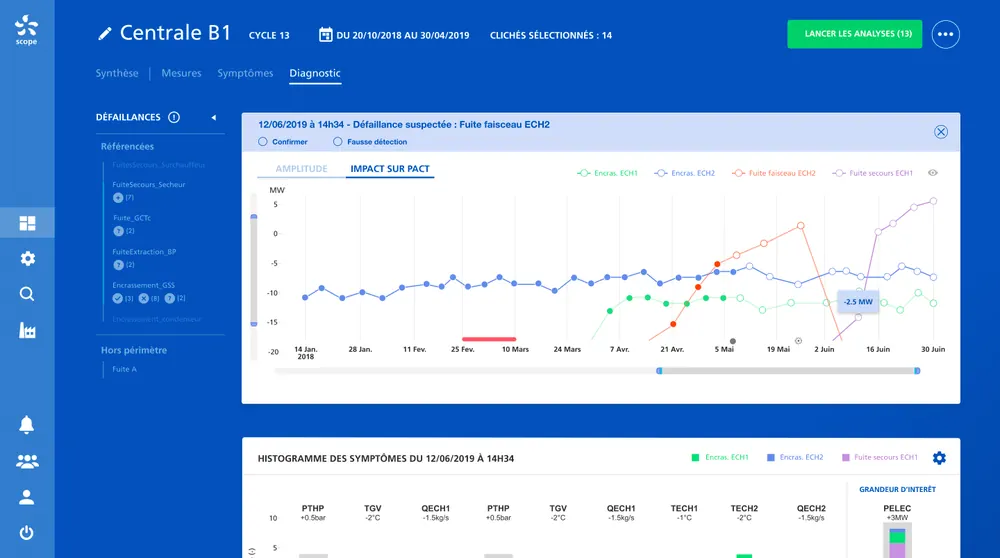
Lyon software used on the shop floor has to stand up to real conditions. For Metroscope, a start-up from EDF’s incubator, Victor Michel, the studio’s founder, designed the interface of a predictive-maintenance AI for nuclear engineers, after observation sessions in the plants and several rounds of on-site testing. Field observation remains where we begin with manufacturers.
Lessons that keep coming up in industrial and business software projects for the Lyon region.
An hour in the workshop teaches more than a day of meetings. You see the tablet resting on a machine, the screen read from two metres away, data entered with one hand while the other holds a part. These constraints change everything: touch target size, contrast, how much information is shown, field order. Without observation, you design for an office that does not exist.
Isolated industrial software creates one more round of data entry. Exchanges with the ERP, the CMMS or the quality system must be scoped at the start: which data flows, how often, which system is the reference when figures differ. Dealing with this early avoids discovering at go-live that an item master or equipment code does not match.
Industrialising an in-house tool means accepting that each site has its own particularities without duplicating code. Per-site configuration, roles by facility, shared reference data and consolidation for management: these architecture choices are made once, properly. They also determine whether the tool can be sold to other manufacturers as a SaaS.
Ask for documented cases, with context, approach and screens. Victor Michel, the studio’s founder, publishes several: MSC’s self-service dashboard, observed at customer sites before being redesigned, Metroscope’s predictive-maintenance AI for EDF, tested in the plants with working technicians, and Swissquote’s Invest Easy robo-advisor. Each shows the screens, the method and the design decisions, so you can assess an approach on facts rather than sales promises.
For our Lyon clients, we work mainly remotely; days on site are used to observe users, kick off the project and sign off the major milestones.
SaaS agency Lyon: answers to the questions we are asked.
Yes, provided we visit the field at the right moments. We organise observation days and on-site workshops, then move forward remotely with regular demos your teams can test.
Yes. We identify what is specific to your company and what is generic, then restructure the screens, permissions and configuration to accommodate other sites or customers without duplicating code.
Yes. We test mock-ups in real conditions: lighting, noise, gloves, sometimes patchy connectivity. The screens we keep favour large touch targets, little information at a time and clear confirmations.
Yes. We share mock-ups, specifications and the design system with your IT department, your ERP integrator or your developers, and we take part in technical trade-offs when they affect the user experience.
Within the studio, Victor Michel designed the product, design system and interactive prototype of EPItrack (workplace safety), then designed and built ProFlow, the main working tool of a property valuation expert. The studio also publishes its own products: Hanny, an AI community manager for small businesses, Stellia, business websites shown finished before payment, and Desy, an AI-assisted design system audit. Victor Michel is also a partner in Terranova, a land valuation PropTech, for which he built the pricing model and go-to-market. Over his career, he has also worked for groups such as Saint-Gobain, Tarkett, EDF and TotalEnergies.
Lyon has many web application development studios. Brutux Studio stands out through an approach centred on field users: workshop observation, tablet testing, ERP and CMMS integration, then development.
No. We are neither vendors nor integrators of CMMS or ERP software. We design and build the applications that connect to them to cover a poorly served use: field data entry, compliance tracking, site dashboards.
We tackle that constraint from the design stage: saving entries in progress, clear messages when the connection drops, syncing once the network returns when the project justifies it. Technical choices are settled during scoping.
Yes, for concrete uses: reading intervention reports, drafting summaries, helping prioritise inspections. We favour suggestions the operator approves over automatic decisions.
30 minutes to talk about your project, in Thonon or by video call. I’ll tell you honestly what will make the difference.
Book 30 minutes ↗