Multi-site industrial mid-caps
Several plants, several divisions, initiatives multiplying: you need a common framework and a roadmap everyone shares.
As an AI consultant for organisations in Lyon and its metropolitan area, we support those that have already run trials and now want to choose, structure and deploy. We work mostly by video call and bring your teams together in person at the moments where it really makes a difference.
Lyon is home to large industrial groups, mid-sized companies, software vendors and a renowned healthcare cluster. In organisations of this size, AI initiatives often spring up in parallel: one department tests a writing assistant, another an analytics tool, a third an in-house prototype. Without someone to arbitrate, these efforts scatter and none becomes a real working tool.
Our work as an AI consultant in Lyon therefore often begins with an inventory of what already exists, followed by a prioritisation shared across several divisions. Each initiative is compared against the same framework: expected value, effort, risk, data required. The resulting roadmap names the projects to pursue, those to merge and those to stop, with an owner for each.
In healthcare, medical devices and biotech, caution is the rule. Some uses fall into the most tightly regulated categories of the EU AI Act, and health data enjoys reinforced protection under the GDPR. We help distinguish low-risk internal uses, such as document summarisation, from those that require a regulatory framework and dedicated specialists.
Organisations where AI is already present, but scattered.
Several plants, several divisions, initiatives multiplying: you need a common framework and a roadmap everyone shares.
Promising internal uses and demanding regulation: you need a clear line between what can move fast and what needs a specialist framework.
Your customers expect AI in the product: choosing the feature, design, evaluation and integration into your software.
You carry the AI agenda internally and need to convince executive management: a method and deliverables that make decisions easier.
Formats designed for organisations where several divisions have a stake.
A census of the trials under way across your departments, what they have produced and the tools used, giving you at last a shared overview.
A common framework and prioritisation workshops that bring business units, IT and executive management together around the same decision criteria.
For healthcare and regulated sectors: separating low-risk uses from those that call for specific legal and technical oversight.
For Lyon software vendors: identifying the AI feature that will serve your customers, then designing, evaluating and integrating it into the product.
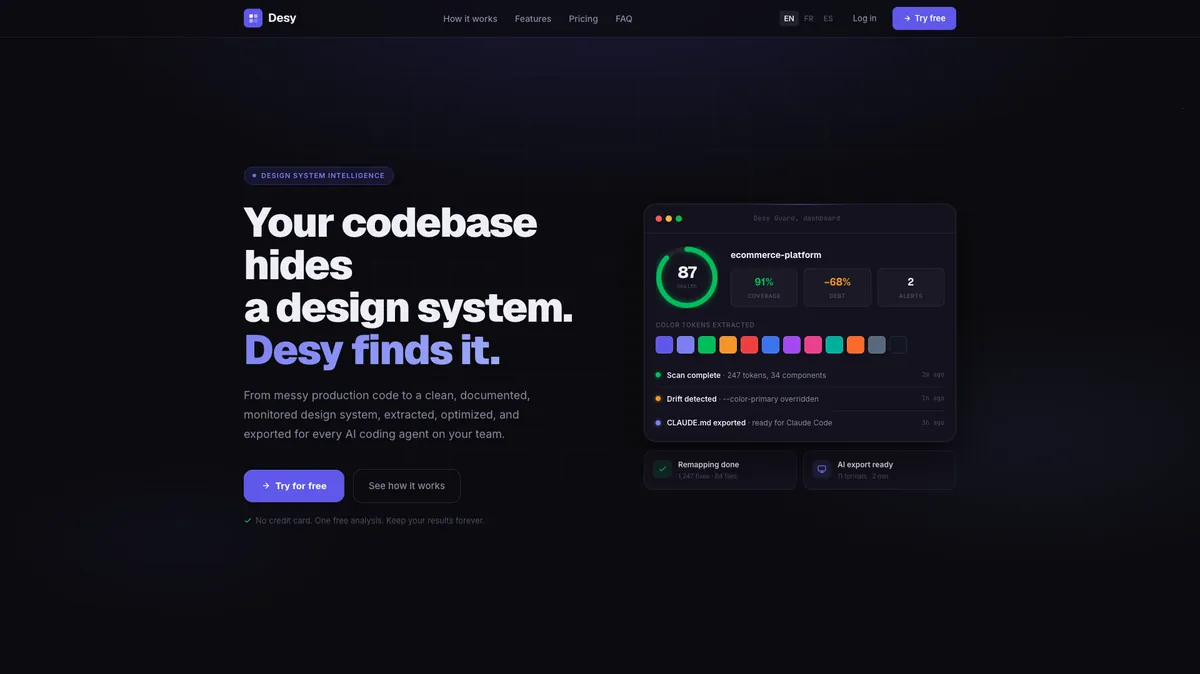
Rolling out AI at scale often starts with one precise, well-framed and verifiable use. Desy, a product designed and built by Brutux Studio, applies AI to auditing a design system: the tool reviews components and rules, then flags the inconsistencies to fix, while the team keeps control of the decisions. Lyon organisations that want to industrialise AI gain from starting with a use case this clear.
What lets a large organisation move from many pilots to a few successful roll-outs.
In large organisations, AI pilots pile up because nobody dares stop one. Yet each ties up licences, time and team attention. A credible roadmap is prepared to close the initiatives that have not shown their value, merge those that overlap and concentrate resources on the most promising, using criteria everyone knows. Stopping a pilot then becomes a reasoned decision rather than an admission of failure.
When each division argues for its own project on its own terms, arbitration turns political. A common framework, known in advance, changes the conversation: expected value, effort, risk, data required, ability to measure. Every initiative is scored the same way, and executive management decides on comparable evidence rather than on its sponsor’s conviction. The framework is then reused to assess each new idea.
Before signing, ask to see a written method and sample deliverables, not just a sales presentation. Check that the provider talks about measurement and governance as much as tools, has built products that run in production and can tell you when a use is not worth the investment. Ask, too, who will actually do the work, and who will be in the room when decisions are made.
Summarising a literature review, preparing meeting minutes or searching internal procedures does not carry the same requirements as a tool that influences a diagnosis or a medical device. The first group can move forward with standard governance; the second falls under specific regulatory frameworks, the AI Act included, and needs dedicated specialists. Confusing the two blocks simple uses or leaves risks poorly assessed.
Three ways to give AI some structure in a Lyon organisation.
| Criterion | Brutux Studio | Large consulting firm | In-house team alone |
|---|---|---|---|
| Who you deal with | The founder, end to end | A team of consultants | Your own staff |
| Perspective | External, no tools sold | External | Deep knowledge, but judge and party |
| Method | CRAFT, in five phases | The firm’s own methods | To be built |
| Link to the product | Design and integration available | Often handed to third parties | Depends on available skills |
| Presence | Video calls, on site for key moments | Strong on-site presence | Permanent |
| Duration | 4–8 week engagement | Varies, often long programmes | Ongoing |
We run Lyon engagements from Thonon-les-Bains: day-to-day exchanges online, with trips to Lyon to kick off the engagement, settle priorities and present the roadmap.
AI consultant Lyon: answers to the questions we are asked.
Mainly remotely: video interviews, shared documents, regular reviews. We travel to Lyon for the key moments: kick-off, prioritisation sessions and presenting our conclusions to executive management.
With a clear-eyed review of what they have delivered. Many pilots have never been measured: we define common criteria, assess each initiative and propose focusing effort on those that live up to their promise.
Probably, at least for some of your uses. The European regulation classifies systems by level of risk; at the time of writing, high-risk obligations are postponed to December 2027, or August 2028 for AI built into a medical device. We help you identify the uses likely to be affected; the detailed legal analysis is a matter for your lawyers or a specialist adviser.
Yes. Prioritisation is carried out with a group representative of the sites and divisions, then training workshops are organised on site or remotely depending on where your teams are based.
Ask for a documented method, sample deliverables and products actually shipped. Brutux Studio applies the CRAFT Method, drawn from MIT Sloan’s Applied AI Strategy, and also designs B2B SaaS: we advise on what we know how to build. The first 30-minute call lets you judge on the evidence.
Allow 4–8 weeks for the inventory, prioritisation and roadmap, depending on how many divisions and sites are involved. Rolling out the selected projects is organised afterwards, by your teams or with us.
Yes, in person in Lyon or remotely for distributed teams: leadership sessions, role-based workshops, coaching for champions, with a usage policy shared across all sites.
Yes: an inventory of uses, roles and responsibilities, data rules, and criteria for launching and stopping projects. Governance is sized to your organisation, so that it gets applied rather than filed away in a binder.
30 minutes to talk about your project, in Thonon or by video call. I’ll tell you honestly what will make the difference.
Book 30 minutes ↗