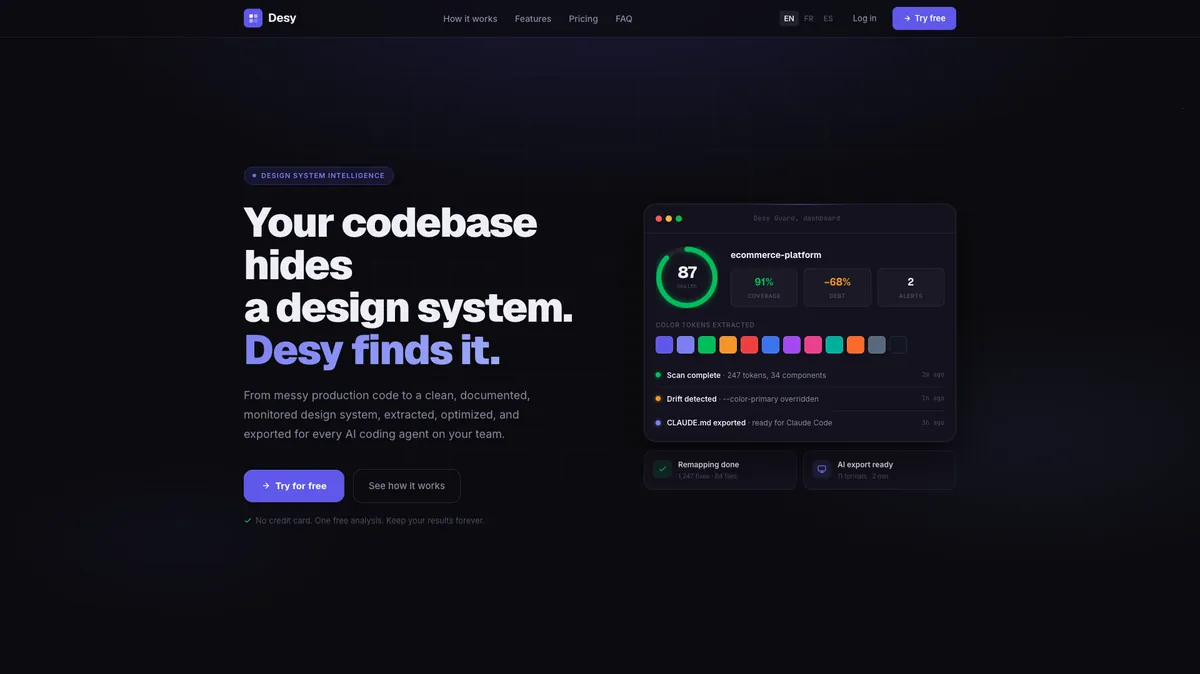
Brutux Studio is designing and building Desy, a product that finds the design system hidden in a codebase, audits it and monitors its drift between design and production.
SaaS · AI · Design systems
2024–2026
product in development
IA
audit and drift monitoring
Cal.com
validated on a real open-source project
Product strategy · AI architecture · UX/UI · Development
The context.
Desy is a Brutux Studio product, in development since 2024. It tackles a problem product and engineering teams know well: auditing a design system by hand takes weeks. Near-identical colours, orphaned components, silent gaps between the mockup and the code: drift sets in without anyone noticing.
Desy automates that analysis. It extracts design tokens straight from the code, produces structured reports, recommends consolidations and monitors drift over time. It can also export the result in a form AI coding agents can read, so they follow the system instead of working around it.
Victor Michel, the studio’s founder, carries Desy end to end: product strategy, architecture, design and code. The project also serves as a testing ground for the AI-assisted development methods the studio then applies for its clients.
The challenge: The first challenge was choosing the right problem. Desy started life as a design-context assistant for AI agents, an appealing but vague idea. The next was making an analysis partly entrusted to language models reliable: an audit is only worth something if its conclusions are reproducible and verifiable by a demanding team.
The approach.
01
Framing the market and the users
The work began with positioning and target profiles: the design lead who wants a consistent system, and the engineering manager who wants to contain debt. Their expectations differ, and the product has to speak to both.
02
Owning a pivot
Rather than pursue the original idea, Victor refocused Desy on a sharper, better-defined problem: auditing design systems and monitoring their drift. Giving up an appealing vision for a real, painful need was the project’s most consequential decision.
03
Documenting before coding
The product is run with the BMAD method: a requirements document, technical architecture, recorded decisions and user stories broken into phases. This documentation guides AI-assisted development and keeps the code from heading off in every direction.
04
Making the AI analysis reliable
The architecture spreads the work across several models via LiteLLM, inside a methodical audit pipeline. Similar colours are grouped by perceptual distance (Delta E 2000) rather than by simple value comparison, to bring together the shades the eye cannot tell apart.
05
Building for production
Desy runs on Next.js and TypeScript, a database hosted in Europe, organisation management for teams, background jobs for long analyses and Stripe for billing. A foundation designed for real customers, not for a demo.
06
Validating on real code
Extraction and recommendations were validated on the code of a real open-source project, Cal.com. A production design system, with its history and its inconsistencies, is the best test bench for an audit tool.
What this project taught
Desy is a reminder that a product’s most important decision is often made before the first line of code: choosing the right problem. It also shows that AI that is useful in a business setting comes wrapped in method, verifiable measurements and an architecture that does not depend on a single model.
What it means for your project
Has your interface grown faster than its design system? Brutux Studio can audit your components and tokens, spot inconsistencies between design and code, then propose a realistic consolidation. And if you are preparing an AI-based product, the studio brings the experience of a multi-model architecture built for production.