Terranova, pricing strategy for a French PropTech.
Victor Michel is a partner in Terranova, a French land valuation PropTech, where he drives pricing strategy and the go-to-market towards real estate networks.
PropTech · Land valuation
Associé
shareholder in Terranova
SaaS
land and property valuation
Partner · Pricing strategy · Go-to-market
The context.
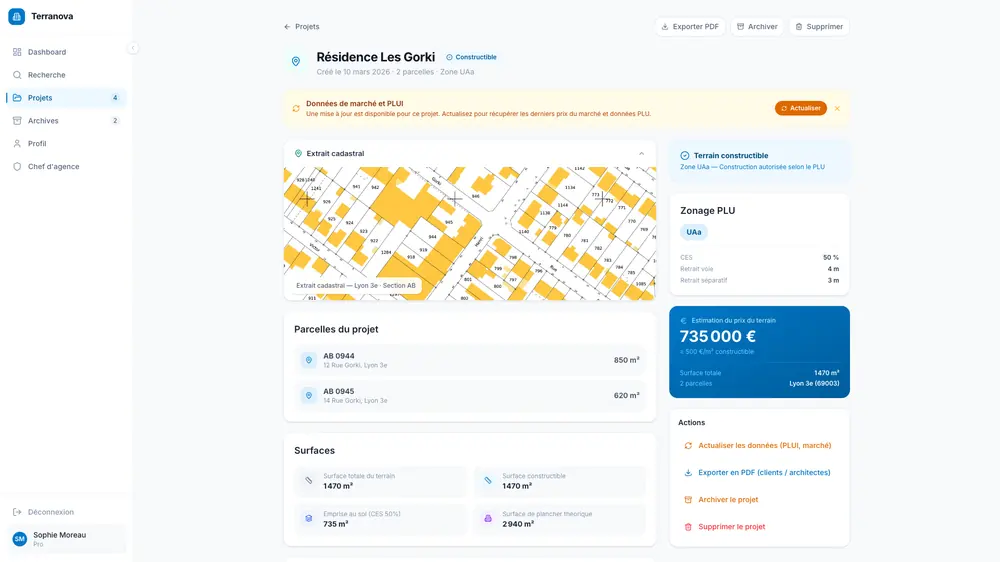
Terranova is a French PropTech dedicated to land and property valuation. The product helps professionals assess a plot: land registry extract, zoning rules, buildable surface, land price estimate, all organised into projects tracked in a dashboard.
Victor Michel, the founder of Brutux Studio, is a partner in Terranova. He brings the strategic and product dimension, with one central goal: turning expert know-how into a recurring SaaS product adopted by real estate agency networks.
For him it is also a commitment of a different kind: carrying a product as a partner, with the long-term decisions that entails, rather than as a contractor. His work is not about the screens shown here but about what decides a SaaS product’s trajectory: who it is sold to, at what price, and how that price evolves with each customer’s usage.
The challenge: A valuation tool does not create the same value for an independent agent as for an agency network. The challenge was to build a pricing model that tracks that value, simple for customers to understand, sustainable for the company, and able to grow with an account without constant renegotiation.
The approach.
01
Analysing the value chain
The work started with the land valuation value chain, from the first assessment of a plot to the investment decision. Understanding when the product saves time or money shows what customers are willing to pay, and why.
02
Designing a tiered model
Victor designed a tiered pricing grid, using a marginal logic where price follows perceived value. Customers start small and move up naturally as their usage grows, without abrupt jumps.
03
Adding options without complexity
Add-on options widen revenue per account for those who need them, without weighing down the core offer. A readable grid remains a priority: a price nobody understands drives people away.
04
Checking sustainability
The relationship between a customer’s lifetime value and the cost of acquiring them was modelled by segment. This shows which customers to target first and how much it is reasonable to invest to win them over. An attractive grid that does not cover the cost of winning a customer is just an elegant way of losing money.
05
Equipping the sales effort
Victor produced the sales material aimed at real estate agency networks and set out product positioning recommendations. Pricing strategy and sales pitch thus tell the same story.
The screens.
Terranova: project record with land registry extract, zoning and land price estimate
What this project taught
Terranova confirms that pricing strategy is a product discipline in its own right. A good pricing model does not extract value: it creates it, by aligning what customers pay with what they gain. Treating price as a product, designed, tested and evolved, rather than as a fixed grid, changes the way a company grows.
What it means for your project
Are you launching a SaaS product or rethinking its offer? Brutux Studio helps you connect product, price and target: what value you create, for whom, and how to turn it into a clear, sustainable pricing grid. This strategy work goes hand in hand with building or redesigning a SaaS product.