Metroscope, predictive maintenance AI for EDF power plants.
Victor Michel designed the interface of a predictive maintenance AI for EDF’s nuclear plants: field research, prioritised alerts and an industrial design system.
Nuclear energy · Industrial AI
56
nuclear reactors operated in France
IA
industrial predictive maintenance
Lead UX · Field research · Data visualisation
The context.
EDF operates 56 nuclear reactors in France. Metroscope, a startup born in its incubator, had built an AI-based anomaly detection system able to anticipate certain mechanical failures before they happen.
The technology worked. The real question was about use: how would maintenance technicians who had never worked with an AI system understand these alerts, trust them and act at the right moment? Without an answer, a high-performing AI risked sitting in a drawer.
Victor Michel, now the founder of Brutux Studio, took on all of the research and interface design. He acted as the link between the data scientists, who produced the model outputs, and the plant technicians, who had to interpret them: two kinds of expertise that did not speak the same language, facing engineers used to demanding industrial tools.
The challenge: In a nuclear plant, a confusing interface is not a mere annoyance: it slows down a diagnosis that may be critical. The audience, engineers and technicians used to rigorous tools, was naturally wary of design. Algorithm outputs, with their uncertainty margins and false positives, had to become readable without ever taking the final decision away from the human.
The approach.
01
Observing in the plants
Victor carried out field observation over several days, in the plants, alongside maintenance technicians. Following their actual work helped him understand their routines, their tools and the moments when a diagnosis is decided. This immersion also built trust with people not used to working with a designer.
02
Understanding what the models produce
With the data scientists, Victor took the algorithm outputs apart: their logic, their confidence intervals, their false positives. You cannot design the interface of an industrial AI without knowing exactly what it knows, and what it does not. He acted as translator between the two worlds.
03
Prioritising the alerts
The alert system was co-designed with the teams: ranking by criticality, the right time granularity, a recommended action for each situation. A technician has to see at a glance what is urgent, what can wait and what to do next. The visual hierarchy had to reflect actual criticality, without overstating or understating it.
04
Testing on real data
Prototypes were built on real plant data, then tested on site with working technicians. Testing in real conditions made it possible to fine-tune information density and visualisations before rollout, where a demo on dummy data would have revealed nothing.
05
Setting up an industrial design system
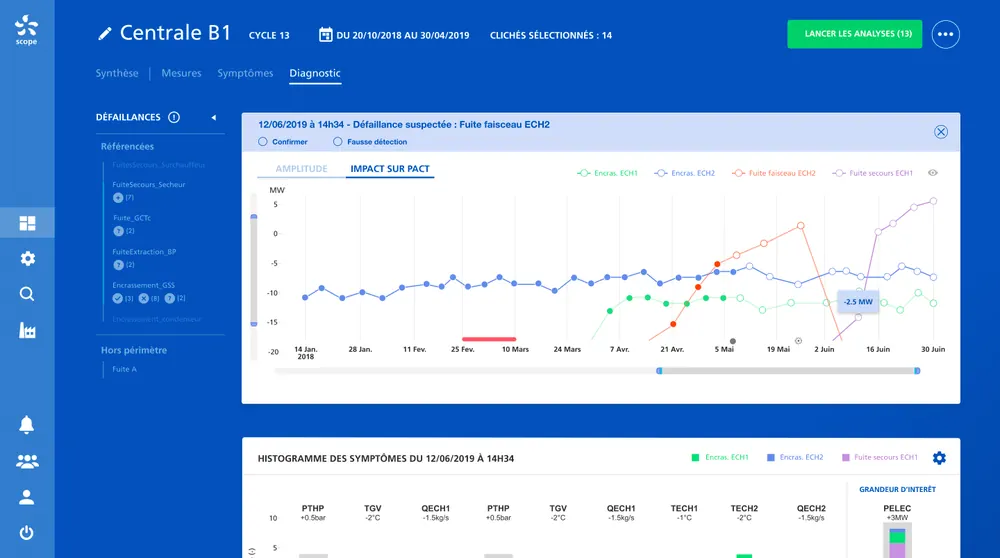
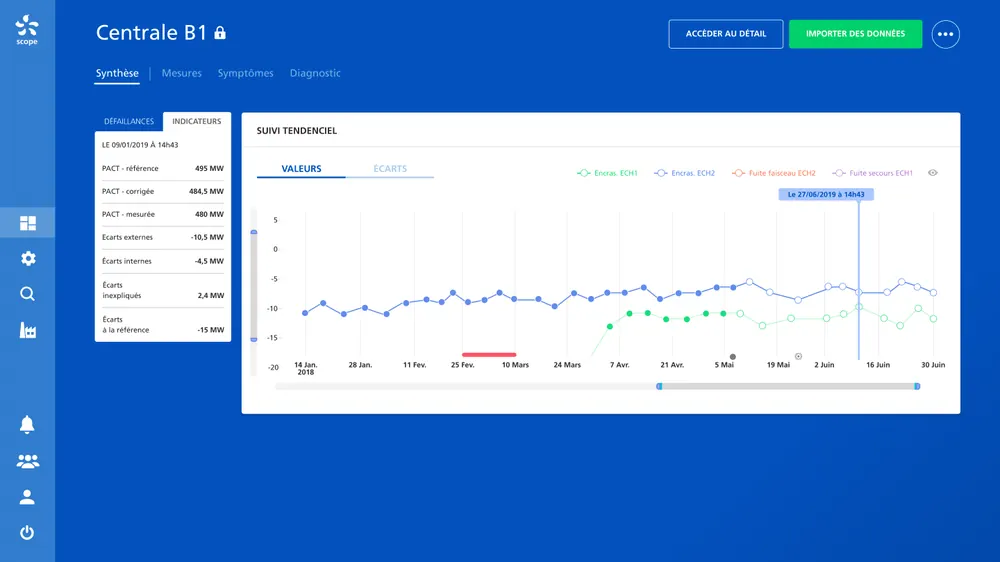
Victor defined a dedicated design system built for readability in an industrial setting, with high-visibility modes. Diagnostics and failure impact, trend monitoring, indicator summaries, plant project management: every screen follows the same rules.
06
Following adoption after rollout
The work did not stop at delivery. After rollout, Victor followed how the teams were taking up the tool and gathered their feedback directly in the plants, to fix whatever still slowed the step from alert to action.
The screens.
Metroscope: login screen reading “Bienvenue sur votre Metroscope”
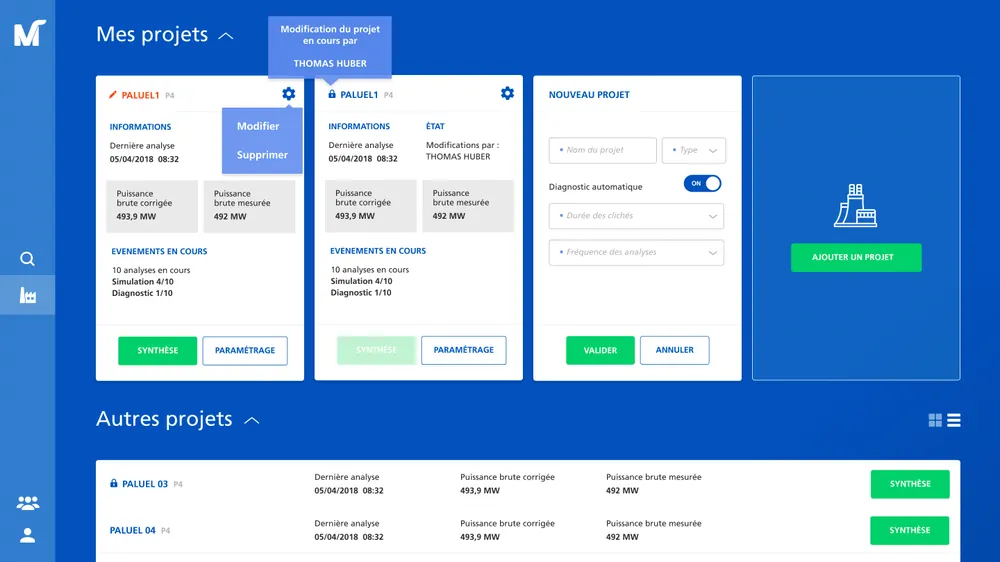
Metroscope: power plant project management
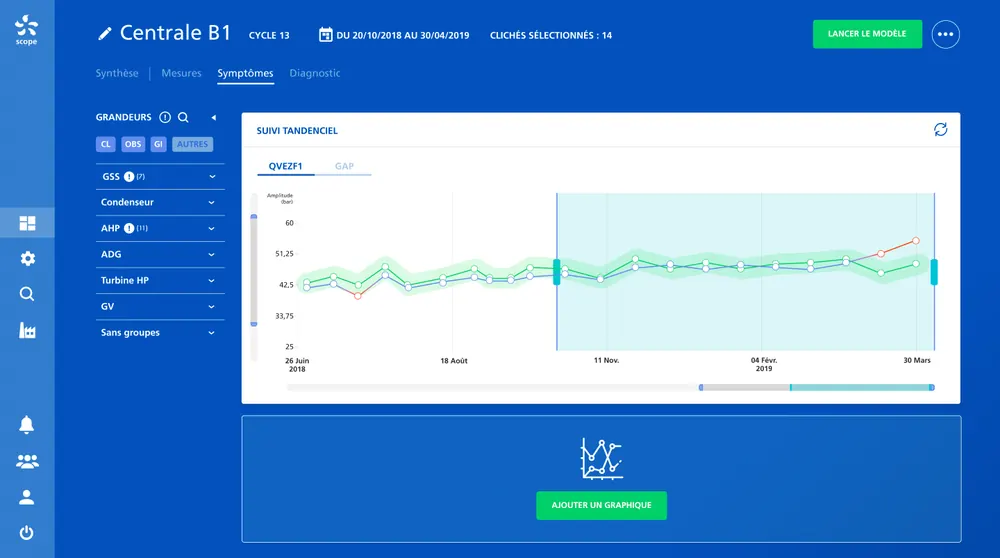
Metroscope: monitoring symptom trends over time
Metroscope: summary of plant indicators
What this project taught
For a predictive maintenance AI, clarity is a safety matter, not a question of taste. This project changed how Victor approaches information density: show less, but show what enables a decision. It also confirmed that an interface built around AI must leave the decision with the person accountable for it, and give them the means to understand every recommendation.
What it means for your project
Many companies now want to bring AI into their products or processes. The hard part is rarely the model: it is how people use it. Brutux Studio puts this experience to work in its AI strategy and AI integration engagements: understanding what the AI actually produces, designing interfaces where its results are readable and verifiable, and testing with end users before rollout. Data-heavy B2B dashboards and business software call for the same discipline.