SME running on spreadsheets
Your processes live in shared Excel files, emails and a few isolated tools. It works, until the day a version mix-up costs you a customer or a week of work.
Custom business software replaces shared spreadsheets, re-keying and siloed applications with a tool built around the way you work. We design it with the people who will use it, from the office to the field, then develop it and put it into service.
It often starts with an Excel file that has become central: several versions circulate by email, only one person knows how to fix it, and data-entry errors end up costing delays or disputes. Off-the-shelf software, meanwhile, imposes its own logic and forces teams to work around the tool to get their job done.
Custom software makes sense for SMEs and mid-sized companies whose know-how lies in a specific process: managing expert assessment files, scheduling field interventions, tracking compliance, handling specialised stock. It is for management teams who want reliable data and for staff tired of makeshift fixes.
Success means a tool your teams open of their own accord every morning. The mistakes to avoid: digitising the process as it stands without simplifying it, designing without field users, forgetting the links with accounting or the ERP, or aiming for full coverage in the very first release.
Custom business software serves organisations whose know-how does not fit into an off-the-shelf package.
Your processes live in shared Excel files, emails and a few isolated tools. It works, until the day a version mix-up costs you a customer or a week of work.
Each site has built its own tools and its own rules. Management wants consolidated information and consistent processes, without imposing a tool nobody will open.
Technicians, experts or travelling sales staff write on paper and then re-key it at the office. A web app that works on tablets and phones removes that double entry.
Your ERP or management software covers the essentials, but one key process slips through. Rather than customising it at great expense, a targeted, connected tool can complement it.
What we take care of, from observing the field to go-live.
Hours spent with your teams, in the office and in the field, to understand the real steps, the exceptions and today’s workarounds.
An interface that works on desktop, tablet or phone, with role-based permissions and screens tailored to each job in the company.
Data exchange with your ERP, CRM, accounting software or files, to eliminate double entry rather than create more of it.
Import and clean-up of historical data, short training for key users, and support through the first weeks of real-world use.
Bespoke management software delivered in stages, with everything you need to keep it alive afterwards.
Custom business software starts from how people actually work. For ProFlow, the working tool of a property valuation expert, Victor Michel, the studio’s founder, led the product strategy, UX and development: understanding every step of her files, then building the tool that supports them. That is what we bring to your teams: software designed for your trade, not a generic product to work around.
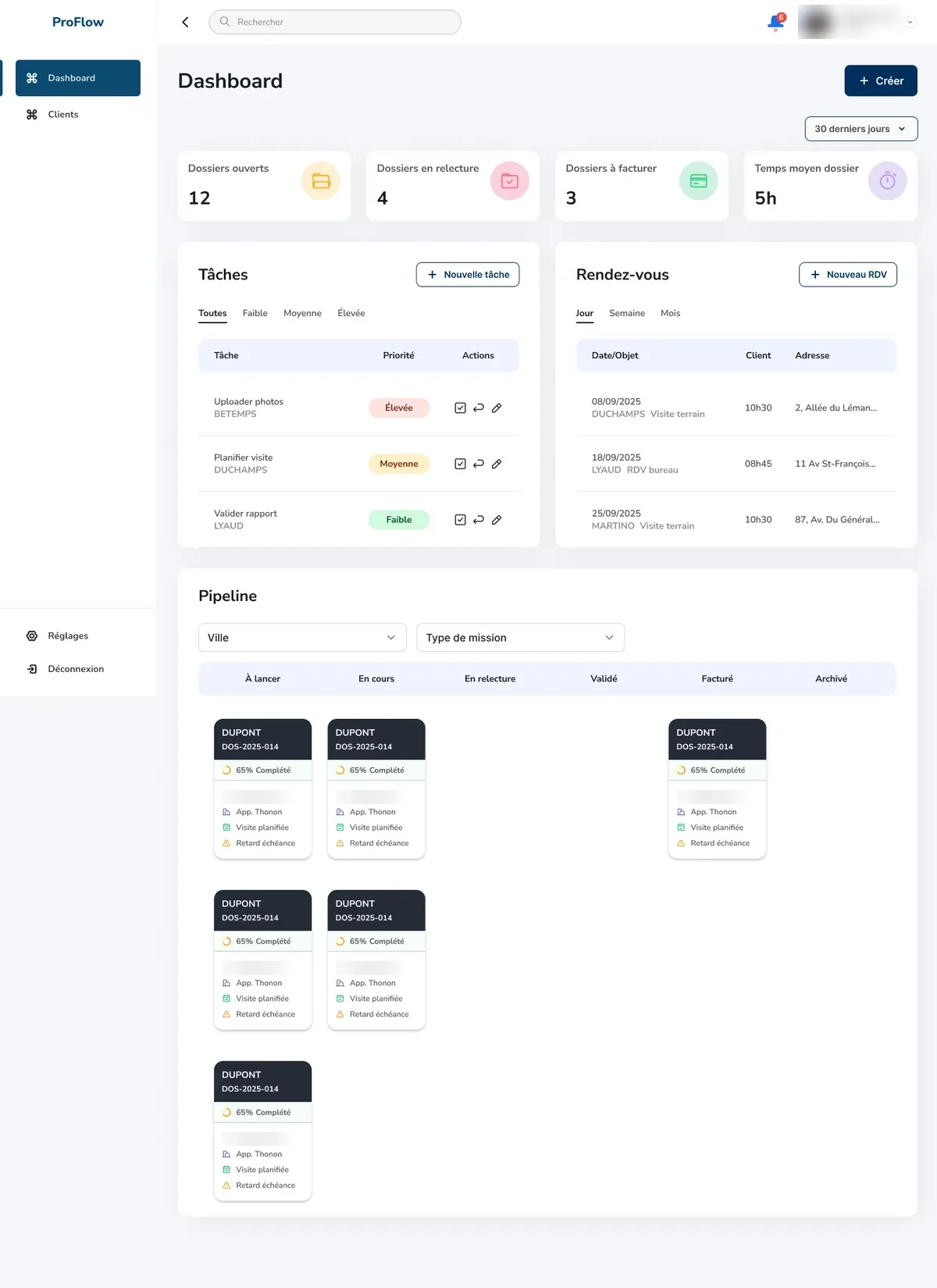
An approach that starts from your teams’ real work and delivers in usable stages.
Workshops and observation to describe the current process, its pain points and its exceptions, then decide what should be simplified before it is digitised.
Key screens are tested by future users in real situations: quick data entry, look-ups on mobile, management approvals.
We first deliver the flow that is most painful today, then the next ones, along with the integrations and data migration each one requires.
Supported go-live, documentation, source code handed to your company, and the option to evolve the tool with us or in-house.
The questions to settle before starting development of a bespoke business application.
A package or an industry ERP works when your processes resemble those of your sector: it deploys quickly and shares the cost of improvements. Custom software is justified when a process is what sets you apart, when adapting a package becomes heavier than the tool itself, or when several systems need connecting through logic that is yours alone. We always start with this question, and sometimes conclude that an existing tool will do.
Replacing an ERP with bespoke development is a heavy project, rarely needed for an SME. Most of the time, the ERP remains the reference for accounting, stock or invoicing, and the business application covers the process it handles poorly, exchanging data with it. We are not ERP integrators: we design and build the tool that connects to it cleanly, without creating yet another round of data entry.
Business software rarely fails for technical reasons. It fails when teams stick with their spreadsheet because the new tool takes more clicks. That is why we observe real work, test screens with the people who will enter the data and time the frequent tasks. An adopted tool is one that is faster than the old way of working from the very first week.
Legacy files contain duplicates, inconsistent formats and columns used for something other than intended. Importing them as they are into a new application reproduces the mess. We set aside time to clean them, define mapping rules and check volumes with your teams, so the software starts on a reliable foundation from go-live.
An internal tool quickly becomes critical. Check who owns the code, where it is hosted, how it is documented and who can evolve it. With Brutux Studio, the source code, documentation and access are handed over to your company: you can carry on with us, with another team or in-house. AI can then be added for specific tasks, such as sorting documents or drafting reports.
Three ways to equip a business process, to weigh up against your situation.
| Criterion | Brutux Studio (product studio) | Software vendor or integrator | Dev shop or freelancer |
|---|---|---|---|
| Fit with the process | Designed around the way you work | You adapt to the software, through configuration | Faithful to the specification supplied |
| Field users | Observed and involved in testing | Trained after deployment | Rarely met |
| Go-live | 2 to 6 months, delivered workflow by workflow | Fast if the standard fits | Depends on project size |
| Evolution | At your pace, with us or in-house | Tied to the vendor’s roadmap | Dependent on the provider’s availability |
| Ownership | Source code and documentation handed over | User licence | Varies with the contract |
| Integration with your systems | Connectors designed with the process | The vendor’s modules and connectors | Must be specified precisely |
Custom business software: answers to the questions we are asked.
Custom software serves the processes of a single organisation; a SaaS is sold to many customers and has to stay generic. The design approach is similar, but the architecture, permission management and evolution model differ.
Sometimes that is the right answer, and we say so when it is. Custom software is justified when your process is a competitive advantage, or when customising a software package ends up costing more than a focused tool.
Yes. We design screens for the tablets and phones of technicians or sales reps on the move: short data entry, photos, signatures, quick access to the information needed for the appointment.
Your company. The source code, documentation and access credentials are handed over to you, leaving you free to evolve the tool with us, with another team or with your own developers.
No. The project generally takes 2 to 6 months, but we deliver flow by flow: the first digitised process is put in your teams’ hands without waiting for the whole scope to be covered.
Yes, it is one of the most common cases. We start from the file, its tabs and its formulas to understand the process, then design an application that keeps the useful flexibility of the spreadsheet and removes competing versions and re-keying.
We do not replace a full ERP and we are not Odoo or SAP integrators. We build the business applications that complement your ERP on a specific process and exchange data with it.
We build in code, which guarantees ownership, performance and integrations over time. For a very simple or temporary need, a no-code tool may be enough: we say so at scoping rather than selling unnecessary development.
Tools genuinely used in production, a method that includes field users, delivery in stages, code ownership and handed-over documentation. Also ask how data migration and training will be handled.
Yes, for specific tasks: reading documents, pre-filling records, summarising a case, helping prioritise. We design it so that users stay in control and can check every suggestion before accepting it.
30 minutes to talk about your project, in Thonon or by video call. I’ll tell you honestly what will make the difference.
Book 30 minutes ↗