SaaS in its growth phase
Sign-ups are coming in, but too few accounts become active: onboarding and activation need rethinking.
Our UX/UI agency works with Paris SaaS vendors whose product has to stand out in a crowded category from the very first login. Activation journey audits, interface redesigns, design systems: we complement your product teams with an outside perspective and a senior point of contact.
Many French SaaS vendors are based in Paris and its inner suburbs. In every category, several products look alike on paper. The difference is often made in the first few minutes: a prospect who grasps the product’s value unaided carries on; one who hits an empty screen goes back to comparing. UX then becomes a sales argument.
Many Paris teams already have designers. What they often lack is time and distance: a packed roadmap leaves little room to revisit onboarding or harmonise screens designed by different people. An external UX/UI agency brings a neutral diagnosis and extra capacity when needed, without replacing the existing team.
The most common projects concern activation, discovery of advanced features and visual consistency across modules. They require combining product data, feedback from sales teams and customer interviews, then turning it all into concrete screens and reusable components your developers implement without reinterpreting.
Three situations we often see among Paris SaaS vendors.
Sign-ups are coming in, but too few accounts become active: onboarding and activation need rethinking.
The roadmap eats all available time; a foundational project, such as the design system or a core module, has been waiting for months.
Each module has its own conventions: the interface needs to regain consistency without slowing releases.
Focused engagements that slot into an existing product organisation.
A new customer’s first journeys scrutinised to find where they drop off before grasping the product’s value.
A core module, such as billing, reporting or settings, rethought without touching the rest of the application or blocking the roadmap.
Component inventory, merging of duplicates and documentation, so several product teams ship a uniform interface, module after module.
A senior designer who joins your rituals for a 6-week cycle, to unblock a project the in-house team cannot absorb.
Prototypes and beta versions put in front of a panel of existing customers, to validate a new interface before rolling it out to everyone.
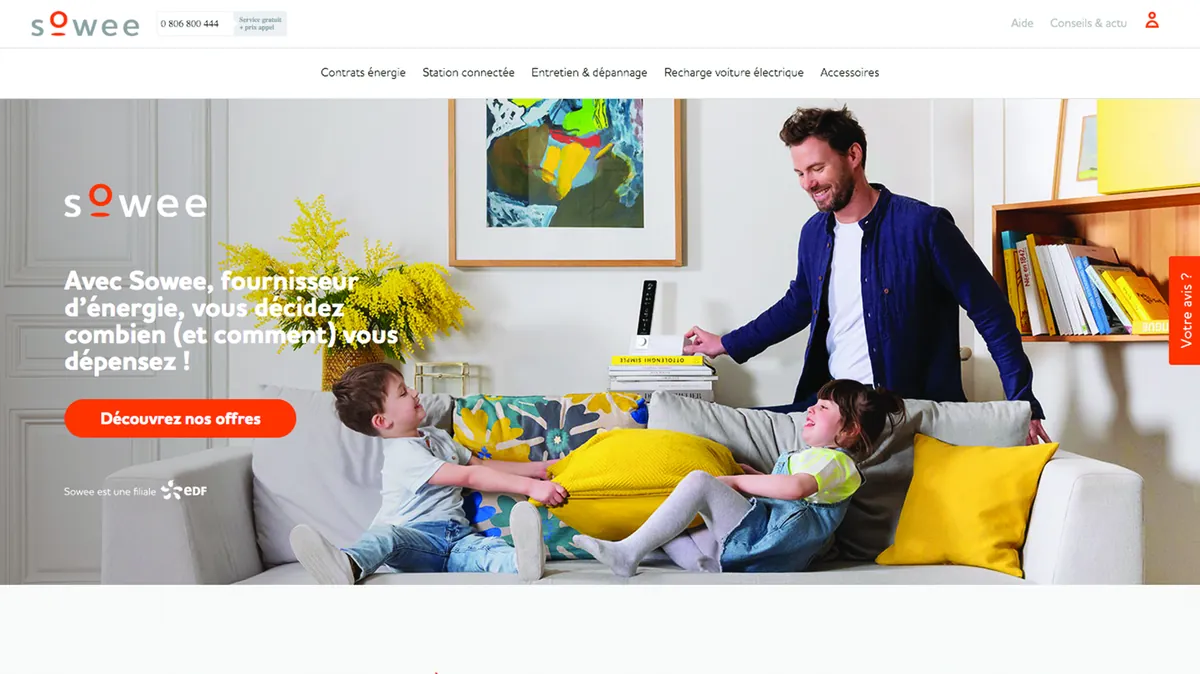
In a crowded category, every hesitation costs a customer. For Sowee, EDF’s connected-home subsidiary, Victor Michel, the studio’s founder, analysed funnels, heat maps and session recordings, ran user tests, then redesigned the home page, product page and checkout, validating each choice through A/B tests with Optimizely. The same logic applies to activation in a Paris SaaS product.
What we recommend to software vendors before starting UX work.
A redesign is tested in three stages. First on a prototype: a few existing customers carry out their usual tasks on the new interface, which reveals the landmarks they lose. Then in beta: a volunteer group switches to the new version, with an easy way to switch back and report problems. Finally through a gradual roll-out, module by module or customer by customer, while tracking usage. This sequence avoids the rejection of an interface that is actually better, simply because it disrupted habits.
Hiring a senior product designer takes time and is a long-term commitment: the right choice for a permanent need. External support suits a well-defined project better, such as redesigning a module, consolidating the design system or auditing onboarding. It also brings a neutral eye, useful when the team is too close to the product. Many vendors combine the two: a studio lays the foundations over one or two 6-week cycles, then the in-house team takes over with full documentation.
When several squads ship in parallel, the design system stops being a Figma file and becomes an internal product, with owners, contribution rules and versioning. Without governance, it fragments as fast as the interface it was meant to unify. We help define that foundation: inventory, shared tokens, priority components, a process for proposing new components and documentation that designers and developers can both read.
In a category where features look alike, experience becomes a sales and retention argument. A prospect who gets a first useful result during the trial has good reason to win over their team. That comes down to concrete choices: sample data instead of an empty screen, deferred set-up, the customer’s vocabulary, help placed exactly when it is needed. These are targeted, measurable UX projects that do not require rebuilding everything.
The alternatives to Paris UX agencies for a B2B SaaS, compared on the criteria that matter to a software vendor.
| Criterion | Brutux Studio | Paris UX agency | Freelance product designer |
|---|---|---|---|
| Proximity | Remote, with workshops in Paris at key stages | Easy to meet at any time | Varies, often remote |
| Fit with your teams | In your tools and rituals, on the same Figma files | Often run as a separate project | Joins the team directly |
| Scope | Audit, design, design system and development | Research and design, sometimes development | Design, within a defined scope |
| Point of contact | One senior designer, no sales layer | Sales, project manager, then designers | The designer themselves |
| Format | 2-to-3-week audit or 6-week cycles | Fixed-price project or time and materials | Day rate |
With Paris teams, the work mostly happens remotely, built into your tools and rituals. For the kick-off, key interviews and the debrief, we organise in-person workshops in Paris.
UX/UI agency Paris: answers to the questions we are asked.
To work directly with the person doing the design, with no sales layer. Remote collaboration is planned from day one, and our trips to Paris are kept for the moments when being there really makes a difference.
Very often, that is the best scenario. We share the same Figma files, respect your conventions and rituals, and hand over everything we produce so the team stays autonomous after we leave.
By starting from the data: where do new accounts stop, and which actions come before regular use? Then by talking to a few recent customers. Fixes often concern empty screens, vocabulary and the order of steps.
A UX audit takes 2 to 3 weeks. A broader design project takes 2 to 6 months, organised in successive 6-week cycles that each end with a demo.
Start with a prototype shown to a few existing customers, then open a beta to a volunteer group, and roll out in stages. At each step, watch real usage and keep a way back to the old interface until the new one has proved itself.
Yes. A senior designer joins your rituals for one 6-week cycle, with a goal agreed upfront: a module, onboarding, the design system. At the end of the cycle, everything is documented and handed over to your team.
Yes. Brutux Studio also builds SaaS products, with AI-augmented development. Depending on your set-up, we hand mock-ups to your developers or take charge of implementing the module concerned.
Yes, across Greater Paris: central Paris, La Défense, Boulogne-Billancourt, Issy-les-Moulineaux, Levallois-Perret. Workshops take place at your offices, follow-up remotely.
We do not publish a price list: every engagement starts with a 30-minute call, followed by a detailed, costed proposal, with no commitment.
30 minutes to talk about your project, in Thonon or by video call. I’ll tell you honestly what will make the difference.
Book 30 minutes ↗