Research spin-off
An algorithm, a sensor or a method out of a lab: the technology is proven, and now it needs a product customers will pay for.
Our SaaS agency supports Lausanne start-ups and technical teams who have mastered a technology and now need to turn it into a product professionals will adopt. We work from Thonon, on the French shore of Lake Geneva, with workshops in Lausanne at key stages.
With EPFL, the University of Lausanne and a dense start-up scene around Lake Geneva, the region produces a great deal of technical innovation. Many young companies grow out of research, an algorithm or a sensor, with founders who are brilliant on substance but have had little exposure to the users who will pay for the software.
Moving from demonstrator to SaaS is delicate: a lab interface, built by and for engineers, becomes the daily tool of a quality manager, a doctor or an administrator. The technical power has to be translated into a few understandable actions, hiding the complexity without betraying it.
For an early-stage SaaS in Lausanne, we favour short cycles: interviews with pilot customers, a prototype tested quickly, then a developed version that serves sales demos as much as the first paid deployments. The design system stays light at first and grows with the product.
The Vaud teams with which our product approach works best.
An algorithm, a sensor or a method out of a lab: the technology is proven, and now it needs a product customers will pay for.
Your users are doctors, operations engineers or quality managers. They are short of time and demanding about reliability.
You want to offer your customers a portal or online tool alongside your business, without building a full product team.
Your developers move fast, but nobody owns the user experience. You are looking for senior product support for a key period.
Formats suited to teams that move fast and need to prove their product’s value.
Interviews and observation with early users to identify the task your technology truly simplifies, and the one it should not tackle yet.
Visualisations, advanced settings, analysis results: we make complex functions readable for users who are not engineers.
A first version in production, with accounts, permissions and usage tracking, built to evolve without starting from scratch at the next stage.
A senior product designer’s perspective at key moments: before a funding round, a trade show, a major pilot or hiring an in-house team.
Deliverables designed for a start-up that has to win over customers and investors.
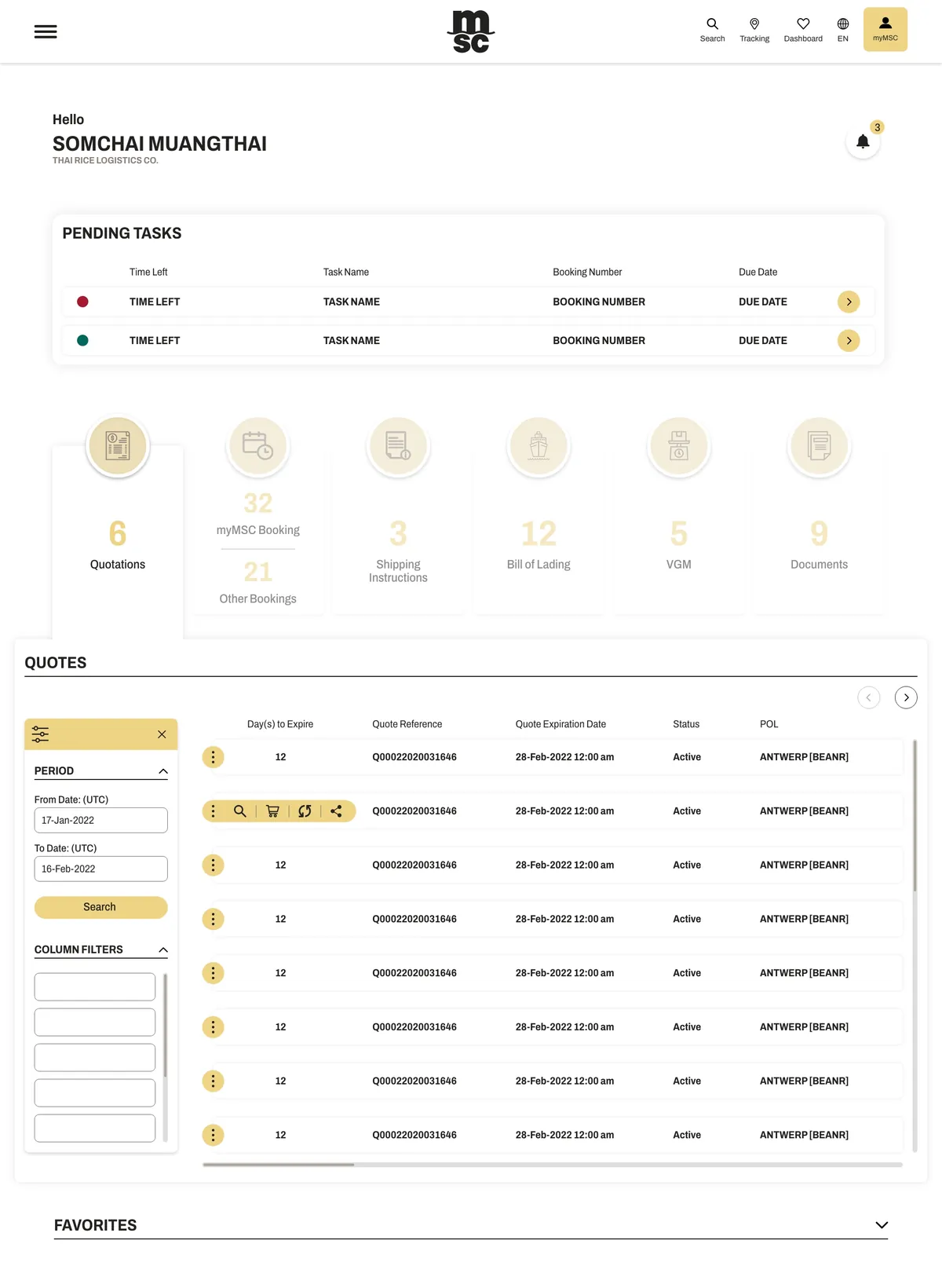
Solid technology does not guarantee adoption. At MSC, the world’s largest shipping company, the self-service app for business customers struggled to find a place in their daily work. Victor Michel, the studio’s founder, went to watch those customers at work before redesigning anything. A valuable lesson for a Lausanne start-up selling to professionals.
What we advise Lausanne founders, whether or not you work with us.
Before choosing a product studio, check four things. Products in production, not just mock-ups. A method that puts the team in front of your users, not only in front of you. The ability to build what it designs, or to work closely with your developers. And finally, ownership of the code and design files, which must come back to you without conditions.
For a funding round or a first pilot, a clickable prototype tested with real users often proves as much as built software, in far less time. A developed MVP becomes necessary when you need to handle real data, measure repeat use or invoice. We help you choose based on what you need to demonstrate, and to whom.
Spin-off founders tend to expose the full power of their technology: parameters, graphs, options. Users, on the other hand, want the answer to a question from their own job. Design work means starting from that question, offering sensible defaults and keeping advanced functions for those who genuinely need them.
A young start-up does not need an exhaustive design system. It needs a few solid components, simple rules and documentation its developers actually read. We start light and enrich the system with each cycle, so the interface stays consistent as the team grows or when an in-house designer is hired.
Getting from Thonon to Lausanne just means crossing the lake: we hold meetings in Lausanne for discovery and user testing, and work remotely between sessions.
SaaS agency Lausanne: answers to the questions we are asked.
Yes, our approach suits them well: short cycles, quick decisions, budget committed in stages. We help turn a technical breakthrough into a usable product, without claiming to replace your scientific expertise.
Not always. A well-tested clickable prototype is sometimes enough to show the vision and early customer feedback. We help you choose between a prototype and a developed version based on what you need to prove, and to whom.
No. We start from what exists, identify the screens that hold back your non-technical users and rework those first. The rest can follow the pace of your roadmap.
In-person workshops in Lausanne or Thonon at key moments, weekly video calls, regular demos and shared tools. You see the product move forward every 6 weeks.
Look at its live products, how it involves your users, its ability to code what it designs or to collaborate with your developers, how often it demos, and who owns the code. A 30-minute call with the studio is often enough to check the essentials.
Yes. A short cycle can produce a tested prototype, a credible demo and a well-argued product vision. We do not get involved in the financing itself; we help you show a product that stands up.
We do not place product managers on secondment. However, every project includes product work: discovery, prioritisation, scope decisions. For an existing team, a senior product designer can join your rituals for a key period.
Yes. If your technology already relies on a model, we design how its results are presented, explained and corrected by the user. Showing a confidence level or letting users challenge a suggestion matters as much as the quality of the model.
A cycle lasts 6 weeks. For a start-up, the first is often used for discovery and a tested prototype; the full project, up to an MVP in production, runs 2 to 6 months depending on scope.
30 minutes to talk about your project, in Thonon or by video call. I’ll tell you honestly what will make the difference.
Book 30 minutes ↗