University spin-off
Solid technology, a first interface to invent and little time before the first customers or investors.
Our UX/UI agency helps young companies and product teams in Lausanne turn solid technology into a product people understand from the very first use. User research, tested prototypes, interfaces and design systems: we step in early, when every design choice shapes adoption.
Lausanne’s universities, led by EPFL, give rise to a steady stream of ventures born in a lab. Their strength is technical; their first hurdle is often the interface. A remarkable algorithm stays invisible if the screen exposing it speaks the language of researchers. UX then becomes translation: which results to show, at what level of detail, and what action to offer next.
For a Lausanne start-up, UX/UI design is also a way to learn fast. A clickable prototype shown to a few potential customers answers questions a development sprint would leave open. We build these prototypes to test a hypothesis, an offer or a journey, then keep what works for the real interface.
Lausanne is also home to the IOC and several international sports federations. Their digital tools reach very different audiences: athletes, volunteers, officials, administrators. Designing for them means accepting occasional use, on mobile, sometimes in several languages, and making every journey understandable without prior training.
Three kinds of Vaud teams, at very different stages of maturity.
Solid technology, a first interface to invent and little time before the first customers or investors.
A product that has found its customers and now needs consistency, with a design system that keeps pace with a growing team.
Tools for athletes, volunteers and officials, used occasionally, on mobile and in several languages.
Formats suited to young products as well as platforms that serve a wide audience.
A clickable journey designed quickly, then put in front of real users to settle a product question before any development.
Interviews and observation with your first customers or pilot users, distilled into concrete needs and design decisions.
Visualisations, advanced settings and complex results presented legibly, for expert users and less technical decision-makers alike.
A lightweight but rigorous component library that grows with the product without slowing down the first releases.
Screens designed for smartphones, for volunteers, officials or customers who only open the app a few times a year.
Deliverables sized for a team that has to learn fast and decide on facts.
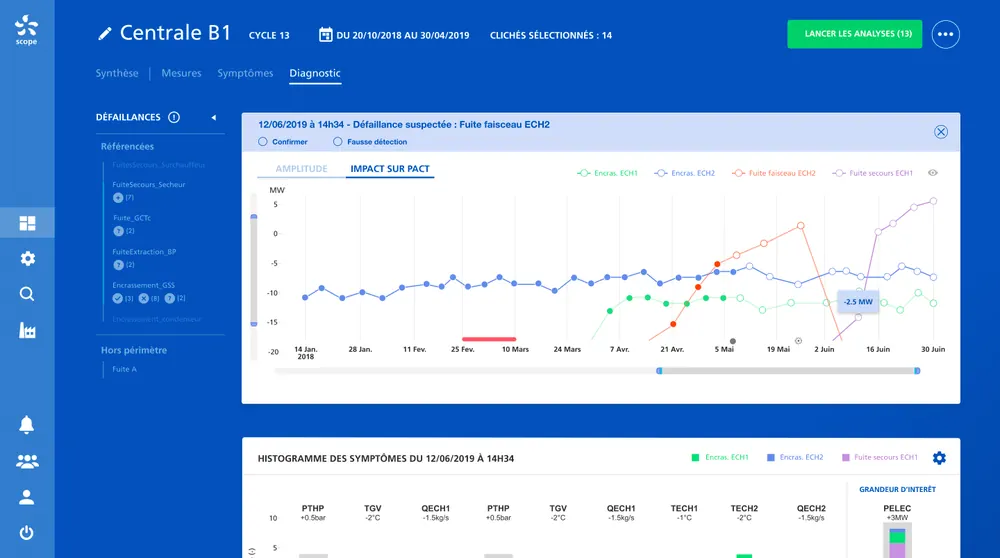
Metroscope, a start-up born in EDF’s incubator, had solid technology: anticipating equipment failures. It still had to make sense to technicians who had never used AI. Victor Michel, the studio’s founder, bridged the data scientists and the field, then designed alerts ranked by criticality, so everyone knows what to look at first. A situation familiar to young Lausanne companies.
The questions Lausanne founders ask most often before starting design work.
An MVP is a real, developed product, however minimal. A prototype is a clickable simulation, built in a few days in Figma, without a single line of code. To check that a journey makes sense or that an offer interests people, a prototype is enough and much easier to change. An MVP becomes relevant when you need to observe use over time, with real data. We often recommend going through a tested prototype before committing to MVP development.
A young company rarely has access to hundreds of users, but it has its pilots: a partner lab, a first customer, a circle of early adopters. A few well-prepared sessions with them already bring the main blockers to light. It all comes down to the protocol: realistic tasks, open questions, and watching what people do rather than what they say. We run these tests in Lausanne or remotely, then turn each finding into a design decision.
Products born in research often expose probabilistic results, models or measurements that are hard to interpret. The interface has to say what the result means, with what level of confidence, and what to do next. That calls for a strict hierarchy, conclusion first and detail second, restrained visualisations and vocabulary tested with non-specialist customers. Advanced settings stay within experts’ reach without imposing themselves on those who only want to decide.
Not a full design system, but its foundations: colour and typography tokens, a handful of recurring components, a few usage rules. This light base stops every developer creating their own buttons in the race for the first features, without slowing the team down. As the product and the team grow, it expands cycle after cycle. Starting from scratch in two years would cost far more than a cleanly laid foundation today.
Lausanne faces Thonon across the water: we cross the lake for the kick-off and testing sessions, then the work continues remotely, punctuated by regular video check-ins.
UX/UI agency Lausanne: answers to the questions we are asked.
Ideally before locking down the first version: a tested prototype avoids building useless screens. But it is never too late: a product that is already live can also be clarified step by step.
Yes. We help translate technical know-how into an interface: choosing what to show, naming things in customers’ words and keeping advanced settings within reach without cluttering the screen.
Yes, it is a common challenge for sports organisations and associations. We design journeys that make sense without a manual, with clear visual cues and short steps, tested on mobile.
Yes. A UX audit (2 to 3 weeks) suits a young company that already has users: it shows where they get stuck and what to fix before the next funding round or trade show.
Yes. We organise sessions at your offices, on campus or at your pilot users’ premises, and remotely when participants are spread out. Every session follows a written protocol, and findings are shared with the whole team.
Yes. Brutux Studio also builds SaaS products: after the prototype and design, we can develop the product in 6-week cycles over 2 to 6 months, keeping the design system in the code.
We design the mobile interfaces of these tools: registrations, call-ups, results, practical information. The focus is on instant understanding, outdoor legibility and short journeys.
A UX agency usually stops at design. A product studio like ours connects user research, UX/UI design, design system and development, so one team carries the product from idea to production.
Yes. Many Lausanne teams work in English: workshops, documentation and interfaces can be run in English, or in both languages.
30 minutes to talk about your project, in Thonon or by video call. I’ll tell you honestly what will make the difference.
Book 30 minutes ↗