Deeptech and AI start-ups
A high-performing model, a strong research team, and the question of adoption by business customers. We work on interaction, evaluation and trust.
As an AI consultant for start-ups and companies in Lausanne, we help with the step that even the best models cannot take on their own: turning them into a tool people actually use. Human-AI system design, evaluation protocols and team adoption are at the core of our work in Vaud.
In the wake of EPFL and UNIL, the Vaud ecosystem gives rise to many young tech companies, a good number of them with a strong machine learning culture. Their difficulty rarely lies in the algorithm. It shows up when a convincing prototype has to become a feature that a business customer understands, adopts and trusts for good reason.
That is where we step in as an AI consultant in Lausanne. Together with the team, we define when the user stays in control, how to display how certain an answer is and which metrics will prove the feature really helps. These design choices often weigh more heavily on adoption than a few performance points gained on a test set.
The canton of Vaud is not just start-ups. Its manufacturing SMEs, service firms, and hospitality and tourism businesses along the Riviera are asking questions too. For them the stakes are more down to earth: lightening the admin load, responding to enquiries faster, making better use of documents built up over years, all in line with the Swiss FADP.
Those building AI as much as those who want to use it.
A high-performing model, a strong research team, and the question of adoption by business customers. We work on interaction, evaluation and trust.
A growing product and an AI feature to add without weakening the existing experience: use case choice, mock-ups, measurement protocol, integration.
Manufacturing, services, retail: a few concrete generative AI uses, simple governance and trained staff, in line with the Swiss FADP.
Replies to enquiries, multilingual content, guest reviews: AI prepares, your teams keep the human touch your reputation rests on.
For teams building AI as much as for those who want to use it.
Who decides, when, with what information: we design the interaction between your model and its users, right down to mock-ups of the screens involved.
Representative test cases, quality criteria and observation in real conditions, defined before development so you know whether the feature delivers.
A review of your processes and data, then a shortlist of realistic uses, each assessed for time saved, effort and risk.
Hands-on workshops in Lausanne or on the Riviera for business teams, with a usage policy designed around Swiss data protection requirements.
Deliverables designed for a product team that wants to decide quickly and well.
A strong model is not enough: you need a system where people understand and decide. At Metroscope, the AI anticipated failures, but EDF’s nuclear engineers remained wary. Victor Michel, the studio’s founder, observed their work in the plants, designed alerts graded by criticality and supported the rollout with the teams. That human-AI design is what we bring to Lausanne teams.
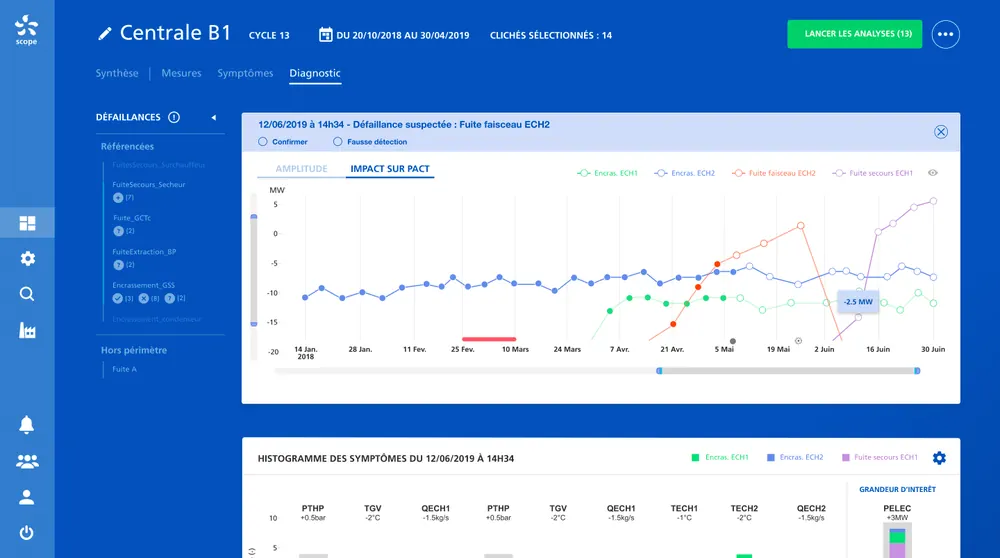
What we see when an AI prototype has to become a product.
A model is never one hundred per cent sure, and the interface should say so. Showing a confidence level, flagging edge cases, prompting users to check when an answer is shaky: these choices stop users following the machine at the very moment it is wrong. That is often the difference between a feature people put up with and one customers trust for good reason.
A machine learning team measures accuracy on a test set. The product must also measure usage: how many suggestions are accepted, edited or ignored, how much time users save, whether they come back. These indicators are defined before going live; they reveal problems the test set cannot show, such as a correct suggestion in the wrong place, or one that arrives too late to be useful.
Before entrusting the design of an AI feature, check four things. Has the studio shipped products used in production, not just mock-ups? Does it work with your engineers rather than beside them? Does it propose an evaluation protocol before designing? Can it say no to a feature that adds nothing? Finally, ask who actually does the design: those answers say more than a portfolio.
Working with a French studio from Lausanne mainly raises practical questions: data protection, contracts, travel. The Swiss FADP is built into our recommendations from the scoping stage, workshops take place at your offices and work moves forward online between visits. The founder remains your single point of contact, from first conversation to final debrief, with no intermediary or sales go-between.
Only Lake Geneva lies between Thonon and Lausanne: design workshops and training sessions take place at your offices, and work carries on online between visits.
AI consultant Lausanne: answers to the questions we are asked.
A product and usage perspective. Your engineers build the model; we work on everything around it: its place in the user journey, human oversight, how uncertainty is shown, how adoption is measured. The two skill sets complement each other without overlapping.
By defining in advance what “ready” means: a set of representative cases, acceptable quality thresholds and a test with real users. Without that protocol, a successful demo can hide inadequate quality once the feature is live.
Yes, just as we do with start-ups. For an SME, the engagement focuses on a few concrete uses, simple governance and training for the staff concerned, with the Swiss FADP taken into account.
Yes, at your offices in Lausanne, Renens or on the Riviera. Design sessions work best in person; follow-up and interim reviews take place online.
Products shipped and in use, a written method, the ability to work with your engineering team and an evaluation protocol before development. Ask who will do the work too: at Brutux Studio, the founder designs, from the first call to delivery.
Yes. We can stop at design and evaluation, or go all the way to integration in your codebase, alongside your developers. The choice depends on your team’s strengths and your timeline.
Not without an explicit decision on your part. We compare the providers and hosting options available, in Switzerland and elsewhere, and set out their implications under the Swiss FADP before any choice is made.
An AI consulting engagement takes 4–8 weeks. For a start-up, it ends with a feature that is specified, mocked up and equipped with its evaluation protocol; for an SME, with prioritised uses and trained staff.
30 minutes to talk about your project, in Thonon or by video call. I’ll tell you honestly what will make the difference.
Book 30 minutes ↗