
Google AI Mode does not ask a local business to start from scratch: Google states that no special optimisation is needed to appear in it, and that a page must first be indexed and eligible for a snippet in classic search. What changes is the shape of the questions and where the answers appear. The businesses that stay visible are those that answer their customers’ questions precisely and whose Google profile is accurate.
Since summer 2026, AI Overviews and AI Mode have also been shown in France. Many small business owners hear about “GEO” and wonder whether they need a new provider, new files or a new way of writing. Here is what Google officially says, what remains useful for a local business, and how to check where you stand.
Google AI Mode: what changes for a small business?
On 22 July 2026, Google France announced the launch of AI Overviews and AI Mode in Search in France, after a worldwide rollout that began in May 2024. The two features do not play the same role.
AI Overviews and AI Mode, two different uses
AI Overviews show a summary above the results, with links to go further. According to the same post, they only appear when Google’s systems judge that a generated answer is useful for the query.
AI Mode is a conversational search tab. You ask a question in writing, by voice or with an image, then follow up with further questions without starting again.
The answer cites websites, with clearly visible links. That is where a small business can appear, provided its pages answer the question asked.
For a small business, the difference matters. An AI Overview mostly appears on informational questions. AI Mode is used to compare, to prepare a decision, sometimes to choose a provider.
Longer questions, split into searches
Google France says an AI Mode search is on average three times longer than a traditional search. People no longer type “plumber Thonon”; they describe a situation: the leak, the type of home, how soon they need someone.
To answer, AI Mode splits the question into subtopics and runs several searches at once. Google calls this technique query fan-out: your page can be picked up for one of these subtopics, even if it does not match the question word for word.
In practice, a page that clearly answers a precise question has more chances of being used than a page that lines up keywords.
What does not change: the index comes first
In its page AI features and your website, Google sets a simple rule. To be shown as a link in an AI Overview or in AI Mode, a page must be indexed and eligible to be shown in Google Search with a snippet. There are no additional technical requirements.
This rule applies to a bakery in Thonon just as it does to a Geneva consultancy. The size of the business changes nothing about the entry conditions.
In other words, a page Google has not indexed has no chance of being cited. Before talking about AI, check that your important pages are actually in the index.
Google also points out that meeting every requirement guarantees neither crawling, nor indexing, nor display. Nobody can promise a citation.
That is also why a slow site, a poorly linked one or one blocked by a forgotten setting loses on both fronts: classic search and generated answers.
Is GEO a new profession?
GEO, for Generative Engine Optimization, refers to work aimed at being cited by answer engines. Google covers it in its guide Optimizing your website for generative AI features on Google Search.
What Google says about GEO
Its position is clear: from Google Search’s perspective, optimising for generative AI search is optimising for search, and therefore still SEO. The guide explains that these features are rooted in Google’s usual ranking and quality systems.
It also invites caution with “GEO” or “AEO” advice and services offered by third parties. And it warns against tools that promise rankings or claim to use internal Google metrics: according to the guide, no third-party tool has access to them.
For a small business, that is good news. The groundwork remains that of search engine optimisation: technically sound, useful pages that are well linked to one another.
The tricks Google calls unnecessary
The same guide lists several practices you can ignore for Google Search:
- llms.txt files and other “special” markup: Google Search does not use them. Publishing them does no harm, but does not help either.
- Chunking content into small pieces: Google’s systems understand a page that covers several topics.
- Rewriting for AI: no particular style is needed, nor every variant of a query.
- Artificial mentions: seeking inauthentic mentions across the web is less useful than it seems.
- Structured data as a shortcut: no special schema.org markup is required, even though it remains useful for rich results.
These files can serve tools other than Google, and the guide says so. We publish an llms.txt file on brutux.studio, for instance, as a precaution, without presenting it as a lever.
Other assistants, such as ChatGPT or Perplexity, use their own crawlers and their own indexes. That is the purpose of our AI visibility (GEO) service, which checks what these tools say about you, with no guaranteed citation.
Which pages should a local business work on?
If the rules remain those of SEO, some pages gain in importance. These are the ones that answer the long questions AI Mode now receives.
Answer the questions your customers ask
Write down the questions you hear on the phone, in meetings or by email. “Do I need a permit for a conservatory in Évian?”, “How long does fitting a kitchen take?”, “Do you work on the Swiss side?”.
Each one deserves a clear answer, at the top of a page or section, under headings phrased as questions. Google’s guide notes that readers appreciate pages organised into paragraphs and sections, with headings that give the content a clear structure.
One service page per activity, and one page per town where you really have customers, remain the foundation. Our article on local SEO in the Chablais details what a town page must contain so it does not become a doorway page.
Content nobody else can write
This is the point Google stresses most: creating content people find unique, compelling and useful will likely influence a site’s presence in generative AI search more than any other suggestion in its guide.
Google contrasts commodity content, based on common knowledge that anyone could have written, with content that brings first-hand experience or real expertise. A tradesperson explaining the constraints of a lakeside job brings what no generic text contains.
Conversely, the guide warns that creating a page for every variant of a question, mainly to manipulate rankings or generated answers, violates Google’s scaled content abuse policy.
Real photos of your work count too. Google notes that its AI features can bring in relevant images and videos, which opens other opportunities to appear.
The business profile, source of local answers
Google’s guide states that generated answers can include information about local businesses, and that a Google Business Profile helps your services be visible in those answers as in the rest of Search.
In its tips to improve your local ranking, Google explains that businesses with complete and accurate information are more likely to appear in nearby results. Address, opening hours, category, attributes: every field counts.
The same document names three criteria for local results: relevance, distance and prominence. Prominence takes into account, among other things, links to your business and the reviews it has received.
Finally, check consistency: the same name, address and hours on your site, your Google profile and directories. A generated answer that cross-checks contradictory information risks repeating the wrong one.
How do you check that Google can cite you?
Before working on content, a few technical checks avoid wasted effort. They come from the list of best practices on the page AI features and your website.
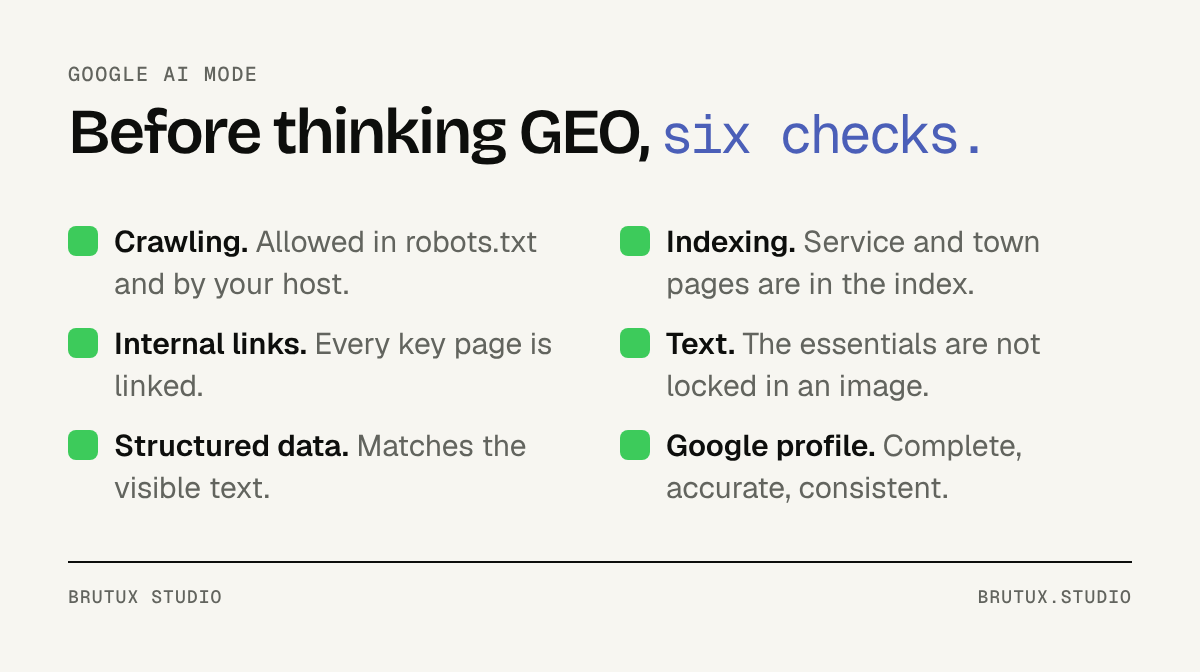 Six checks before thinking about GEO.
The technical basics in five checks
- Crawling is allowed, in the robots.txt file and in your host’s or CDN’s settings.
- Important pages are linked internally, so Google can find them.
- Essential content is in text, not only in an image or a PDF.
- Structured data matches the visible text on the page.
- The business profile is up to date, as Google reminds you in the same list.
Google adds that there is no need to create new machine-readable files or special markup. The time saved can go into the pages that are missing.
Verifying your site in Search Console remains the first step: that is where Google flags pages crawled but not indexed, and errors that prevent display.
The Search Console setting
Google has also added a control to Search Console. According to Google France’s post, it is available in France and lets site owners decide whether their site appears in Search’s generative AI features and helps ground their answers.
Google states, in its June 2026 announcement, that sites that opt out receive no traffic or impressions from these features, and that this choice is not used as a ranking signal for classic results.
For a small business looking for customers, the point is usually to be included. Simply check that this setting has not been switched off by mistake, by you or by a former provider.
How do you measure visibility in AI answers?
Measuring is harder than with a classic ranking, because a generated answer varies with the wording and the moment. Three sources complement one another.
The generative AI report
Google says appearances in AI Overviews and AI Mode are counted in Search Console’s Performance report, under the “Web” search type. They are therefore already mixed into your usual figures.
The guide also mentions a dedicated generative AI performance report. In its June 2026 announcement, Google describes a gradual rollout, starting with a subset of sites in the UK, with impressions and the pages that appear in answers.
If it is not yet available for your site, do not wait for it to act. The indexing and performance reports are enough to start.
Test your customers’ questions yourself
Keep a fixed list of about ten real customer questions. Once a month, ask them in AI Mode and note whether your business is cited, with which page and which information.
A single screenshot proves nothing, as the answer can change from one time to the next. It is repetition, with the same questions, that shows a trend.
Note the errors as well: old opening hours, a discontinued activity, a competitor cited instead of you. They show which source to correct, on your site or elsewhere.
Correct the source, not the answer: an assistant repeats what it reads. An outdated directory listing is corrected with the directory.
Track enquiries, not just views
Google states that clicks from results pages with an AI Overview are of higher quality, meaning visitors spend more time on the site. That is its observation, to be checked against your own figures.
The most reliable approach is still to count what matters to a small business: forms sent, calls, quote requests. Ask every new customer how they found you, too.
A simple column in your tracking file is enough: “Google”, “an AI”, “word of mouth”. After a few months, you will know where your enquiries really come from.
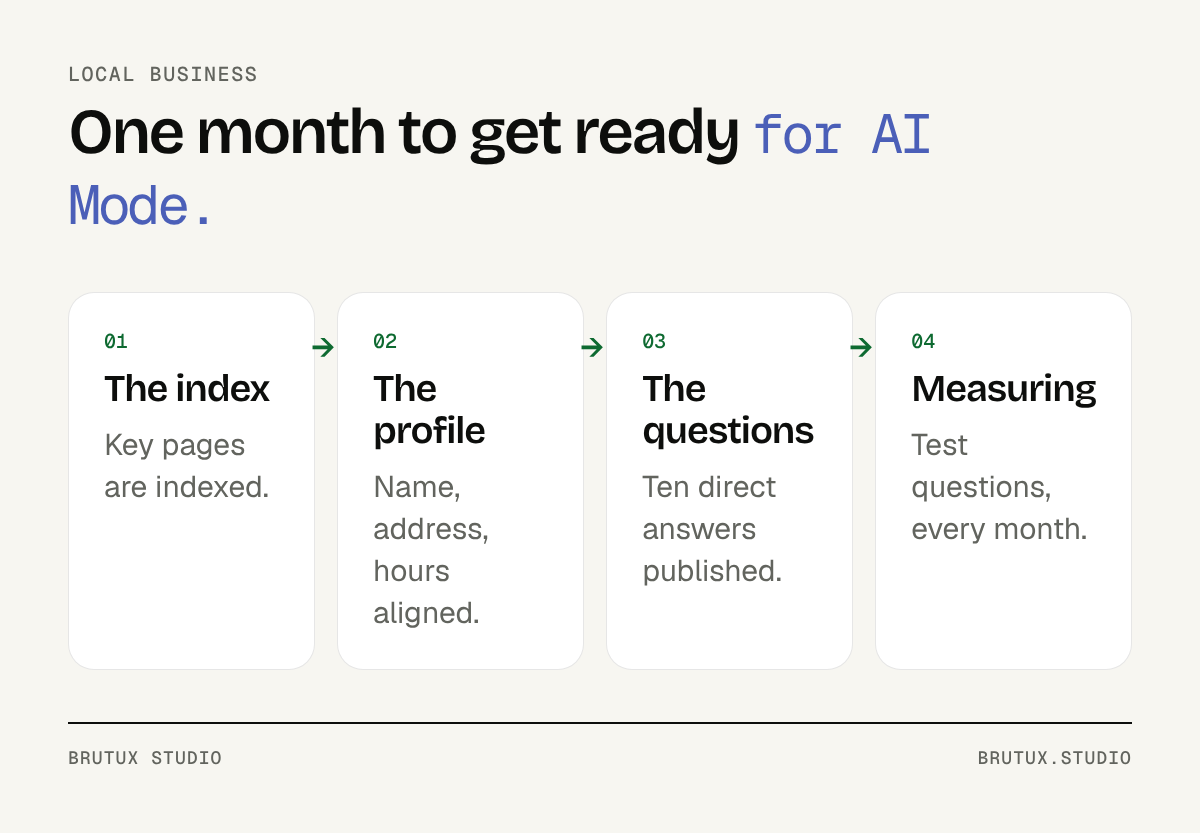 One month to reset the basics.
Where should you start this month?
There is no need to do everything at once. One month is enough to lay the foundations, at a few hours a week.
A four-week plan
- Week 1: the index. Check in Search Console that your service and town pages are indexed, and fix those that are not.
- Week 2: the profile. Complete your business profile and align name, address and hours everywhere.
- Week 3: the questions. Add direct answers to the ten most frequent questions, on the relevant pages.
- Week 4: measuring. Ask your test questions in AI Mode and note the starting point.
If your site is old or hard to change, the issue may not be AI but structure. Our article on redesigning a website without losing SEO explains how to rebuild without losing what works.
Brutux Studio applies these rules to every page it writes for its clients, from Thonon-les-Bains, as our web agency in Thonon-les-Bains page explains. The simplest step is to talk it through: in 30 minutes, we look together at what Google knows about your business.
Sources
- Google France, Lancement des Aperçus IA et du Mode IA dans la Recherche Google en France (22 July 2026)
- Google Search Central, AI features and your website
- Google Search Central, Optimizing your website for generative AI features on Google Search
- Google, New opportunities, control and insights for website owners (3 June 2026, updated 31 August 2026)
- Google Business Profile Help, Tips to improve your local ranking on Google