
The European Accessibility Act applies to your website if it lets consumers buy, book or subscribe online, and if your company is not a micro-enterprise providing services. Since 28 June 2025, these services must be usable by people with disabilities. A showcase site that presents your business without letting anyone conclude a contract is generally not covered by this law, even though accessibility remains good practice.
Many business owners have heard of this directive without knowing whether it affects them. Here is what the text says, the most common cases for a business website, the exemptions, the situation of a Swiss company, and a method to comply without rebuilding everything. For a specific case, have your analysis confirmed by a lawyer.
European Accessibility Act: what is it?
The European Accessibility Act is the common name of Directive (EU) 2019/882, adopted on 17 April 2019. It sets common accessibility requirements for a list of products and services sold in the European Union.
An EU directive, applied since June 2025
In France, the directive was transposed by the law of 9 March 2023. According to Entreprendre Service Public, the French government’s official information site for businesses, it has applied since 28 June 2025.
The same site states that an online procedure now lets people report a non-compliant product or claim an exemption. The procedure is run by the DGCCRF, the French consumer protection authority.
The law does not only cover websites. It also covers products: computers, smartphones, payment terminals, ticket machines, television equipment.
The products and services covered
On the services side, the list published by Entreprendre Service Public includes:
- telephony services and access to audiovisual media;
- certain elements of air, rail, road and sea transport, such as websites, apps and electronic tickets;
- consumer banking services;
- e-books;
- e-commerce.
For most small businesses, it is the last line that matters. An online shop, a paid booking module or a subscription taken out on the site can fall into this category.
The law does not stop at the payment page. It covers the service as a whole: finding the product, its page, the basket, identification and confirmation.
What “accessible” means
An accessible website can be used by a blind person with a screen reader, by someone who navigates only with a keyboard, by a partially sighted person who enlarges the text, or by someone who struggles with complex instructions.
The directive requires websites and apps to be perceivable, operable, understandable and robust. These are the four principles of the W3C’s WCAG guidelines, the international reference for web accessibility, organised into success criteria at levels A, AA and AAA.
These needs do not concern only a minority. A parent ordering with one hand, an older person enlarging the screen or a customer on a dimly lit train benefit from the same settings.
Does your website fall within the scope?
The right question is not “do I have a website?”, but “does my website let a consumer conclude a contract?”.
Online sales: the definition that matters
The directive defines e-commerce services as services provided at a distance, through websites and mobile services, by electronic means, at the individual request of a consumer, with a view to concluding a consumer contract.
Three elements must therefore come together: a consumer, a request made online, and a contract at the end. A basket, an online payment or a subscription almost always bring them together.
A website that sells only to businesses does not fit this definition, since it does not conclude consumer contracts. Still, check that consumers cannot order through the same journey.
Showcase site, B2B site, booking: common cases
Here is how the situations we see most often read, subject to a lawyer’s analysis:
| Your website | E-commerce within the meaning of the law? |
|---|---|
| Showcase site with a contact form | Generally not: no contract is concluded online |
| Online shop for consumers | Yes, unless a micro-enterprise providing services |
| Booking paid online | Very likely yes |
| Free appointment booking | To be examined depending on what is committed online |
| B2B site with quotes, no online sales | Generally not |
Our article on choosing between a showcase site and a B2B site helps place your project. A site that moves towards online sales changes category: better to know before launching the module.
Large companies should also take note: in France, the website accessibility obligation has existed for longer for public bodies and for companies whose turnover in France exceeds €250 million. According to the official RGAA page, that obligation covers all their websites, whether they sell online or not.
Exemptions: micro-enterprises, disproportionate burden
The directive exempts micro-enterprises providing services. Entreprendre Service Public gives the threshold: fewer than 10 employees, with annual turnover or a balance sheet total below €2 million.
Two other exemptions exist, according to the same source: when compliance would fundamentally alter the product or service, and when it would impose an excessive organisational or financial burden on the company.
The latter two cannot simply be claimed: they must be justified and declared, through the online procedure mentioned above. They are also reassessed over time.
A company that grows beyond the micro-enterprise thresholds leaves the exemption. Better to plan for it in the site’s next evolution than to discover it during an inspection.
Finally, the law excludes certain content from its requirements: videos and office files published before 28 June 2025, third-party content you do not control, and archives that are no longer updated.
What if your company is in Switzerland?
Switzerland does not apply the directive. But many companies in Geneva or Lausanne sell online to French customers.
Selling to consumers in the Union
The directive covers services provided to consumers in the Union. A Swiss shop that delivers to France, accepts orders from French consumers and addresses them may therefore be covered.
The simplest approach is often to design a single accessible checkout for all customers. Maintaining two versions of a checkout costs more than making one accessible.
On this point, our web agency in Geneva page explains how we work for companies serving customers on both sides of the border.
What is being prepared in Switzerland
In Switzerland, the Disability Discrimination Act is being revised. According to a fact sheet from the Federal Bureau for the Equality of People with Disabilities dated 24 March 2026, the bill aims to better protect people with disabilities in access to private-sector services.
The same fact sheet states that private actors would be required to make reasonable and appropriate adjustments, and that the planned measures will open services, digital ones included, to a wider clientele. The bill is still before Parliament.
So nothing yet requires a Swiss small business to make its website accessible under this law. But a redesign launched today will serve for several years: you may as well design it to be accessible.
And an accessible website is easier to use for all your customers, in Switzerland as elsewhere: readable text, clear buttons, forms that say what they expect.
What does the law actually require?
The obligations come down to three parts: an accessible service, information about that accessibility, and follow-up over time.
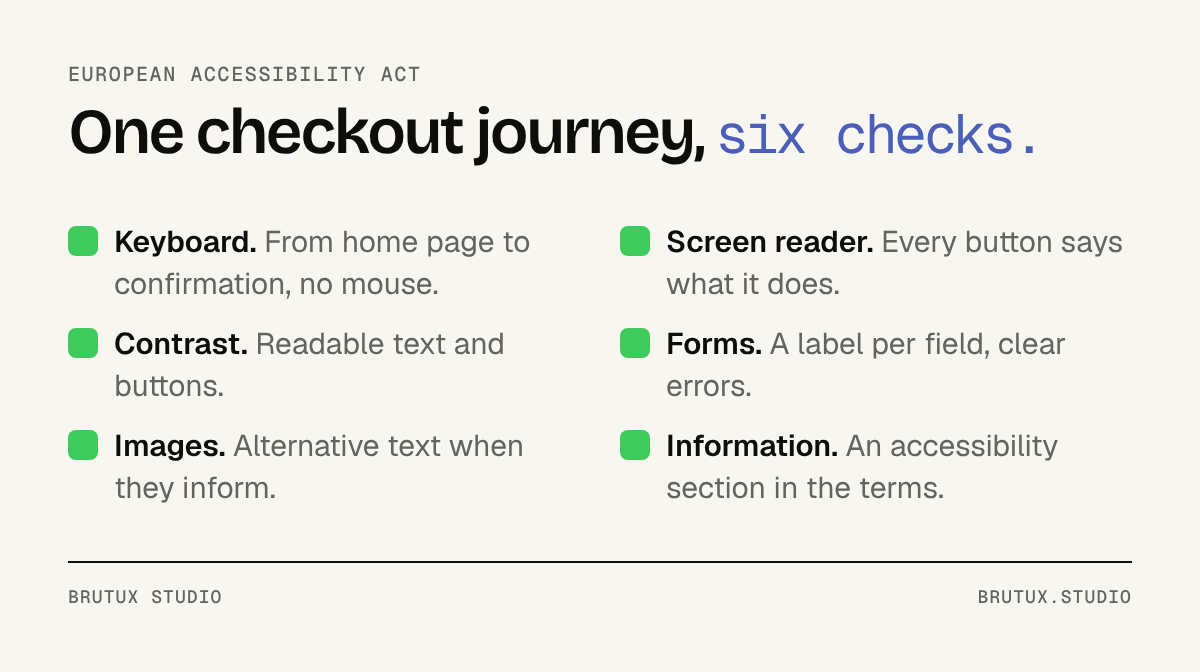 Six points to check on a checkout journey, before anything else.
A perceivable, operable, understandable, robust website
In practice, this means very concrete points: sufficient contrast, images described by alternative text, structured headings, forms where every field has a label, and a complete journey possible by keyboard.
The checkout journey deserves particular attention: search, product page, basket, identification, payment. A payment button that cannot be reached by keyboard blocks the whole order, even if the rest of the site is perfect.
In France, the public reference framework, the RGAA, has 106 test criteria. Websites subject to it are deemed compliant if they meet the European standard EN 301 549, and the companies concerned may also refer to WCAG 2.1, levels A and AA. It is a good working basis, even for a company not formally subject to it.
Accessibility information in your terms and conditions
The directive requires service providers to explain how their service meets the accessibility requirements. Its Annex V specifies that this information goes in the general terms and conditions, or an equivalent document.
It includes a general description of the service in an accessible format, the explanations needed to understand how it works, and how the requirements are met. This information must remain available for as long as the service operates.
In practice, a clear section in your terms of sale, or a dedicated page linked from the footer, does the job. It must be honest: what works, what is being fixed, how to report a problem.
Keeping compliance over time
The law also requires procedures so that the service stays compliant as it evolves. In case of non-compliance, the provider must correct it and inform the competent authorities.
A new payment module, an updated theme or an added plugin can break accessibility without anyone noticing. The check is therefore part of every release, just like testing the payment.
Appoint a person responsible for this check, with a short checklist. Without someone in charge, the check disappears at the first rushed update.
How do you bring a website into line without rebuilding it?
Making a website accessible does not necessarily mean rebuilding it. It all depends on its state and its technology.
The checks to do first
Start with the journey that earns money: from the home page to the order confirmation. Do it with the keyboard only, then with your phone’s screen reader, and note every blocker.
Then check the contrast of text and buttons, form field labels and error messages. An error message that names neither the field nor the fix is a frequent blocker, for everyone.
These checks do not replace a full audit, but they reveal most blockers in a few hours. They also tell you whether a fix is enough or whether the technical base is the problem.
Automated testing tools help spot some errors, such as insufficient contrast or an image without alternative text. They do not replace a real trial: a journey can pass every test and still be impossible to complete by keyboard.
A redesign, the right moment
When a site is old, built on a heavy theme or patched over the years, fixing accessibility page by page often costs more than planning it into a redesign. Handled from the wireframes, it is solved in the structure instead of being bolted on at the end.
A redesign also carries a risk for search rankings: our checklist for redesigning without losing SEO details the precautions to take. Accessibility and SEO often go together: structured headings, alternative text, readable content.
On a checkout journey, every step counts. Victor Michel, the studio’s founder, reworked the purchase funnel of LinsenMax, a Swiss online contact lens shop, from the home page to the order, treating mobile as a journey in its own right. It is on this kind of journey that accessibility is won or lost.
In every UX audit, we check the basics of accessibility. For a formal conformity statement, a specialist auditor remains the right contact, and we then fix the screens concerned.
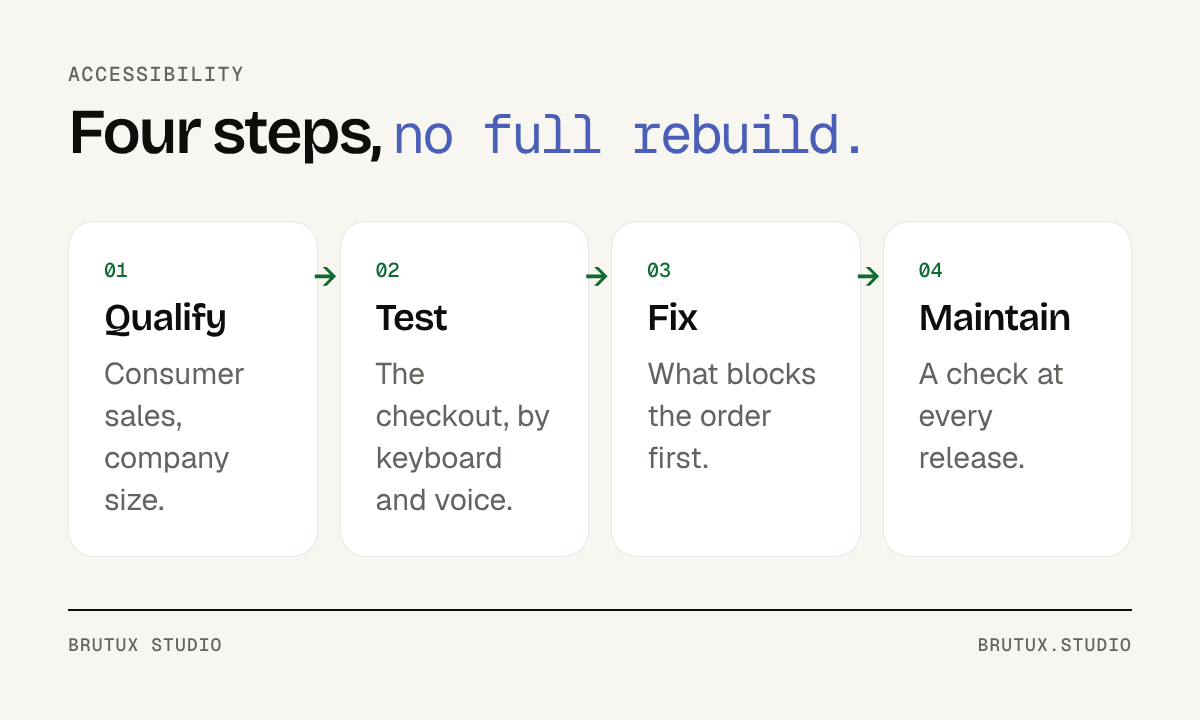 Four steps, from qualification to ongoing checks.
Where should you start?
One week is enough to know where you stand, without committing any budget.
The aim is not to reach perfection in a day, but to know precisely what blocks, what it costs to fix, and in what order.
One week to know where you stand
- Qualify your website: online sales or bookings to consumers, or not? Micro-enterprise providing services, or not?
- Test the main journey by keyboard and with a screen reader, on desktop and mobile.
- List the blockers by severity: those that prevent ordering first, comfort issues next.
- Decide: targeted fixes on the current site, or accessibility built into a redesign. Then write the information to place in your terms and conditions.
If your website is covered and the technical base cannot keep up, a redesign becomes the simplest project. The quickest step is to talk it through: in 30 minutes, we look at your checkout journey together.
Sources
- European Union, Directive (EU) 2019/882 on the accessibility requirements for products and services (17 April 2019)
- Entreprendre Service Public, Directive « Accessibilité » : possibilité de demander une exemption en ligne (27 November 2025)
- DINUM, RGAA : rappel du champ d’application
- W3C, WCAG 2 Overview
- Swiss Federal Bureau for the Equality of People with Disabilities, Politique du handicap : vue d’ensemble des projets de loi actuels (24 March 2026)