
On AI Act chatbot rules, the principle has been simple since 2 August 2026: a person talking to an assistant must know they are dealing with an AI, at the latest at the first exchange, unless it is obvious. The obligation falls first on whoever designs the system, but the business that shows it on its website has every reason to check it. It is mostly settled in the interface: a clear, visible, accessible message.
Many businesses have added an assistant to their website or product, sometimes in a few hours, using a vendor’s tool. Here is what the text says, who must do what, how to show it in practice, and what applies to a Swiss company. This article offers design guidance, not legal advice: for a specific case, have your analysis reviewed by a lawyer.
What does Article 50 of the AI Act say?
The European regulation on artificial intelligence, known as the AI Act, devotes its Article 50 to the transparency obligations of certain AI systems. The text of Article 50 is available on the European Commission’s service desk.
Four obligations, two actors
The article distinguishes two actors. The provider develops the system, or has it developed, and places it on the market or puts it into service under its own name. The deployer uses that system under its own authority, in a professional context.
The text covers four cases:
- Systems that interact with people: the provider designs them so users know they are talking to an AI.
- Generated content: the provider marks text, images, audio and video in a machine-readable way.
- Emotion recognition and biometric categorisation: the deployer informs the people exposed.
- Deepfakes and certain published texts: the deployer discloses that they were generated or manipulated by AI.
For a business website with a chat assistant, the first case matters most. The others mainly concern those who publish realistic images or informational texts.
Software vendors are often in both roles at once: providers of the assistant built into their product, deployers of the AI tools they use for their own communication.
Since 2 August 2026, with no postponement
According to the Commission’s AI Act page, the regulation has applied since 2 August 2026, with exceptions. The AI Omnibus, in force since 27 July 2026, moved the rules for high-risk systems to 2 December 2027 and 2 August 2028.
Article 50 transparency is not among those postponements. The Commission’s guidelines on transparency, published on 20 July 2026, state that Article 50 applies from 2 August 2026.
We set out this timeline in our article on AI in a B2B SaaS. Here, we focus on what transparency changes on screen.
What Article 50 does not require
Article 50 bans no assistant and requires no prior authorisation. Nor does it require explaining how the model works to every user.
Emotion recognition and biometric categorisation follow their own, stricter rules. If your project comes close to them, the legal analysis comes before any design work.
It does not replace other rules. The text states that it applies without prejudice to other transparency obligations under Union or national law. If your assistant processes personal data, the GDPR still applies in full.
In other words, Article 50 is a floor. An assistant can comply with it and still raise other problems: data sent without sorting, inaccurate answers, commercial promises made in the company’s name.
AI Act chatbot obligations: who must inform the user?
The first question is the role. It decides what you must do yourself, and what you must check with a vendor.
Provider or deployer: the role decides
The Commission’s FAQ on Article 50 recalls the definition: a provider is whoever develops an AI system, or has it developed, and places it on the market or puts it into service under its own name or trademark.
If you had an assistant designed that you put into service under your name, you are therefore probably the provider, and the obligation to inform is yours. If you display a vendor’s tool, the vendor is in principle the provider.
In that second case, do not stop there. Check in the interface that the information actually appears, and ask the vendor how it applies Article 50. If you heavily modify the tool or present it under your brand, have a lawyer settle your role.
Keep a record of this analysis: who is the provider, on what basis, and what the vendor told you. It is the first document you will be asked for if questions arise.
The four criteria of an interactive system
According to the same FAQ, the guidelines set four cumulative criteria for the obligation to inform to apply:
- the system qualifies as an AI system;
- it is designed for a genuine two-way exchange, not merely to collect data or send automated responses;
- the interaction is direct: the AI itself communicates with the person, with no human intermediary;
- the interaction is with natural persons, whether customers, professionals or other users.
An assistant answering visitors’ questions ticks all four boxes. An AI sorting emails in the background, with no direct contact with people, falls outside this obligation, according to the Commission.
In between, each case needs a look. An AI that drafts a reply which a colleague then reviews and sends does not speak to the customer directly: the human intermediary changes the analysis.
The “it’s obvious” exception, to be handled with care
Article 50 waives the duty to inform when the interaction with an AI is obvious to a reasonably well-informed, observant and circumspect person, taking into account the circumstances and context.
The Commission asks for this exception to be interpreted restrictively, because it deprives people of information. An assistant presented with a first name and a photo is anything but obvious.
In practice, the exception costs more than it saves. A greeting line is enough to remove any doubt, and it builds trust rather than weakening it.
Context also changes with time and audience. What seems obvious to a seasoned user is not obvious to an older or hurried customer discovering your site on their phone.
How do you inform clearly, from the first exchange?
The text sets two requirements of form: the information is given in a clear and distinguishable manner, at the latest at the first interaction, and it meets the applicable accessibility requirements.
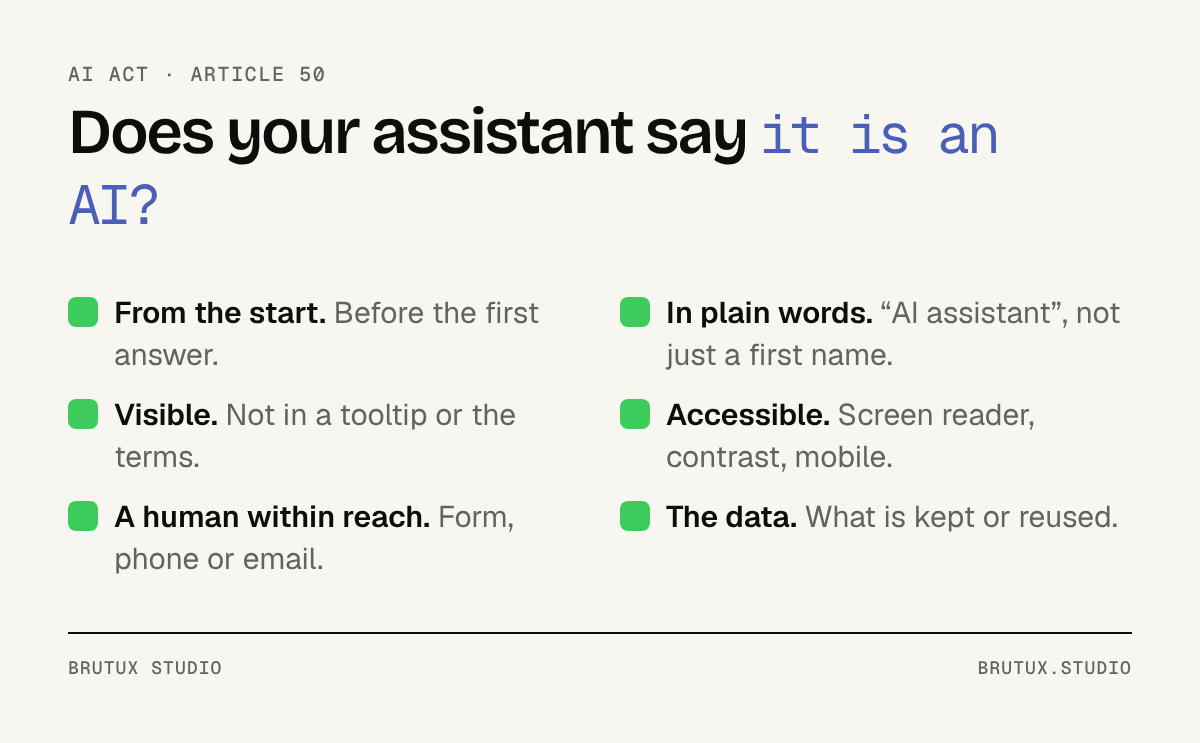 Six points to check on an assistant, before anything else.
The greeting and the assistant’s name
The simplest approach is to say it from the start: “I am an automated assistant, an AI. I can make mistakes.” One short sentence, above the input field or at the top of the conversation.
The name matters too. A human first name, a photo and a very familiar tone create exactly the ambiguity the text aims to avoid. If you want a first name, pair it with an explicit label such as “AI assistant”.
Think of the other entry points: a voice assistant on the phone, a widget on a help page, a reply sent by email. The information must follow the person wherever the AI speaks to them directly.
Visible and accessible information
The information must be readable by everyone. Light grey text, a hover tooltip or a mention buried in the terms and conditions do not match the idea of “clear and distinguishable”.
Accessibility comes into play: the message must be read by a screen reader, have sufficient contrast and stay visible on mobile. For a voice assistant, the announcement is spoken, at the start of the call.
Test it like a real journey. Open the assistant on a phone, with a screen reader, and check that the information arrives before the first answer.
Repeat this test after every update to the tool or the website. A new theme or a new widget version can make the message disappear without anyone noticing.
Handing over to a human
The AI Act does not require it for a website assistant, but it is good design practice: offer a simple way to reach a person. A link to a form, a phone number, an address.
It is also a safeguard. An unhappy customer who only finds an AI in front of them will tell others; a customer who can reach someone keeps their trust.
Finally, say what happens to the conversations: retention, reuse, transfer to the model provider. These questions fall under the GDPR and, in Switzerland, the data protection act. Our article on AI and data privacy details the design choices to make.
What about generated text, images and voices?
Article 50 does not only target assistants. It also covers what AI produces and you publish.
Articles reviewed by a person
The deployer must disclose AI-generated text when it is published to inform the public on matters of public interest. The FAQ cites, among others, politics, public health, the environment, consumer safety or economic developments that may be the subject of public debate.
The obligation falls away if the text has undergone human review or editorial control, and a person holds responsibility for it. The Commission specifies that mere spelling or grammar correction does not count: a genuine review of the substance is needed.
For a business, the rule of conduct is simple: a competent person reviews and takes responsibility for every published text. That is how Hanny works, the studio’s product that prepares social media posts: nothing goes out without the person’s approval.
Realistic images and videos
Deepfakes, meaning generated images, audio or video that resemble real people, places or events and could pass as authentic, must be disclosed by the deployer. The FAQ specifies that the technical marking added by the provider is not enough: a visible or audible label is needed.
A product photo retouched in the usual way is not affected in the same way as a fake video testimonial. But if a generated image shows a job site, a team or a customer that does not exist, say so, or better, use real photos.
Your company is in Switzerland: are you concerned?
Switzerland is not part of the European Union. Yet many companies in Geneva or Lausanne serve French or European customers.
The AI Act applies once the output is used in the EU
The Commission’s FAQ says so: providers established outside the Union are also subject to the AI Act when the output of their AI system is used in the Union.
A Geneva software vendor whose assistant answers customers in France should therefore pay attention. The simplest approach is often to design a single interface that meets both frameworks.
A company in the Chablais serving customers on both sides of the border is in the same situation, the other way round. A single rule, applied everywhere, is better.
Swiss data protection law
In Switzerland, the Federal Data Protection and Information Commissioner points out that current data protection law applies directly to AI.
The Commissioner states that a user interacting with a language model has the right to know whether they are talking or writing to a machine, and whether the data they enter is reused, for example to improve the system. The expectation is therefore close to Article 50’s, with an emphasis on data.
For companies in French-speaking Switzerland, we run this work on site or remotely, as our AI consultant in Geneva page explains.
Where should you start?
There is no need to launch a major compliance project. One hour is enough to know where you stand.
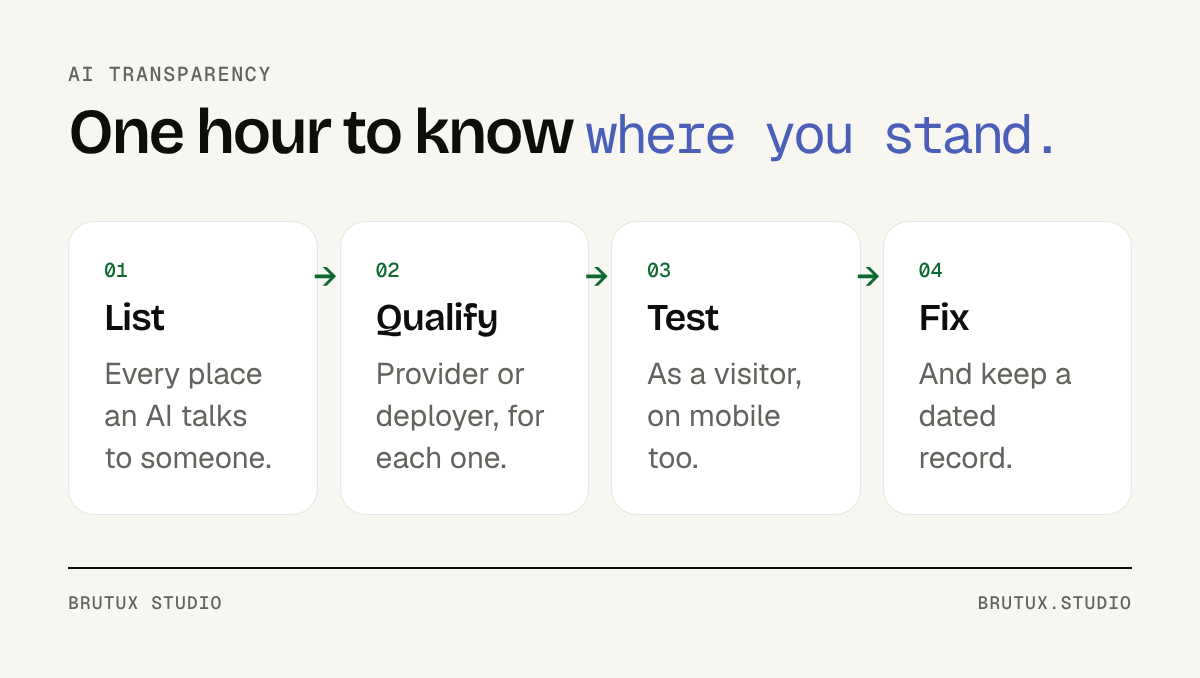 Four steps, from inventory to verification.
Inventory your AI features in one hour
- List every place where an AI speaks directly to someone: website assistant, in-product chat, automated replies, phone.
- Clarify your role for each: a vendor’s tool displayed as is, or an assistant designed for you and put into service under your name.
- Open each assistant as a visitor, on desktop and on mobile, and note whether the information arrives before the first answer.
- Fix and document: greeting, label, access to a human, information on data. Keep a dated record of what you did.
Then have the whole reviewed by a lawyer if your role is unclear or your assistant touches on sensitive topics. Interface fixes, for their part, often take a day.
Brutux Studio designs AI features that say what they are, suggest rather than act alone, and leave the decision to a person. The simplest step is to talk it through: in 30 minutes, we look at your assistant together.
Sources
- AI Act Service Desk (European Commission), Article 50: Transparency obligations for providers and deployers of certain AI systems
- European Commission, Transparency obligations under Article 50 of the AI Act (FAQ)
- European Commission, Guidelines on transparency obligations for providers and deployers of certain AI systems (20 July 2026)
- European Commission, AI Act, Regulatory framework on AI (application timeline and AI Omnibus)
- Swiss Federal Data Protection and Information Commissioner, La loi actuelle sur la protection des données est directement applicable à l’IA