
Local SEO in the Chablais rests on three levers, in this order: an accurate and complete Google Business Profile, regular and genuine customer reviews, then website pages that prove you actually work in each town you serve. You cannot change your distance from the customer; everything else can be worked on, without an advertising budget.
You might be a plumber in Thonon, a chalet owner in Morzine, a practice in Évian or a building firm in the Bas-Chablais. When a customer searches for "electrician near me", Google shows a handful of businesses on a map.
This article explains what decides which ones appear. It also lists what you can fix yourself this week.
Local SEO in the Chablais: what does Google look at?
Google does not publish its formula, but it does give the broad outline. Knowing it saves you spending energy where it makes no difference.
Three criteria, and only one is out of your hands
According to Google's official help, local results are based mainly on relevance, distance and prominence. Relevance measures how well your profile matches the search. Distance is calculated from the location of the person searching.
Prominence is the broadest criterion. Google says it draws on what it knows about you from across the web: links, articles, directories. Your number of reviews and their rating are part of it.
The same page states that there is no way to pay for a better local ranking. Be wary of any offer that promises otherwise.
We covered these basics in our guide to building a website in Thonon. Here we go further: profile rules, reviews within the law, and town pages without the risk.
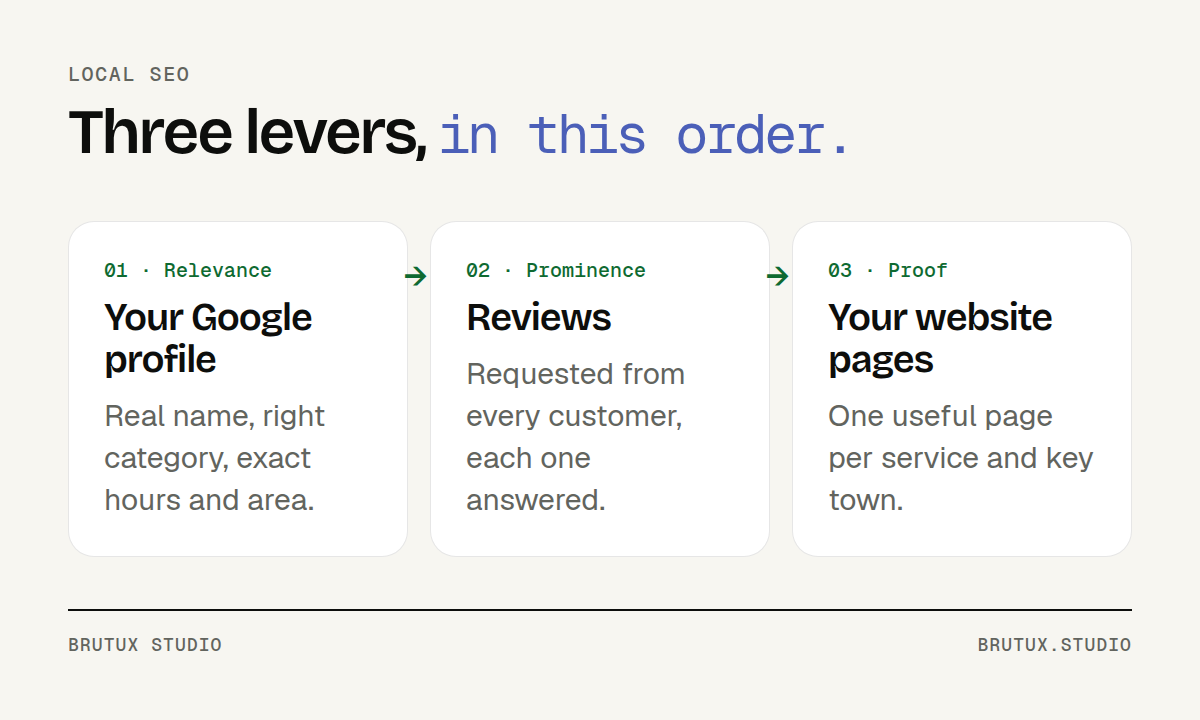 The three levers of local SEO, in the order to tackle them.
The Chablais: one word, two countries
"Chablais" on its own is not enough of a target. The Historical Dictionary of Switzerland notes that Bern conquered part of the Chablais in 1475, and that part has remained Swiss. So the name also refers to a Swiss region at the eastern end of Lake Geneva.
More importantly, your customers rarely type "Chablais". They search for a town ("physio Thonon", "carpenter Bons-en-Chablais"), a known place ("restaurant port de Rives") or nothing at all, adding "near me".
"Chablais" is useful for trades that cover the whole area, such as a joiner or a roofer. For everything else, think in towns.
The area also mixes very different realities: lakeside towns, the Abondance and Aulps valleys, the Portes du Soleil resorts. A host in Châtel and an accountant in Thonon have neither the same customers, nor the same seasons, nor the same searches to target.
The same need is also phrased differently depending on where people are. Someone types "ski hire Morzine" on the spot, and "plumber Évian" from their living room.
How do you make your Google profile flawless?
Your Google Business Profile is often the first thing a customer sees of you. It is also the quickest thing to fix. Three points make the difference.
Your real name, and nothing more
Google's rules are clear: the profile name must reflect your business's real-world name, as used on your shopfront, website and stationery. Other details, such as address, service area or category, go in their own fields.
Adding "Plumber Thonon Évian 24/7 emergency" to the profile name is tempting. It breaks these rules, and your customer is looking for a name they recognise anyway. If your trading name genuinely includes a place name, that is different: keep it as it is, on the profile and on the shopfront.
Categories, hours and services: relevance
The primary category is a decisive setting: it tells Google what your trade is. Choose the most precise one for your main activity, then a few secondary categories you genuinely practise. A category that is too broad puts you up against everyone.
Opening hours are the weak spot of many Chablais profiles. In the resorts, activity changes between winter and summer; by the lake, shops adjust their hours to the season.
Update your hours with every change, and add special hours for public holidays. A customer who finds the door closed will not leave a good review.
Then complete the list of services, a description in plain sentences and recent photos: your work, your team, your premises, your van. A detailed profile helps Google match you with the right searches.
Post an update or a seasonal offer on the profile from time to time. It shows customers that the business is active.
Visible address or service area?
If customers come to you, show your address. If you travel to them, like most tradespeople, you can hide your address and set a service area.
Google lets you list up to 20 service areas, as towns or postcodes, and recommends that the whole area should not extend beyond about two hours' drive from your base. It also states that a service area cannot be set as a radius around the business. So list the towns where you really work: Thonon, Évian, Sciez, Douvaine, or the valley villages you serve. An inflated area muddies your profile, and distance remains a criterion anyway.
One last point: your name, address and phone number must be identical on the profile, on your website and in directories. An old number left in one directory is enough to sow doubt.
How do you get regular reviews without cutting corners?
Reviews count twice: for Google, which factors them into prominence, and for the customer choosing between two tradespeople. What matters is a steady flow of recent reviews, not a sudden spike.
Ask at the right moment, with the right link
Most happy customers do not leave a review because nobody asked them. Google provides a link and a QR code for requesting reviews, to include in a thank-you email or on a receipt. The same help page reminds you that offering anything in exchange for a review is prohibited.
The right moment is just after the job, when the result is visible: the work finished, the session over, the stay ended. Four habits are enough.
- a template message ready to send, with the direct link, in one sentence;
- the QR code printed on the invoice, the counter or the chalet welcome booklet;
- a request to every customer, not only the ones you are sure of;
- no discount or gift in return, however small.
Asking everyone is also more honest. A profile with nothing but perfect scores can inspire less trust than one with a few well-handled criticisms.
Finally, think about your team. The technician who finishes the job is often best placed to ask for the review, as long as the link is to hand.
Reply to every review, especially the critical ones
Your reply is public and read by every future customer. Google recommends short, polite replies and points out that a negative review is not necessarily a sign of bad business practice. The reviewer is notified when you reply.
Faced with criticism, say thank you, acknowledge the specific point, explain what you did or offer to discuss it by phone. Do not mention personal data and do not argue. A future customer judges your reply as much as the complaint.
For a host or ski school with international guests, reply in the language of the review when you can. Travellers notice that kind of attention.
What French law prohibits
The DGCCRF, the French consumer protection authority, describes the practices it finds: fake positive reviews posted by the business itself or by paid people, fake negative reviews from competitors, and negative reviews deleted or held back. These are misleading commercial practices.
One point applies directly to your website: if you display reviews there, you become a review manager. You must then state whether those reviews go through a verification procedure. The simplest option is to link to your Google profile, or explain in one sentence how the displayed reviews are collected.
These rules also protect your business: fake negative reviews from a competitor fall under the same ban. Keep a record of every job so you can show it.
Do you need a page for each town on your website?
Yes, if you genuinely work in several towns and have something specific to say about each. No, if the page only exists to place a town name. The line between the two is precise.
Useful page or doorway page?
Google classes as spam pages targeting specific regions or cities that funnel users to one destination, with very similar content from one page to the next. These are known as doorway pages. Ten identical pages for Thonon, Évian, Publier and Allinges are the textbook example.
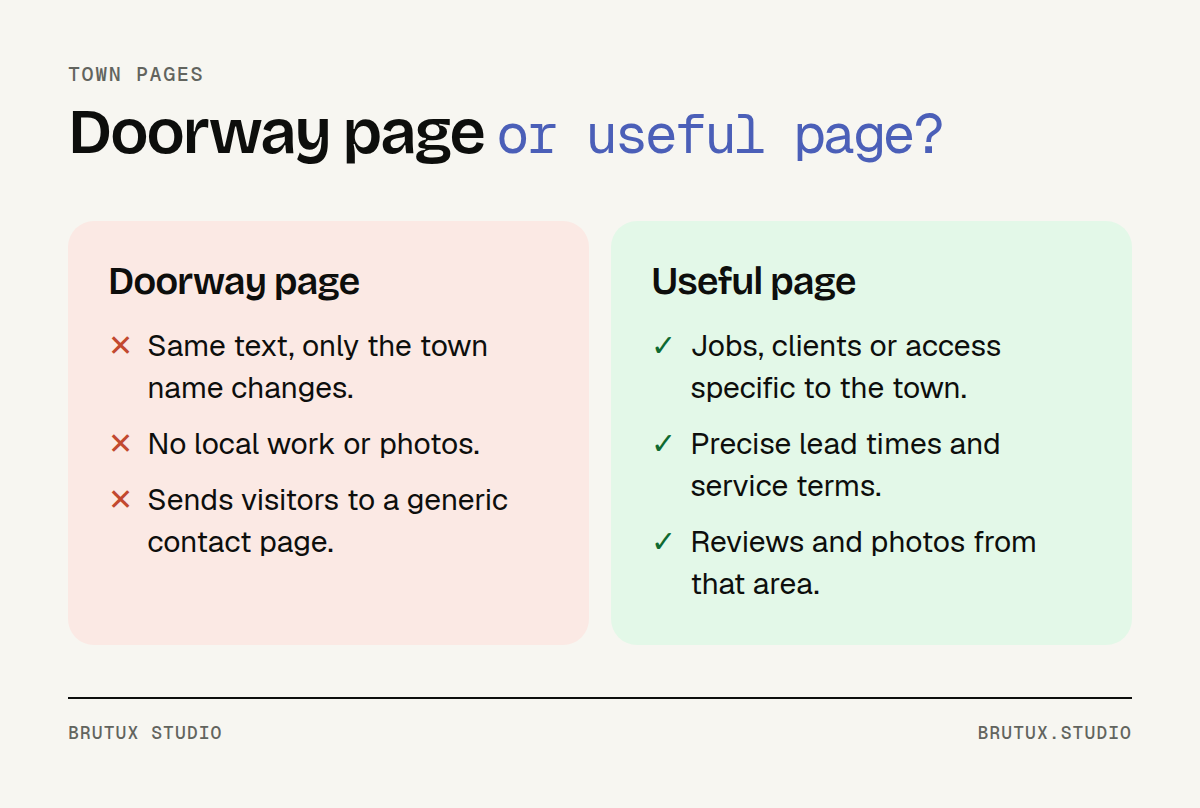 The difference is not the number of pages, but what each one tells the visitor.
A useful page answers the questions of a customer in that town: do you come to me, how quickly, have you worked here before? If you have nothing specific to say about a town, group it with its neighbours on an area page.
So the number of pages is not a goal in itself. Three rich pages are worth more than thirty empty variations.
What a town page should contain
For each town or area you choose, gather material that only you can provide. A competitor cannot copy it.
- local work, with photos, type of job and neighbourhood, without personal data;
- your service terms: usual lead times, travel, seasonal access;
- reviews from customers in the area, quoted with their consent or linked to your profile;
- practical information: route from your base, parking, opening hours;
- a clear call to action: phone, quote form or booking.
To choose the towns, start from your real customers rather than the map. A Thonon tradesperson often starts with Thonon, Évian and the Bas-Chablais; a host, with their resort and valley. Our page on our web agency in the Chablais shows how these realities shape a site's structure, from the lake to the resorts.
Think about the other side of the border too. If you work for clients in Geneva or Vaud, say so on a dedicated page, with your precise terms. A vague line in the footer does not answer a Swiss customer's question.
These pages sit under a "Service areas" section and link to your services. They are built naturally as part of a showcase website designed for local search.
How do you know whether your efforts are paying off?
Local SEO is judged by real enquiries, not by a position checked one day from your office. Results change from one street to the next because distance counts: a screenshot taken in Thonon says nothing about what a customer in Morzine sees.
The indicators that matter
Your Google profile shows its own performance statistics: searches that displayed it, calls, direction requests, clicks to your website. Google Search Console, which is free, shows the queries that bring visits to your town pages.
Add what only you can count: quote requests received, and the question "how did you hear about us?" asked of every new customer. It is often the most telling indicator for a small business.
- Profile: calls, directions and clicks to the website.
- Reviews: number of reviews received in the month and average reply time.
- Website: clicks from Google to your town pages and forms sent.
Compare each month with the same month the previous year. In the Chablais, February in a ski resort cannot be compared with May.
A one-hour monthly routine
One hour a month is enough to stay on course. Reread your profile (hours, photos, contact details), reply to pending reviews and look at the month's figures. Then note down a single action for the following month.
Before each season, do a fuller review. In the resorts, the profile and home page should switch to the winter or summer offer before the first customers arrive, not during.
Where should you start this week?
The most useful thing is to fix the costly mistakes before adding anything. Most can be sorted in a few hours.
The most common mistakes
- Two profiles for the same business, often after a move: merge them or remove the older one.
- A profile created by a former provider in their name: reclaim it, you should be its primary owner.
- Keywords in the profile name, against Google's rules.
- Winter hours showing in midsummer, or the reverse.
- Reviews left unanswered for months, criticism included.
- Copy-and-paste town pages that say nothing about each town.
These mistakes are easy to spot, but rarely on your own profile. An outside, methodical review saves time.
One month to get the basics right
Here is a realistic order of work for a business starting from an existing but neglected profile. Each week covers one lever, and the last one sets up measurement.
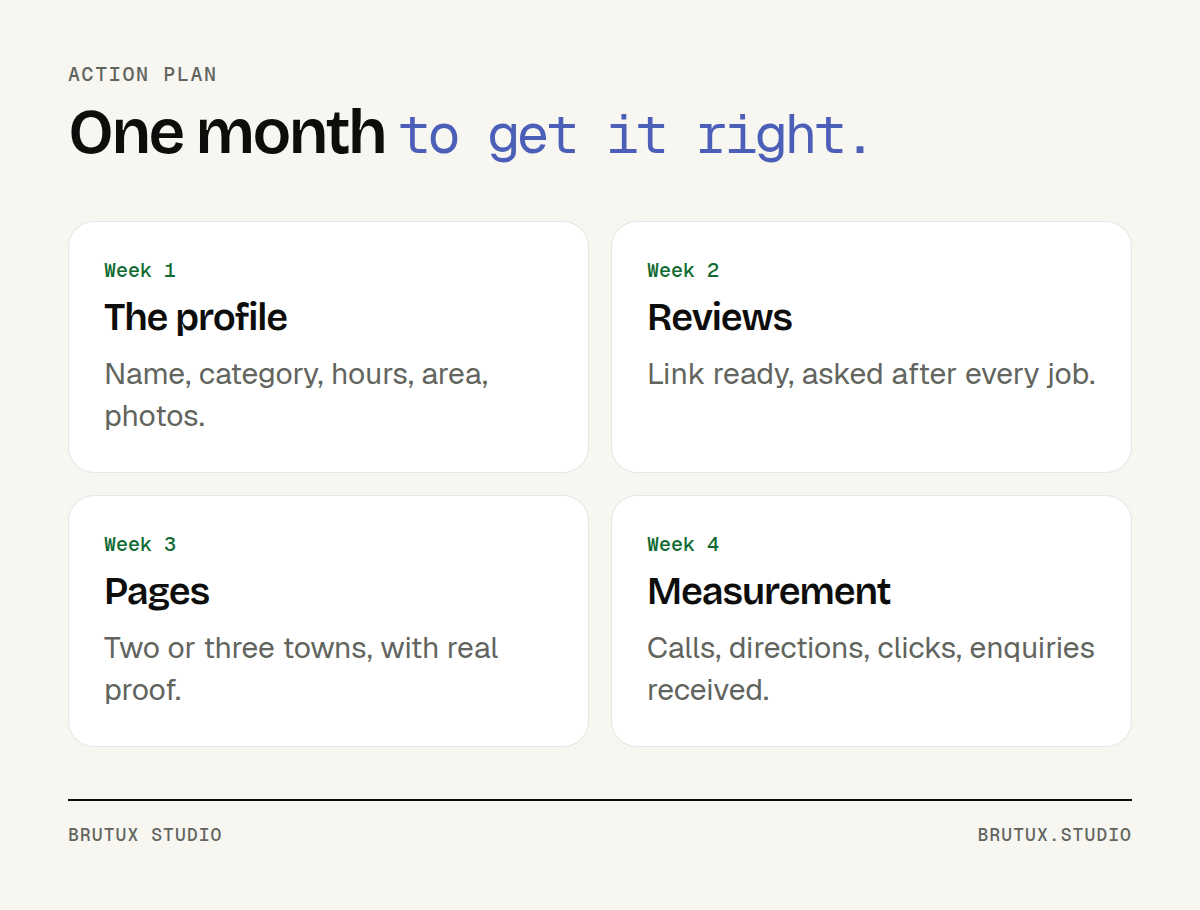 One lever per week, then a monthly routine.
The studio's own website, based in Thonon-les-Bains, follows the same principle: each town page describes local realities rather than a recycled text. Our web agency in Thonon-les-Bains page is an example you can compare with your own site.
Nobody can guarantee you first place on Google, so be wary of anyone who promises it. On the other hand, an accurate profile, regular reviews and a few useful pages give a Chablais business solid foundations that many competitors neglect. For a diagnosis of your situation, explore our SEO and local search service, or book a call.
Sources
- Google, How to improve your local ranking on Google: relevance, distance, prominence; reviews; no way to pay for a better ranking.
- Google, Guidelines for representing your business on Google: real-world business name, details in dedicated fields.
- Google, Service areas for service-area and hybrid businesses: up to 20 areas, about two hours' drive, no radius.
- Google, Link and QR code to request reviews: sharing the link, incentives prohibited.
- Google, Manage customer reviews: short, polite replies, negative reviews.
- Google Search Central, Spam policies for Google web search: doorway pages targeting cities.
- DGCCRF, Avis en ligne : attention aux faux commentaires (in French): fake reviews, review managers.
- Historical Dictionary of Switzerland, Chablais (in French): part of the Chablais conquered by Bern in 1475.