
Website design in Thonon follows four steps: scoping the project, designing the structure, building the site with its content, then launching it and following up. Allow 10 to 15 days for a showcase site and 3 to 6 weeks for a B2B site, provided the content arrives on time.
You run a shop in the town centre, a professional practice, a construction business or an SME in the Chablais. Your customers recommend you, but it is often online that a new customer discovers you or checks that you are reliable. Here is what you need to judge a website project, your own or a provider's, before you commit.
How does website design in Thonon work?
A serious project always follows the same order: you only move on to the next step once the previous one has been approved. That is what stops you redesigning the home page three times.
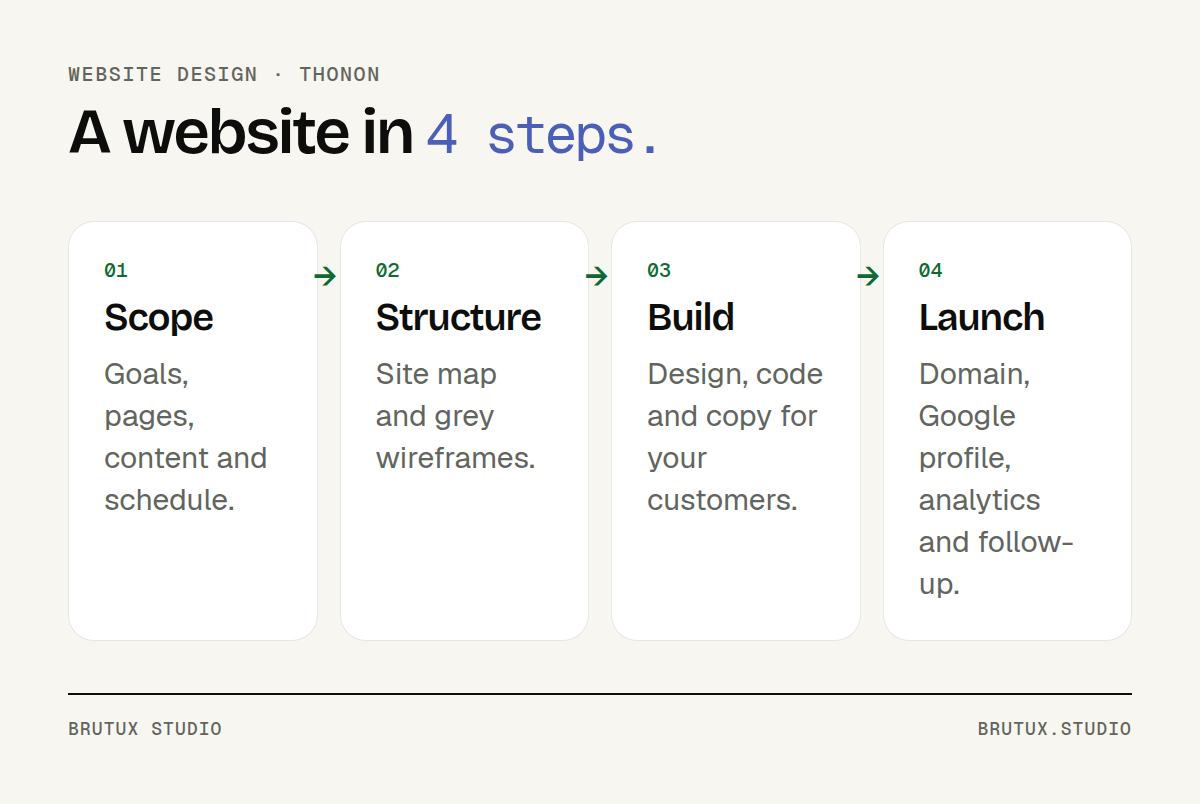 The four steps of a website project, in the order in which they are approved.
Step 1: scope the project
Everything starts with a conversation, not an automated quote. It is there to understand your business, your customers and your area. Above all, it sets out what the site should get visitors to do: call, request a quote, book or make an appointment.
It is also the time to take stock: an old website, a Google profile, a domain name, and reusable photos and copy all change the scope and the timeline.
With us, this first conversation lasts 30 minutes, in Thonon or by video call. It is followed by a detailed, costed proposal, with no obligation. What scoping should produce:
- One main goal per type of visitor, stated in a single sentence.
- The list of pages, even a provisional one, and the geographical area to cover.
- A content inventory: what exists, what is missing, who writes it.
- A schedule with the review dates on your side.
Step 2: the structure and wireframes
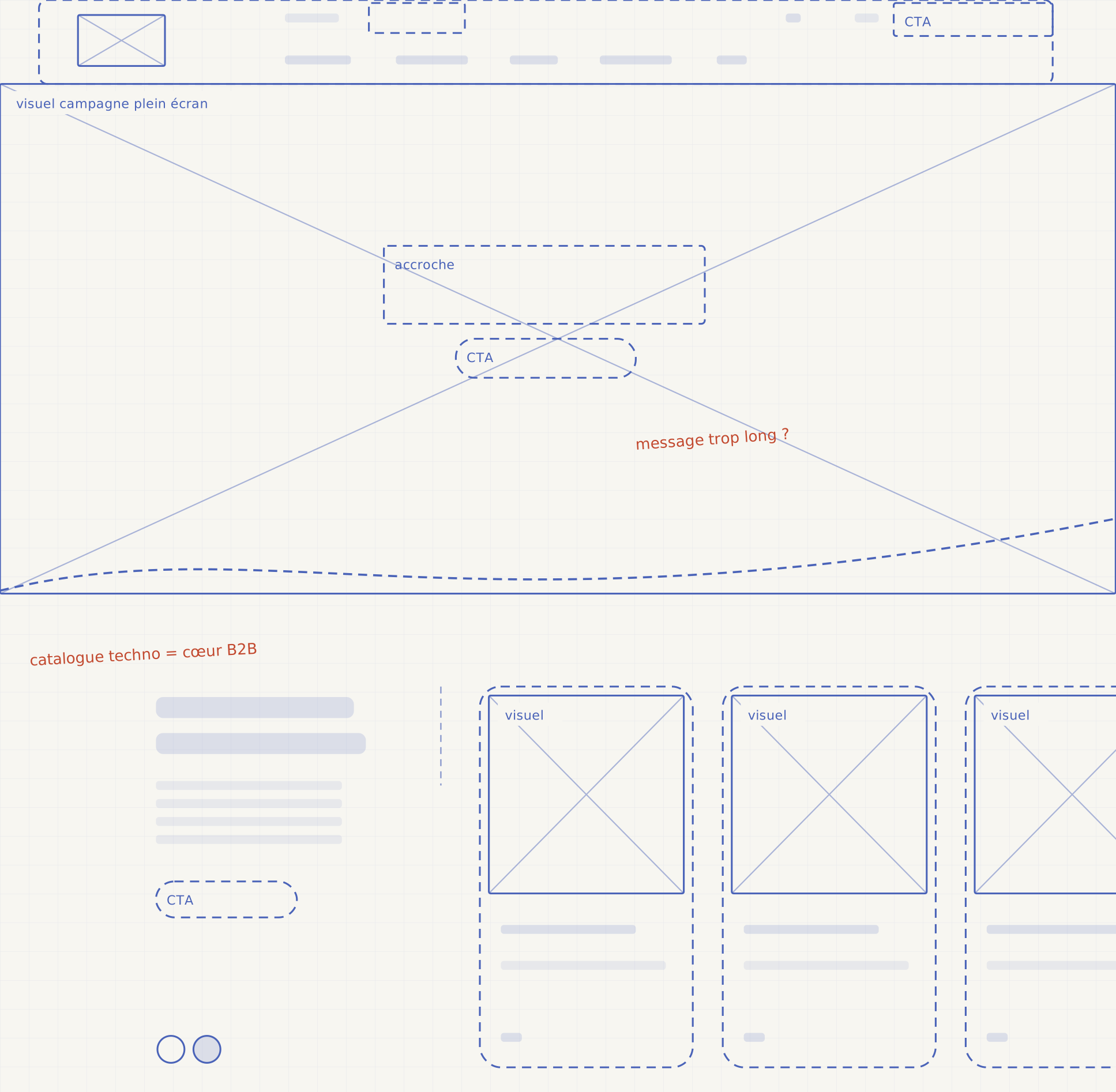
Before any colours, you decide on the site map: which pages, in what order, linked how. Then come the wireframes, grey mock-ups with no photos or refined typography. They force you to judge the message on its own.
A wireframe answers simple questions. What does a visitor see first on mobile? Where is the call button? Correcting these choices on a grey mock-up takes a few minutes. On a developed site, it takes much longer.
The B2B website for The LYCRA Company went through this step: the wireframe first set out who each block speaks to and where the call to action sits. The design only came afterwards.
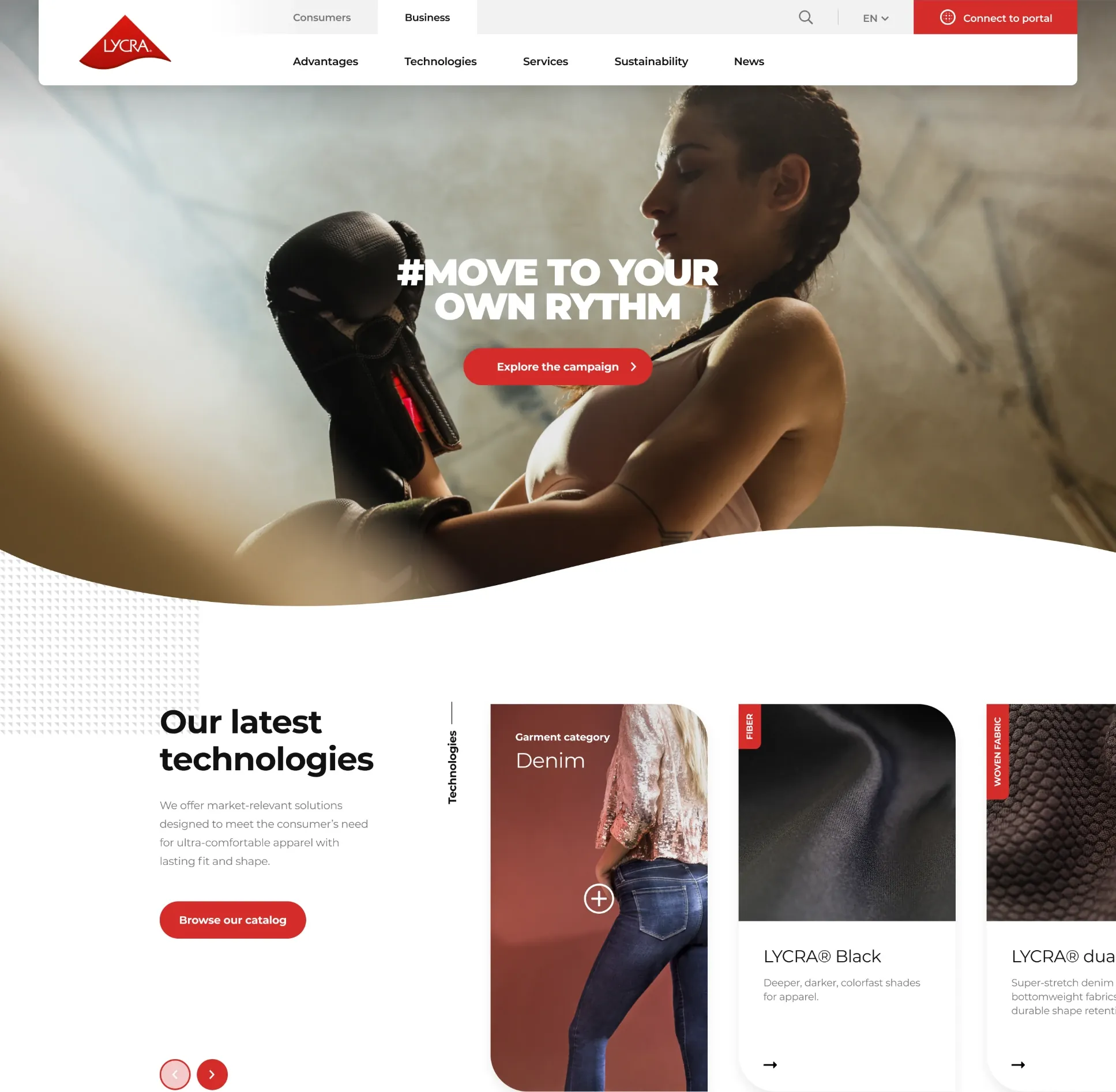 The LYCRA Company's B2B website, built on a structure approved in grey.
Step 3: development and content
Once the structure is approved, the final design applies your colours and brand identity, then the site is developed. We build it in code, with Next.js, rather than with a purchased theme. A custom-coded site loads faster and does not depend on any platform subscription.
The copy matters as much as the code. You bring your industry knowledge in an interview, we write, you review. The copy uses the words your customers actually type, such as "plombier Thonon" (plumber Thonon) or "électricien Chablais" (electrician Chablais), rather than the company's internal vocabulary.
The technical foundations of SEO are part of this step, not optional extras: title tags, structured data, a sitemap, links between pages. Nobody can guarantee a position on Google, but a badly built site starts with a handicap that is hard to make up.
Step 4: launch and follow-up
On launch day, the domain name is connected, every form is tested, the Google profile is linked to the site and analytics are installed. The site is also registered in Google Search Console, the free tool that shows how Google sees your pages.
If you are replacing an old site, every useful old URL must redirect to the new one with a 301 redirect. Without this, the pages that used to bring you visits disappear from the results. This point alone justifies a carefully planned website redesign.
After launch, keep a close eye on the first few weeks: errors, pages not indexed, enquiries received. Then the site grows with new projects and new pages.
How long should you allow?
The timeline depends less on the technology than on content and approvals. A project where each page waits for three reviewers drags on, whoever the provider is.
| Type of site | Indicative timeline | What makes it vary |
|---|---|---|
| Showcase site, 4 to 8 pages | 10 to 15 days | Photos, logo and information supplied early |
| B2B or marketing site | 3 to 6 weeks | Number of pages, case studies, languages |
| Redesign of an existing site | Depends on site size | Page inventory and redirects |
Showcase site: 10 to 15 days
A showcase site usually has four to eight pages: home, services, projects, about and contact. The timeline assumes your photos, logo and practical information arrive from the outset.
A very local business can add a page for each town it serves. This is one of the rare cases where a showcase site benefits from growing, provided each page brings real information specific to that area.
For details of the format and what it includes, see our page on showcase website design.
B2B site: 3 to 6 weeks
A B2B site speaks to several profiles: the engineer looking for a solution, the buyer comparing options, the management team signing off. It therefore needs more pages, more proof and sometimes several languages.
In this type of project, the technology rarely slows things down. What makes the schedule slip is the internal approval of copy and the production of case studies. Three signs a schedule is about to slide, whatever the format:
- Content has no named owner in the company.
- The scope changes after the wireframes have been approved.
- Decision-makers discover the project at the end, when it goes live.
How do you get found in Thonon, the Chablais and Geneva?
For a local business, the website never works alone: it has to strengthen your Google Business Profile, and vice versa.
Google explains in its help pages that local results are based mainly on three factors: relevance, distance and prominence (Google Business Profile Help). You cannot change distance. You can, however, work on relevance and prominence.
Your Google Business Profile
Relevance measures how well your profile matches what someone is searching for. A complete and detailed profile helps Google understand your business: the right category, up-to-date opening hours, services, service area and real photos. Google also states that there is no way to pay for a better local ranking.
The website must use exactly the same contact details as the profile: name, address and phone number. The same information should appear in the directories that matter for your trade.
Customer reviews
Again according to Google, prominence takes into account the number of reviews and their rating: more reviews and good ratings can improve a business's local ranking.
The simplest method is still the most effective: ask every satisfied customer for a review, straight after the job, with a direct link. Reply to every review, including critical ones, with specific answers. Never buy reviews: only a genuine reputation lasts.
One page per town, and customers in Geneva
A page for each area you serve helps you answer "trade + town" searches. A tradesperson in Thonon who works in Évian, Sciez or Douvaine can dedicate a page to each area, with local projects and terms of service. A page where only the town name changes adds nothing and ends up penalising the site.
In the valleys and resorts of the Chablais, business follows the seasons and mobile coverage can be weak: the site needs to stay light and easy to update. We cover these cases on our page about our web agency in the Chablais.
Then there is the border. According to INSEE, France's national statistics office, more than one in five working people in Haute-Savoie work in Switzerland (INSEE). Some of your customers are therefore looking for you from Geneva. Your site should state clearly whether you work in Switzerland, on what terms, and how to reach you.
A .ch domain is not essential to target Geneva: a .fr site can rank well if it specifies your service areas and terms. This is particularly true in the Bas-Chablais, as we explain on our page about website design in Douvaine.
Why are speed and accessibility part of the project?
A slow or hard-to-use site loses visitors before they even read your offer. Both issues are dealt with from the design stage: catching up afterwards always takes more work.
Core Web Vitals
Google measures a page's experience with three metrics, the Core Web Vitals. According to web.dev, the experience is good when the largest element appears within 2.5 seconds (LCP), when the page responds to an interaction within 200 milliseconds (INP) and when the layout shifts very little, with a CLS of 0.1 or less (web.dev).
These thresholds are assessed at the 75th percentile of real visits, not on the developer's computer. In other words, it is your customer's phone, on their connection, that counts.
Ask the provider how they measure these metrics before and after launch. PageSpeed Insights and the dedicated Search Console report let you check for yourself.
Accessibility
An accessible site remains usable with a keyboard, a screen reader or enlarged text. The W3C's WCAG standard rests on four principles: information must be perceivable, the interface operable, the content understandable and the code robust, so that it works with assistive technologies (W3C).
It is also a legal requirement for some businesses. Since 28 June 2025, e-commerce sites aimed at consumers must be accessible to people with disabilities, except those of micro-enterprises (fewer than 10 staff and no more than €2 million in turnover or balance sheet), as France Num, the French government's digital programme for small businesses, points out (France Num). A showcase site with no online sales is generally not covered, but these good practices benefit all your visitors. Four simple checks:
- Sufficient contrast between text and background.
- Alternative text on images that carry information.
- Keyboard navigation, with a visible indicator on the active element.
- Labelled forms, with clear error messages.
What are the legal requirements for a business website?
A French business website must follow a few rules, whatever its size. They are easy to build in during the project.
The legal notice. France's law on confidence in the digital economy (LCEN) requires the site publisher to be identified. For a company, the Ministry of the Economy lists in particular the company name, legal form, share capital and contact details, as well as information about the host (economie.gouv.fr). A dedicated page, linked from every page, remains the clearest solution.
Cookies. Analytics or advertising trackers generally require the visitor's consent. The CNIL, France's data protection authority, puts it unambiguously: refusing cookies must be as easy as accepting them (CNIL). In practice, a "Reject all" button placed at the same level as "Accept all" offers that clear choice.
Form data. A quote request form collects personal data: name, phone number, sometimes an address. State what it is used for, how long you keep it and how to have it deleted, in a short privacy policy.
For an online shop, further requirements apply, such as terms and conditions of sale. They go beyond the scope of this article: have them checked by a legal adviser.
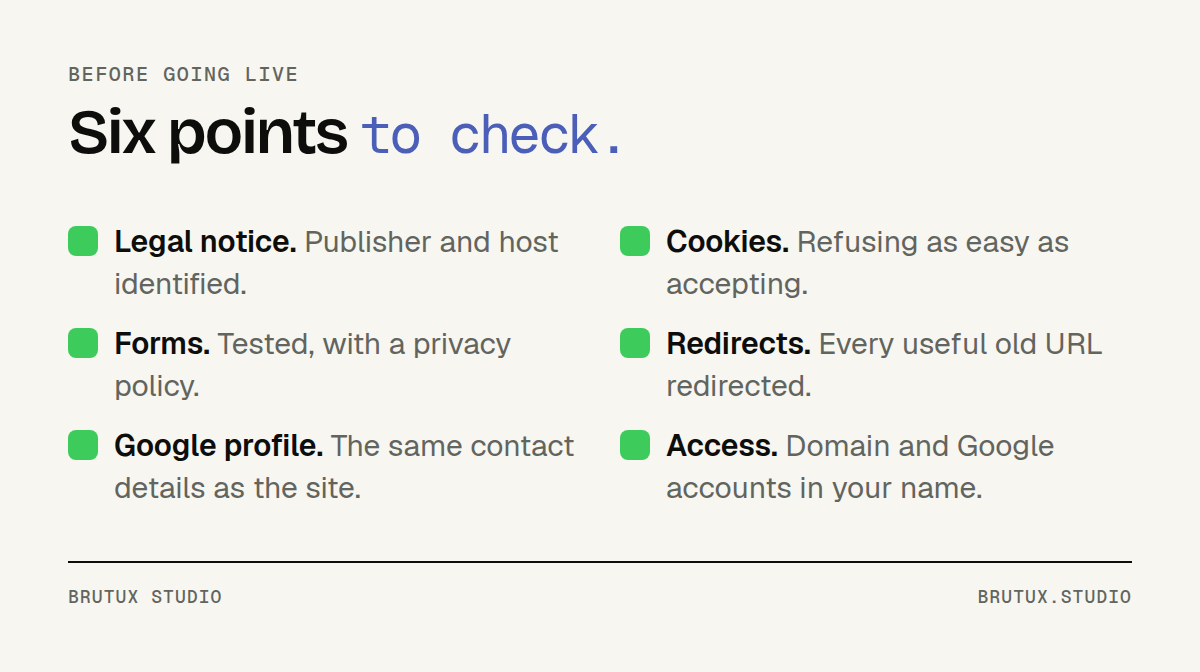 Six points to check before opening the site to the public.
Who owns the website, and what should you ask the provider?
This is the question people ask least. A website brings together the domain name, hosting, code, content and Google accounts: each must be in your name, or transferable to you without conditions.
Domain name, code and access
The domain name comes first. Afnic, which manages the .fr extension, makes this clear in its guide: the holder of a domain name is the person, natural or legal, listed as such in the Whois database and holding the associated rights (Afnic). If your provider registered the domain in its own name, it is the provider that holds it.
So check who the holder is, and ask for the domain to be registered in your company's name. Do the same for the Google profile, Search Console and the analytics tool: you are the owner, and the provider is invited.
The code and content follow the same logic. At Brutux Studio, the code belongs to you and the site does not depend on any platform subscription.
Questions to ask before you sign
These questions apply to any provider, including us. The answers should be clear, and written into the proposal.
- Who will be my point of contact? Ideally the same person from the first conversation through to launch.
- In whose name will the domain and Google accounts be? The only right answer: yours.
- Is technical and local SEO included? Tags, structured data, a sitemap and the Google profile should not be optional extras.
- How do you measure speed and accessibility? With which tools, before and after launch.
- Who writes the copy, and who approves it? With a date for each approval.
- What happens after launch? Maintenance, further development, or the ability to edit your pages yourself.
- What do we get back if we part ways? Code, content, access: everything should be listed.
Be wary of two promises: a guaranteed top position on Google, and a timeline that does not depend on your content. Neither can honestly be kept.
A local provider also has a practical advantage: you can meet them. The studio is in Thonon-les-Bains, Douvaine is about twenty minutes away and Annemasse is connected by the Léman Express. Key stages can happen face to face, and the rest by video call.
A good project is judged on its method as much as its design: clear scoping, a structure approved before the colours, copy written for your customers and a launch that is followed up. For a website in Thonon or the Chablais, discover our web agency in Thonon-les-Bains, or book a conversation directly.
Sources
- Google Business Profile Help: how to improve your local ranking
- INSEE: strong growth in cross-border work (in French)
- web.dev: Core Web Vitals thresholds
- W3C: introduction to WCAG 2.2
- France Num: accessibility of e-commerce sites (in French)
- economie.gouv.fr: mandatory information on a website (in French)
- CNIL: refusing cookies must be as easy as accepting them (in French)
- Afnic: practical guide for .fr domain name holders (in French)