
An AI strategy for SMEs starts with a list of tasks, not with the choice of a tool. Identify what comes back every week and weighs on the team, keep two or three use cases that are easy to check, set rules for your data, then test on a small scale, measuring before and after. Everything else, subscriptions included, follows from those decisions.
Many business owners feel they should "do something" with AI without knowing where to begin. Here is a practical approach, criteria for choosing and the mistakes to avoid, based on the CRAFT method and on public figures from France and Switzerland.
Where do SMEs stand with artificial intelligence?
Before building a plan, it helps to know where comparable companies stand. Recent surveys all say the same thing: use is growing fast, method much less so.
In France, use is growing but the benefit remains unclear
According to INSEE, the French statistics office, 18% of companies with 10 or more employees used at least one AI technology in 2025, eight points more than in 2024. The rate climbs to 58% in companies with 250 or more employees: the gap with smaller firms remains wide.
The most cited obstacle may come as a surprise. Among companies that do not use AI, 71% say they see no use for it and 54% point to a lack of expertise. In other words, many SMEs do not yet know which task to apply it to.
Bpifrance Le Lab, the research arm of France's public investment bank, sees a similar gap among business leaders. In its study published in June 2025, 58% consider AI important or very important to the future of their company over three to five years.
Yet 43% of SMEs and mid-sized companies do not analyse data to steer their business. And a company engaged in digitalisation is five times more likely to use AI: the groundwork matters as much as the tool.
In French-speaking Switzerland, tools come before rules
In Switzerland, the Confederation's SME portal reports AXA's annual study: the share of SMEs that have adopted AI rose from 22% to 34% between 2024 and 2025. Translation (52%) and correspondence (47%) are the most common uses.
But only 34% of companies have set clear rules on what data employees may enter into these tools. Everywhere else, each person decides alone what to hand over to the machine.
In Geneva, the survey carried out for the canton found that 54% of responding companies had already adopted AI in one form or another, and that 60% of business leaders would like support from the State. Lack of knowledge and data security stand out as the main obstacles.
These figures describe a common situation: tools already in the hands of teams, with no designated tasks, no rules and no measurement. The good news is that you are not starting from scratch; you are putting things in order.
Why does an AI strategy for SMEs start with tasks?
An SME has neither an innovation department nor the budget for endless experiments. Every hour spent on AI has to free up more time elsewhere. Starting from tasks is the only way to check that it does.
Three wrong places to start
The first is buying a tool for everyone and hoping the use cases will follow. In practice, two or three enthusiasts use it and the others open it once. At renewal time, nobody can say what it delivered.
The second is the pilot launched under pressure, because a competitor is talking about AI or a vendor gave an impressive demo. Without a measured starting point, the pilot can neither succeed nor fail: it simply stops, for lack of evidence.
The third is leaving the whole subject to the IT provider. They will install and secure the tool, but the gains are made in the business itself: the accountant chasing payments, the salesperson pricing a quote, the technician writing documentation. They are the ones who know where time is lost.
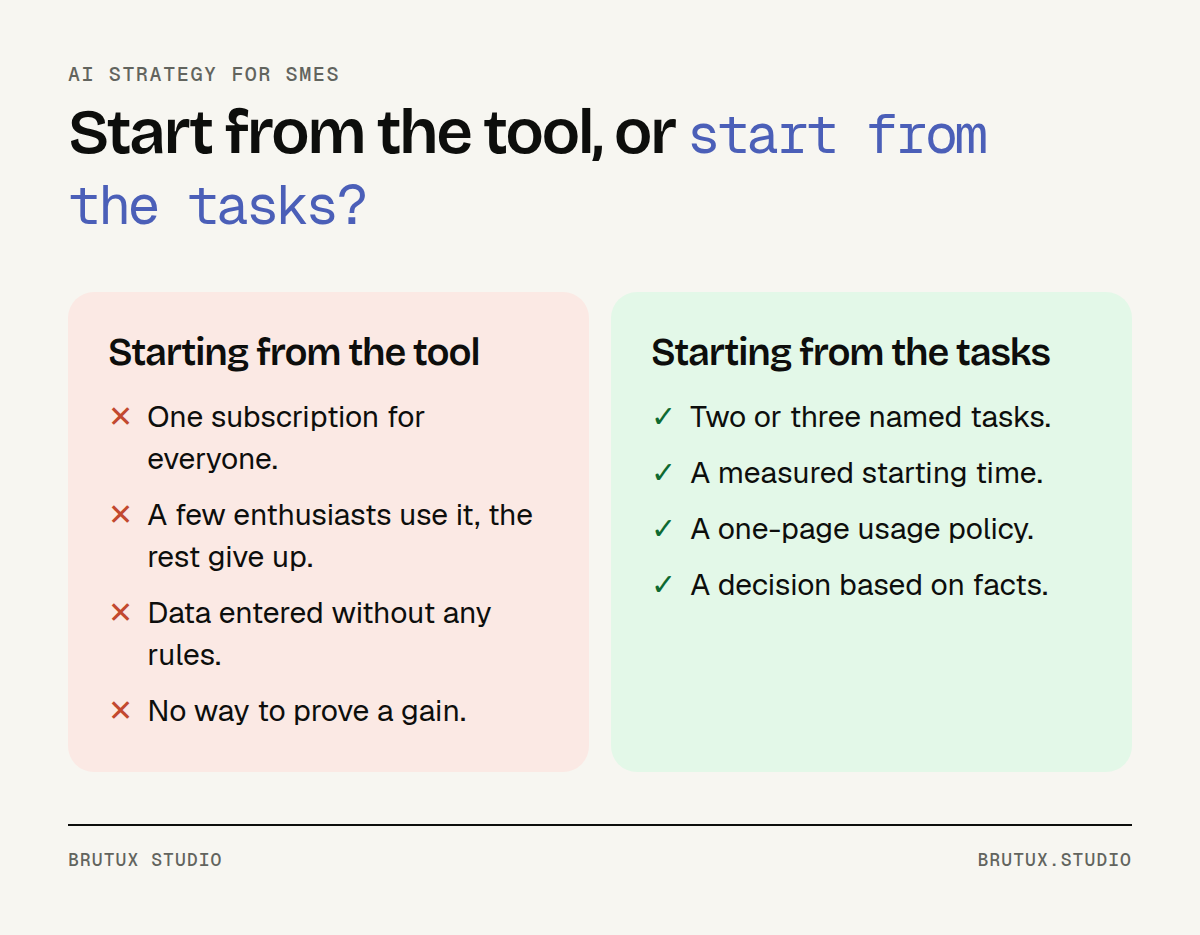 Starting from the tool or from the tasks: two very different paths.
Observe real work before choosing
France's data protection authority, the CNIL, takes the same line in its Q&A on generative AI: it recommends starting from concrete needs to choose the most suitable system. It also notes that an internal writing assistant carries less risk than a decision-support tool applied to customers or job applicants.
To find those needs, nothing beats observation. Victor Michel, the studio's founder, applied this when relaunching a self-service B2B dashboard for MSC: go and watch customers at work before touching a single screen, then build the solution with a group of pilot customers.
An AI strategy follows the same logic: you look at how a quote is actually prepared before deciding whether to automate it. What looks slow from the management office is not always slow on the ground, and vice versa.
In practice, spend half a day with each team. Note the recurring tasks, how long they take, the tools used and the irritations everyone accepts "because that's how it is". This raw list is worth more than any catalogue of tools.
How do you choose the first two or three use cases?
An observation list quickly runs to thirty lines. The job is to keep only two or three, using criteria the whole management team understands. The aim is not to find the most impressive use case, but the one that builds trust.
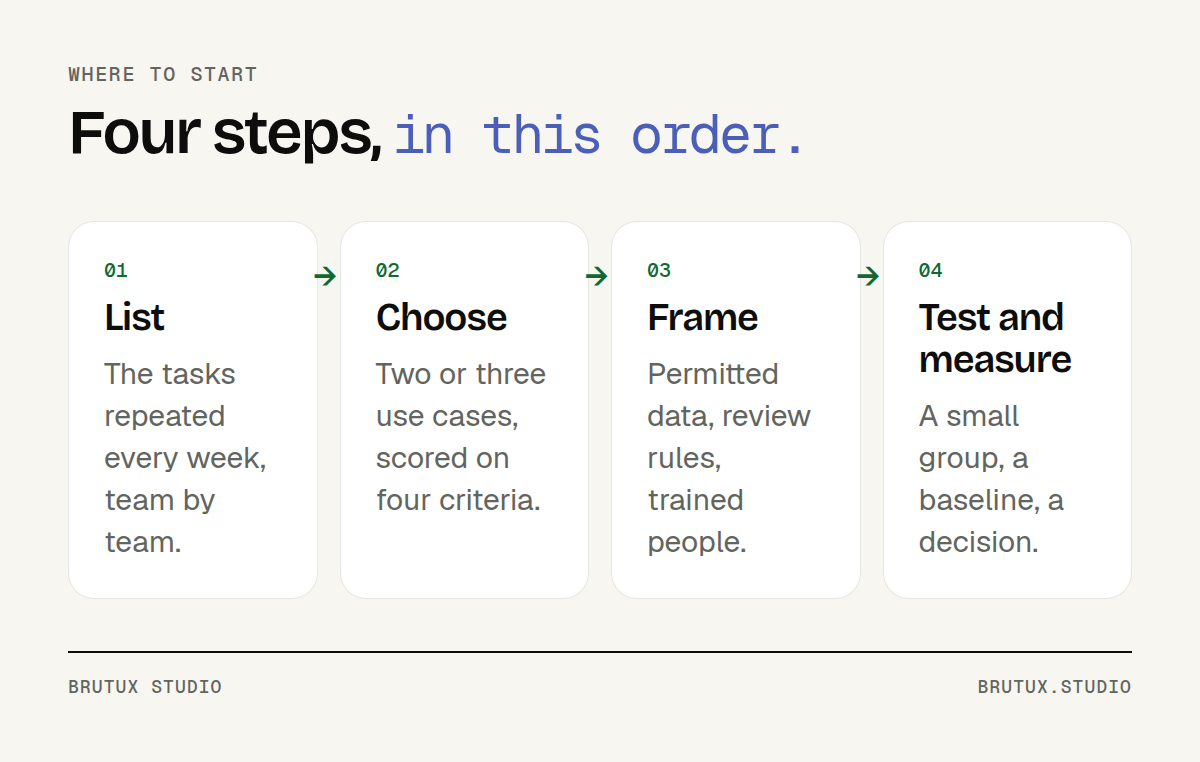 The four-step approach, in this order.
Four criteria to score each idea
For each candidate task, give a simple score on four criteria. These are the ones we use in our consulting engagements:
| Criterion | Question to ask | Good sign |
|---|---|---|
| Value | How much time, quality or revenue is at stake? | Weekly task, several people involved |
| Effort | Does it need a new tool, an integration, a process change? | Feasible with a tool you already pay for |
| Cost of an error | What happens if the result is wrong? | Visible error, quickly corrected |
| Data | Does the information exist, and can you reach it? | Templates, records or documents already organised |
The best candidates combine a frequent task, a result that is easy to review and data that is already available. In an SME, these are often first drafts of documents: quotes, replies to routine requests, meeting notes, product sheets, translations.
Drop without regret any idea that needs data scattered across ten files, or whose result nobody will be able to judge. For sorting ideas by gain and by the cost of an error, our article on where AI creates value in B2B SaaS sets out a gain-and-risk matrix you can apply to your own tasks.
Look first at what you already pay for
Before adding a subscription, take stock of the AI features included in your current software: office suite, management software, CRM. They are often there and unused.
Activating and configuring what you have brings two advantages: no new contract to negotiate, and a team that stays in a familiar environment. Buying a dedicated tool is only justified if the chosen use case truly requires it.
A narrow use case beats an all-purpose assistant
A good first use case does one thing, well. That is the approach behind Hanny, the AI community manager that Brutux Studio designed and built for very small businesses and SMEs: it reads the company's website, learns how it speaks and prepares each month's posts for LinkedIn, Instagram and Facebook.
The person reviews, corrects, then publishes. The tool prepares; it does not decide on their behalf.
The scope is deliberately narrow: one identified task, which many small businesses give up for lack of time, and a human who stays in control of what goes out. This is the kind of use case an SME should look for first, whatever its field.
What needs to be framed before the first test?
Testing without rules means risking an employee pasting a client contract into a consumer tool. Three workstreams are enough to start properly: a usage policy, a decision on data and a short training session.
A one-page usage policy
The CNIL recommends framing the use of generative AI with a policy that clearly defines permitted and prohibited uses. It adds two simple rules: only submit information you are authorised to share, and never reuse a tool's output as it stands.
For an SME, one page is enough. It lists the approved tools, the data that is never entered into them, the outputs that must be reviewed and the person to ask when in doubt.
The canton of Geneva has also announced a model charter to help its companies with this. So there is no need to start from a blank page.
Data: what stays inside the company
This concern is widely shared. In the OECD survey of more than 5,000 SMEs in seven countries, 52.5% of SMEs that do not use generative AI put it down to concerns about what happens to the information fed into the models.
The answer is not to ban everything, but to classify. Public documents and internal templates can be used without difficulty; personal data about customers or employees requires a tool under contract, known hosting and often the opinion of your data protection officer.
In Switzerland, the Federal Data Protection and Information Commissioner (FDPIC) points out that the law in force since 1 September 2023 applies directly to AI-based processing. An SME working on both sides of the border, between the Chablais and Geneva, must therefore take both the GDPR and the Swiss FADP into account when choosing its tools.
Train the people involved
The same OECD survey shows that nearly half of non-user SMEs (49.8%) cite their employees' lack of skills. A short training session, on the selected tasks and using your own documents, removes much of that obstacle.
It is also expected under European law. Since 2 February 2025, Article 4 of the AI Act has required companies that deploy AI to take measures to build AI literacy among their staff. Since the 2026 AI omnibus, no specific level or standard training is imposed, but the obligation remains. Our generative AI training page describes how we run these sessions.
How does the CRAFT method structure the approach?
List, choose, frame, test: these four steps need a common thread to stay focused. We use the CRAFT method for this, rooted in MIT Sloan's Applied AI Strategy.
Five phases, one deliverable each
CRAFT runs through five phases without skipping any. Cartograph sets out the company's objectives and constraints. Review assesses processes, data and the team's maturity.
Architect describes, for each selected use case, who decides and with what information. Frame prioritises and builds the roadmap. Transform supports deployment, training and follow-up.
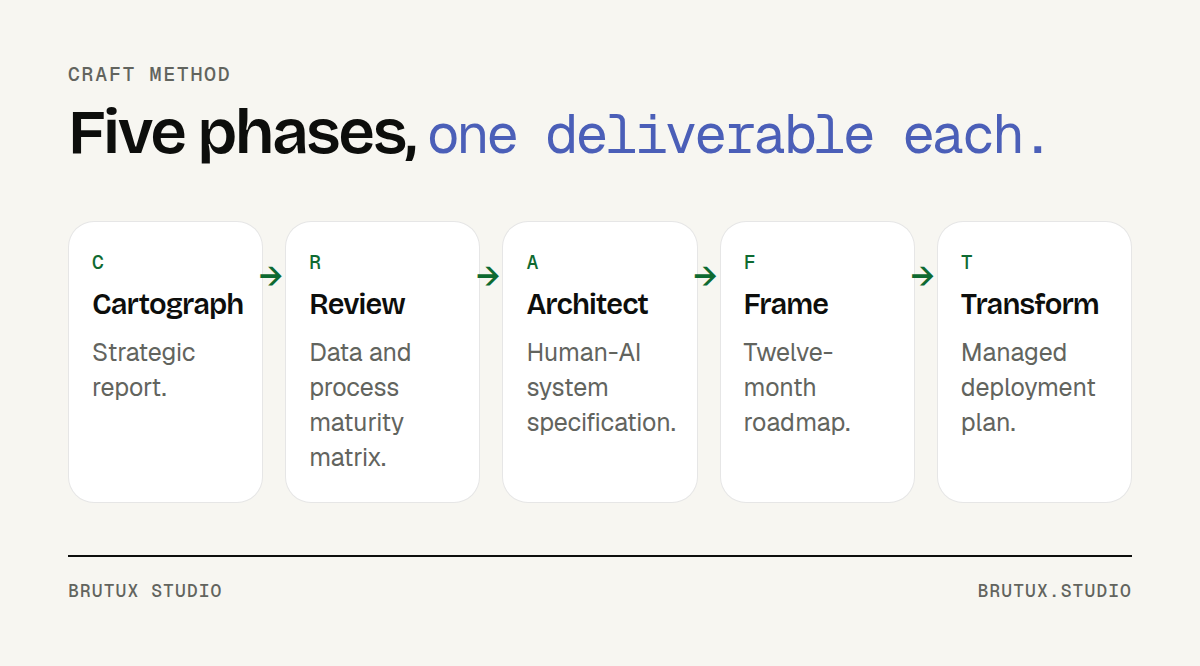 The CRAFT method: each phase produces a written document that remains yours.
Each phase ends with a written document, presented in a review session, which remains the company's property. You can then carry out the implementation in-house, with another provider or with us.
The phases are detailed on our page about the CRAFT method. You will also find the four principles that guide every engagement.
A version sized for an SME
A full CRAFT engagement is aimed mainly at structured organisations, with several departments and established processes. A fifteen-person SME does not need the same set-up: it needs the same questions, asked in less time.
For a small business, the groundwork often comes down to a site visit, a list of tasks, two or three scored use cases and a usage policy. For a larger SME or a mid-sized company, an AI strategy consulting engagement usually takes four to eight weeks, depending on how many business teams are interviewed.
Either way, we come to you. From Thonon, we work with businesses in the Chablais as an AI consultant in Thonon-les-Bains, and with those in the Geneva area through our AI consulting in Geneva.
How do you measure the first results, and which mistakes should you avoid?
A test without measurement produces impressions, not decisions. The measurement does not need to be sophisticated; it simply has to be set before you start.
Measure before, compare after
Before the test, time the task on a few real cases and note the usual error rate. Pick representative cases, not just the easiest ones.
For a few weeks, a small group uses the tool on that task only. At the end, you compare the time spent, the quality of the result and how the team feels about it.
Three decisions are then possible: roll out, adjust or stop. Stopping is not a failure. It is an expense avoided, and useful information for choosing the next use case.
Remember to ask users for their feedback at regular intervals, as the CNIL recommends. They will be the first to see whether the tool saves time or adds work.
The most common mistakes
- Buying before knowing what for: the tool is chosen after the tasks, not the other way round.
- Aiming for ten use cases at once: the team spreads itself thin and none becomes a habit.
- Forgetting the starting point: without an initial measurement, no gain can be demonstrated.
- Letting the tool reply to customers on its own: in an SME, the relationship makes the difference; AI prepares, a human sends.
- Neglecting training: a tool that is poorly understood is abandoned within weeks.
- Keeping the subject in the boardroom: the people who do the task must help choose.
One last, subtler mistake: believing AI will make up for a muddled process. If nobody knows who approves a quote, AI will simply produce quotes faster, still without approval.
Sometimes the process has to be simplified before a tool is added. That clarification work benefits the team, with or without AI.
A well-run AI strategy in an SME comes down to a few written decisions: which tasks, with which tools, under which rules and with what measurement. If you want to make them based on facts, our AI strategy consulting team can support you, from the first visit to the roadmap.
Sources
- INSEE, Information and communication technologies in businesses in 2025: AI use and obstacles.
- Bpifrance, AI in French SMEs and mid-sized companies: a quiet revolution: business leaders' views.
- Swiss Confederation SME portal, AI gains ground in Swiss SMEs: AXA study.
- Republic and Canton of Geneva, Half of Geneva SMEs use AI, according to a new study: cantonal survey.
- CNIL, Q&A on using a generative AI system: usage policy and training.
- OECD, Generative AI and the SME Workforce: obstacles for SMEs.
- FDPIC, Current data protection law is directly applicable to AI: FADP and AI.
- European Commission, AI Literacy, Questions & Answers: Article 4 of the AI Act.