
When you type “web agency Geneva”, Google mixes Geneva agencies, freelancers and studios based just across the border, in the French Genevois or the Chablais. For a Geneva company, the right choice depends less on the provider’s address than on how well they understand your clients, data protection and search on both markets. The border does change a few practical points, invoicing above all, and it is better to know them before you sign.
This guide explains what really changes when your website is designed in Haute-Savoie for a Geneva audience, what does not, and how to compare offers from both sides with the same criteria. It is also for French companies in Greater Geneva that want to be found by Swiss clients.
What do you find when you search “web agency Geneva”?
The top results are mostly agency directories, listings on matchmaking platforms and a few local agency sites. Few of these pages help you choose: they list providers without saying what sets them apart.
For a business owner, the question is not finding an agency, there are plenty. It is finding the one that will understand your audience, your languages and your constraints, then deliver a site that works for you.
Geneva agencies, freelancers and Greater Geneva studios
Three profiles come up. Agencies based in Geneva know the local market well and can meet you in town. Freelancers often offer a single point of contact and a lot of flexibility, with limited capacity on large projects.
The third profile is the studios of the French Genevois and the Chablais, such as Brutux Studio in Thonon-les-Bains. They work for clients in both countries, travel to Geneva for the important stages and run the rest of the project remotely.
None of these profiles is better by default. A bilingual site for a fiduciary, a platform for a foundation and a showcase site for a craftsman do not call for the same provider.
Before comparing, write down what your site must do: inform, reassure, generate enquiries. That need, more than the provider’s profile, should guide the choice.
What the border changes, and what it does not
The border changes nothing about the quality of a website. A fast, clear, well-written and well-ranked site is built the same way in Carouge or in Thonon.
It does change three concrete things: the invoicing framework, the way your site must speak to people in each country, and how meetings are organised. Those are the three points to look at closely, rather than the address printed on the quote.
Geneva agency or Chablais studio: what really changes?
For a Geneva client, the comparison comes down to proximity, knowledge of both markets and the administrative framework. Here is what to know about each.
Proximity: meetings, workshops and travel
A website project needs a few in-person moments: the kick-off workshop, the presentation of the mock-ups, sometimes training on content management. The rest works very well by video call, with a staging site to follow progress.
From the Chablais, Geneva is reachable by road and by the Léman Express. Brutux Studio, less than an hour from Geneva, holds the key meetings at its Geneva clients’ offices and the interim reviews remotely.
What matters is that the provider commits to this travel in the proposal. Ask how many on-site meetings are planned, and at which stages.
A well-prepared project does not require an agency round the corner. It requires useful meetings, prepared in advance and followed by written notes.
Knowing both markets
A Geneva company often targets an international clientele, and sometimes French clients in Greater Geneva. A company in Annemasse or Thonon targets the reverse: French people, but also Genevans and cross-border commuters.
A provider who works on both sides knows these back-and-forths. They know that a Geneva user often searches on google.ch and does not use the same words as someone in Haute-Savoie, and that a Swiss client’s practical questions are not a French client’s. Our web agency in Annemasse page details these differences for French companies in Greater Geneva.
The contract and invoicing
This is the point most often forgotten. In Switzerland, the Federal Tax Administration applies an acquisition tax to certain services bought from foreign companies, according to its page Impôt sur les acquisitions TVA.
If your company is on the VAT register, it declares and taxes these acquisitions itself. If it is not, it becomes liable once it acquires more than 10,000 francs of such services in a calendar year, again according to the FTA.
This is not an obstacle, it is one more line in your accounts. Have your fiduciary confirm the treatment before you sign, and ask the provider how they invoice a Swiss client.
Which data rules apply when the site is built in France?
Geneva clients often worry about this: does handing your site to a French agency create a data protection problem? In most cases, no. But the site itself must comply with Swiss law.
The revFADP applies to your site, wherever the agency is
The revised Federal Act on Data Protection (revFADP, nLPD in French) came into force on 1 September 2023, according to the Federal Office of Justice. One of its aims is greater transparency in how data is processed.
For a website, it covers everything that collects information about your visitors: contact forms, analytics tools, videos and fonts loaded from third-party servers, chat tools. You, as the company, are responsible for them.
A good provider helps you limit what the site collects and explain it clearly. Less data collected means fewer risks and a simpler privacy notice. Legal sign-off remains your adviser’s job.
One simple question helps you sort things out: does each tool added to the site really serve your visitors or your business? If the answer is unclear, it can probably go.
Data that flows between France and Switzerland
The two countries recognise each other as offering an adequate level of protection. On the European side, Switzerland benefits from an adequacy decision dated 26 July 2000, confirmed by a European Commission report of 15 January 2024, according to the Federal Office of Justice.
On the Swiss side, France appears on the list of States guaranteeing an adequate level of protection drawn up by the Federal Council.
In practice, a French studio can therefore work on your site and your content without any special legal arrangement. Keep an eye on the third-party tools the site uses: that is often where data goes elsewhere, more than at the agency.
How do you get found in Geneva and in France with one site?
Many companies think they need one site per country. It is almost never necessary. What you need is a site that tells Google, and visitors, clearly who each page is for.
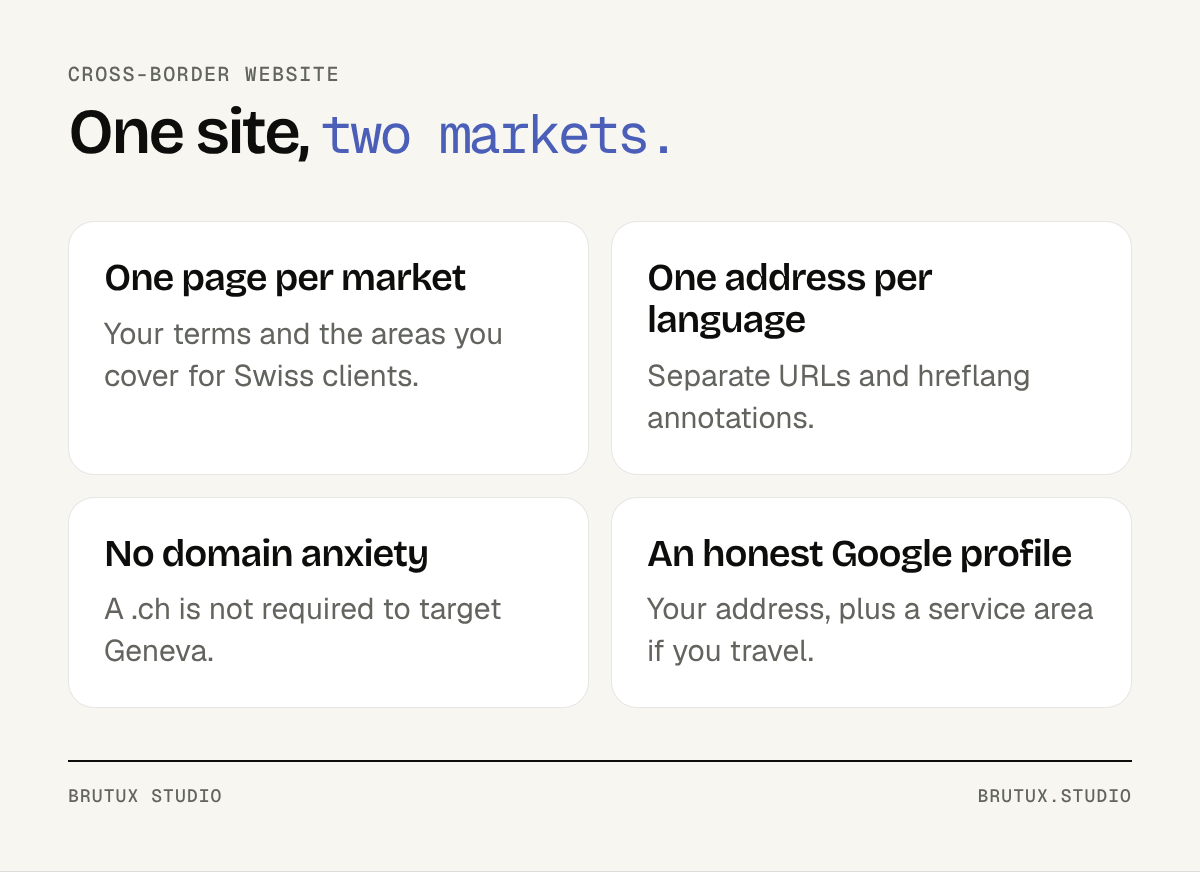 What to set up to be found on both sides of the border.
One page per market rather than one site per country
Google explains that country-code domains, such as .ch or .fr, are associated with a specific country, whereas generic domains like .com are not, in its guide Managing multi-regional and multilingual sites. A .ch is therefore not required to target Geneva.
What works better is a dedicated page for each market that really matters: your terms for Swiss clients, the areas you cover, answers to the questions they ask. A Thonon company that does a lot of work in Geneva gains from a page that talks about Geneva, rather than a passing mention in the footer.
Conversely, a Geneva company that also targets the French Genevois can add a page for Annemasse or Thonon, with its terms for French clients.
Separate addresses and hreflang annotations for each language
In Geneva, a site is often bilingual French-English. Google recommends separate URLs for each language, rather than switching language with a cookie, and hreflang annotations so that each user lands on the right version.
The same guide advises sticking to one language per page and avoiding automatic redirects based on the language a browser seems to use. An expatriate who reads French must be able to stay on the French version.
Translation alone is not enough either. The words people type change from one language to another, and each version must answer its own audience’s questions, with its own headings.
The Google profile and the service area
Your Google Business Profile stays tied to your business address. If you travel to your clients, you can declare a service area: Google Business Profile Help says you can add up to 20 service areas and recommends keeping the overall area within two hours’ drive.
For a Thonon or Annemasse company that works in Geneva, this is the honest way to show up on the Swiss side. Our article on local SEO in the Chablais covers the rest: reviews, consistent information, pages per town.
Answers generated by AI assistants follow the same logic. Clear pages about who you are, what you do and where, in each language, are more likely to be picked up correctly, as our AI visibility page explains.
How do you compare providers on both sides of the border?
Quotes rarely look alike. One includes copywriting, another does not; one talks about SEO, another about “basic SEO” without saying what it covers. To compare, ask every provider the same questions, whatever their country.
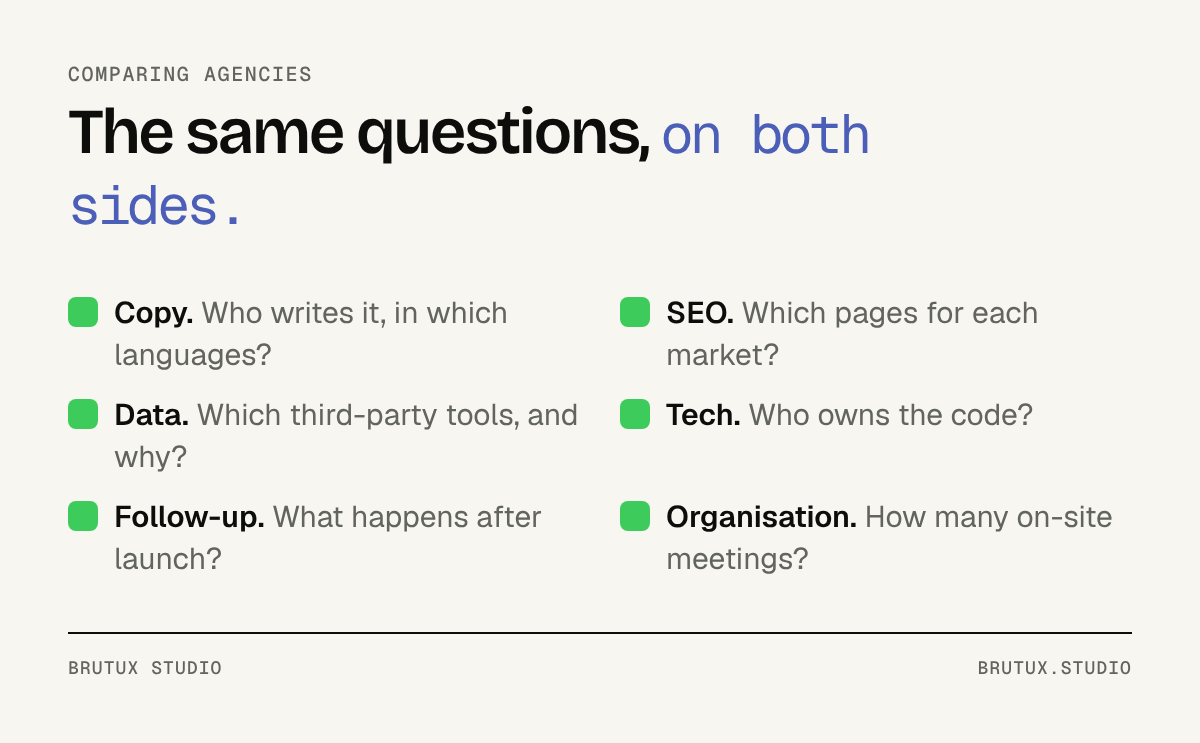 The questions to ask every provider.
The questions to ask every provider
A handful of questions is enough to bring out the real differences between two offers.
- Copy. Who writes it, in which languages, and who checks the translations?
- SEO. Which pages are planned for each market, and how is the Google profile handled?
- Data. Which analytics and third-party services does the site use, and why?
- Tech. Which technology is the site built on, and who owns it at the end?
- Follow-up. What happens after launch: fixes, changes, updates?
- Organisation. How many on-site meetings, and who is your day-to-day contact?
The answers to these questions say more than the portfolio. A provider who answers precisely has already thought about your project.
Note the answers in a table, line by line. The gaps between offers show up quickly, far more clearly than by rereading three quotes in different formats.
Warning signs
Be wary of any offer that promises first place on Google. Nobody can guarantee it, on either side of the border.
Be careful, too, with a multilingual site offered as a simple machine-translation option, or a quote that mentions neither data protection nor accessibility. These are often the items that cost the most to fix later.
An offer far removed from the others also deserves a direct question: what is not included? The answer avoids many surprises during the project.
Finally, check that you will own your domain name, your content and the code. Changing provider must remain possible without rebuilding everything.
How does a project with a Chablais studio work?
At Brutux Studio, a Geneva client follows the same path as a Thonon client, with meetings in Geneva for the key stages. Here is how it works in practice.
The project stages
Everything starts with a 30-minute conversation to understand your business, your audiences and your languages. A detailed proposal follows, with the content of the pages, the planned languages and the on-site meetings.
Then come a kick-off workshop at your offices, the site structure and the mock-ups, then development on a staging site you can follow online. A simple showcase site takes 10 to 15 days, a multilingual company site 3 to 6 weeks, depending on the volume of content and languages.
The site is built in code, with Next.js, rather than on a WordPress theme. Pages are fast and the site does not depend on plugins that need updating.
Throughout the project, you keep a single point of contact, the studio’s founder, from the kick-off workshop to launch.
What you receive
You receive a multilingual site with one address and hreflang annotations per language, privacy-friendly analytics and forms limited to the data you actually need. The privacy information is prepared for your adviser.
As for experience, Victor Michel, founder of the studio, worked at Swissquote and for a Swiss public service, on the digitalisation of judicial procedures. The studio also designed the B2B website of The LYCRA Company, which speaks to brands around the world: the same need for clarity as a Geneva site read in several languages.
If you are still unsure about the type of site, our article showcase site or B2B site will help you decide. For companies across the region, the web agency in the Chablais page presents our work from Douvaine to the ski resorts.
The simplest thing is to talk about it: in 30 minutes, you will know what your Geneva site needs, and on which side of the border the right provider for you is.
Sources
- Google Search Central, Managing multi-regional and multilingual sites
- Google Business Profile Help, Manage your service area
- Federal Office of Justice, Renforcement de la protection des données
- Federal Office of Justice, Adéquation de la Suisse par l’UE
- Federal Office of Justice, Recognition by Switzerland of States guaranteeing an adequate level of data protection
- Federal Tax Administration, Impôt sur les acquisitions TVA